When an infectious disease has brought much of the world to a standstill, think how proud you'd feel knowing that your skills could kickstart everyday life.
And how about knowing that your knowledge and research could ensure families keep on enjoying a roast chicken dinner for years to come?.
The scientist Dr Tom Peacock can claim to be one of those people. He works as a A scientist who specialises in viruses. at Woking’s Pirbright Institute, which aims to prevent and control viral diseases - ranging from influenza and HIV to coronavirus and avian flu, also known as bird flu or the H5N1 virus.
It’s only when you get down to the nitty-gritty of bacteria and viruses, he says, that you realise how little we actually know about them - but breaking down the details can be incredibly rewarding.
He told BBC Bitesize: “Viruses are an incredibly diverse family of organisms - if you want to call them organisms - and some we have are extremely well studied, things like HIV, flu, coronavirus. But there are animal and plant and insect viruses that are barely understood, and people are discovering viruses that don’t look like anything else that we see. So it really varies, but even the ones we understand very well, we’re always learning new things about them.
“The nice thing is that, the more you understand about it, the better you can do things like designing vaccines.”
How do you become a scientist?
Dr Peacock had an interest in science from an early age, particularly chemistry and biology. He studied Science that examines chemical processes in living organisms. at university as he couldn’t decide between the two. From there he developed a passion for Science that deals with the study of microorganisms. This includes the study of microorganisms linked to diseases. which ultimately led to his career in virology.
“Viruses are a really cool way to look at biology,” Dr Peacock said, “because they’re so small and simple, you can spend a whole career working on them and not quite understanding how they work. If you think about how many genes a virus has compared to a cell, they’re almost the most basic unit of life you can have. If you’re interested in biology, they’re a super place to start because they do things with so little.”
What does a virologist do?
The Pirbright Institute deals with viruses related to the veterinary world, as well as immunology for animals and humans. For example, its experts will examine how mosquitoes carry infectious diseases such as dengue and zika. When the world went into lockdown in 2020 to combat Covid-19, Dr Peacock was among the team looking at coronavirus. They were able to request greater surveillance on potential new variants coming into the UK, such as omicron. Their findings even had an impact on official policy, including updates to vaccines where necessary.
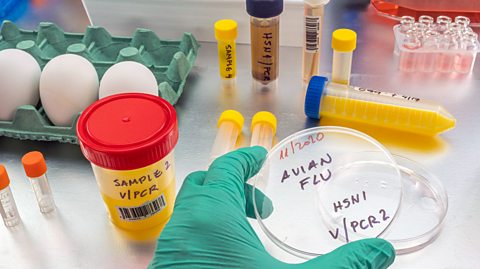
Working days can vary. Dr Peacock may find himself testing samples sent to Pirbright to check if they test positive for viruses, along with advising students and many other tasks: “Some days, I will be wearing a lab coat and, not quite moving coloured liquids from one test tube to another, but more or less. Other days it will be lots of replying to emails, writing and marking and other days will be lots of calls.”
While tackling a major global issue like Covid-19 is one aspect of Dr Peacock’s work that is making life potentially better for everyone, there are others which also have a big impact on society - but we don’t necessarily hear about them.
He explained: “Avian flu has a massive impact on the poultry industry. If there’s a really bad outbreak in poultry for one year, the price of eggs and chicken will go up. There may be shortages and that can have a knock-on impact as well.
“If we have better vaccines for avian flu, then we basically keep things more stable year on year, and we’re less likely to have more shortages. Of course, avian flu is a virus that can jump species and cause pandemics, so having better control of it in poultry… these sort of interventions could potentially be reducing the risk of a future pandemic.”
What if science isn’t for you?
Science has been a passion for Dr Peacock since school, but it’s fair to say that not everyone relishes the sight of double chemistry popping up on their timetable. As someone whose expertise has helped in the fight against Covid-19 - and making sure we can still have chicken for a roast dinner if we wish - what advice does he have for those who struggle with the subject?
“I can completely understand,” he replied. “I mean, I had the same thing about maths. But I guess, you know, science is the study of everything around us, whether it’s at the micro scale or the universal scale, it’s science at the end of the day, and if you really want to understand stuff, there’s no other way of doing it.”
He added: “Even if you don’t want to end up in science, I think it teaches a lot of skills that are useful, both in everyday life, but in other careers and other areas as well. Having critical thinking is important in the humanities and the arts.”
But if you needed to sum up why science can make such a brilliant career in a single sentence?
It’s simple: “You can find out about everything in the world if you look into science.”
This article was published in September 2024
Five movies that got technology wrong
Hacking, Earth-saving viruses and enhanced images - these are Hollywood's most epic tech-fails.
Four fascinating places we’re not allowed to set foot in
Why an island of snakes, a seed bank and a spiritual rock formation are all off limits.

The British scientific discoveries quiz
How much do you know about the inventions and theories pioneered in the UK?