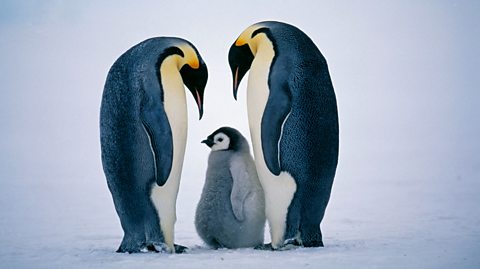
Earth is full of mystery and wonder - and part of its beauty is the mind-boggling links that can be found between two seemingly random things.
Whether its a connection between humans and animals or fossils and plants, sometimes we learn a fact about the planet we call home that takes us by complete surprise. BBC Bitesize takes a look at the remarkable relationships that connect the natural world.
Mushrooms and rain
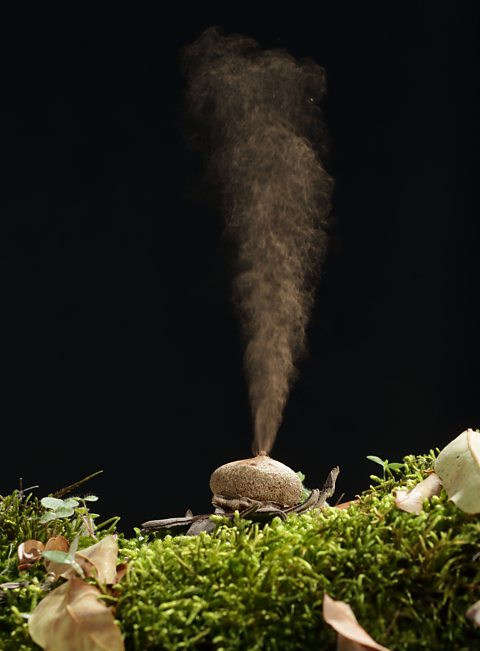
The world of fungi has long fascinated scientists and research studies have found that mushrooms, which form part of the fungi kingdom, may have the power to influence the weather.
In 2015, scientists in the US from Mount St. Joseph University and Miami University, both in the American state of Ohio, found that mushroom Spores are produced by fungi and other non-seed plants as a way to reproduce. along with plant and pollen spores, help to collect water in the air and contribute towards the formation of large water drops in clouds - meaning that mushroom spores may promote rainfall in some ecosystems.
Fungi produce 50 million tons (50,000,000,000 kg) of airborne spores each year, the same mass equivalent as over 3.6 million Big Bens.
At a certain point, these spores are flung into the air at around 10,000 times the force that an astronaut experiences during a space shuttle launch.
Once in the air, the mushroom spores float in the air and attract new drops of water to join them.
When billions of spores in the air attract billions of drops of water, rainclouds are formed.
This is particularly true of environments where it rains all the time, like tropical rainforests. You mush be kidding me!
Honeyguides and humans
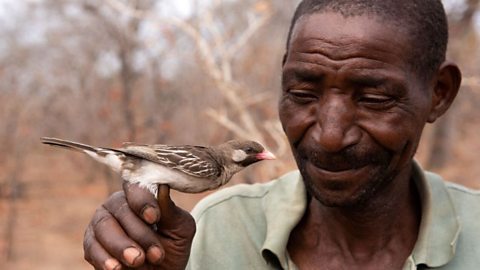
Cooperation between humans and wild animals in the natural word is extremely rare. But an extraordinary bond between a species of small free-living birds called honeyguides and some African communities is an example of how they can team up and work together for mutual benefit.
Widely found in sub-Saharan Africa, honeyguides regularly feed on the beeswax that can be found inside the nests of wild bees. Meanwhile, human honey hunters seek out the nests for the bees’ honey.
A 2016 paper by Claire Spottiswoode, an evolutionary biologist at the University of Cambridge and University of Cape Town, explored the relationship between the honey hunters and honeyguides in northern Mozambique.
They found that cooperation between them relies on two-way communication. Honeyguides make a special call for humans with a chattering call, flying from tree to tree in the direction of a bees’ nest, showing the honey hunting followers where to go. Alternatively, the honey hunters use a specialised and culturally unique ‘brrr-hm’ call, which honeyguides have learned to associate with honey trips over time.
After locating the nest, humans can then subdue stinging bees with smoke and chop open the nest to extract honey, which also allows the birds to feed on the wax combs left behind.
Researchers found that the use of the call increased the overall probability of honey hunters being shown a bees’ nest from 16% to 54%.
The unique relationship between honey hunters and honey guides is thought to have been cultivated for thousands of years. Now the continent’s once widespread practice is only used by a few ethnic groups.
Dust from the Sahara fertilises the Amazon
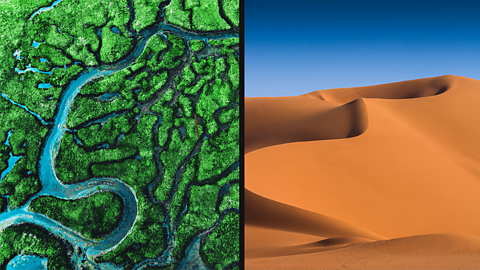
At first glance, it may not seem like the world’s largest desert and the world’s largest tropical rainforest have a lot in common. But in 2015, a NASA satellite revealed a unique relationship between the Sahara desert and the Amazon rainforest.
Scientists studied how Saharan dust is picked up by the wind and carried on a 4828 km (3000 mile) journey across the Atlantic Ocean.
The dust - which amounts to around 27 million tonnes each year - then drops out of the sky and into the The part of South America drained by the Amazon River and its branches. The nutrient-rich dust contains a small amount of a chemical element called phosphorus, and other fertilisers, which revitalises the Amazon’s soils. This encourages plants and trees to grow, enabling them to turn carbon dioxide into oxygen, in a process known as photosynthesis.
One of the places dust is picked up from is the Bodélé Depression, an ancient lake bed found in the lowest point of Chad. Widely regarded as one of the largest single sources of dust in the world, it contains significant sums of dead microorganisms - meaning some of the phosphorous which fertilises the Amazon is the product of fish fossils.
In a 2015 paper, atmospheric scientists were able to accurately estimate how much phosphorus travelled the trans-Atlantic expanse for the first time ever. Speaking of the dust’s extraordinary journey, lead researcher, Hongbin Yu told Science Daily, "This is a small world, and we're all connected together."
This article was published in January 2025
Looking for quizzes, amazing stories and fun facts?
Bitesize Topical has it all!

Six hidden ruins that can be found across the UK
Ancient Roman bridges in Yorkshire, cottages in Wales - and a secluded church in the heart of London
Can you guess the natural landmarks from the aerial photos?
Do you know your caves from your trenches? Take a look at these aerial photos and see if you can figure out which natural landmarks they are.
Meet the animals that live in the most extreme environments
From the mouse at the top of a volcano to the worms at the bottom of the ocean, BBC Bitesize takes a look at the animals that live in the wildest of habitats