The big announcement has been and gone, the online ticket queues are over, now the business of the first Oasis tour since 2009 can finally get underway.
Whether you’re one of a new generation of fans of the Manchester legends, or someone who witnessed Noel and Liam Gallagher’s ’90s rise to champagne superstardom, you’ll no doubt be anticipating your favourite tracks making it into the live setlist. To mark one of the biggest reunions in UK music history, BBC Bitesize takes a look at the stories behind three of the band’s best-known songs which definitely maybe belted out in Cardiff this Friday.
Supersonic: Thirty minutes to launch a band
Although Oasis and the Gallagher brothers will be forever linked to Manchester, their debut single was recorded in Liverpool in what could be described as unusual circumstances.
In December 1993, the band gathered in the Pink Museum studio, a former motor museum near the city’s Sefton Park. They were originally there to record the existing song Bring It On Down for the label Creation Records, which had signed them earlier in the year. For some reason, the song didn’t come across as well as planned - but Oasis still needed to come up with something for the label. In what could be one of the most important decisions in music history, they decided to down instruments and have a takeaway.
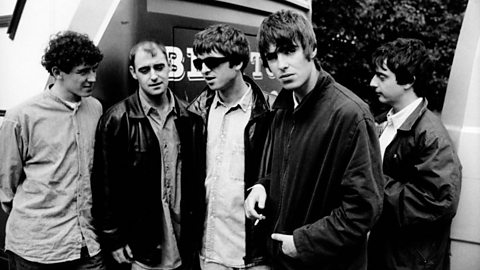
As Noel Gallagher remembered in an interview about the song: “Somebody had sent out for Chinese or fish and chips or something… I went in the back room and, as bizarre as it sounds, wrote Supersonic in about however long it takes six other guys to eat a Chinese meal.” It’s not clear what the other band members and studio crew ordered but it must have taken a while to eat as Noel said in another interview that the song took half-an-hour to write.
The track was recorded that same day with vocals by Noel’s brother Liam and the version released was the same mix from that Liverpool recording session. The lyrics refer to someone called Elsa, who wasn’t a person but a rottweiler dog who belonged to one of the studio engineers and was there at the time. There is also a mention of The Beatles’ Yellow Submarine, with the Liverpool group being a big influence on Noel’s songwriting.
Supersonic was released on 11 April 1994 and the band performed it during their UK TV debut on the late night Channel 4 show The Word. More than 30 years later, it remains one of Noel’s favourite Oasis songs.
Don’t Look Back in Anger: Who’s Sally?
Oasis’ second album was released in the autumn of 1995. (What’s the Story?) Morning Glory went on to become the fifth biggest selling album of all time in the UK, approaching five million sales as of June 2025. It hit the shelves as the Britpop phenomenon was in full flow and included two number one singles, one of which was Don’t Look Back in Anger, written by Noel shortly before the band achieved major success.
It famously mentions a woman called Sally and is, according to Noel, about not worrying over the opportunities that have never come your way and embracing the life you have.
Noel said of the song in an interview: “That was written in a hotel room in Paris when we were just on the way to the Sheffield Arena to play our first ever arena gig. I was doing it in the sound check and the ‘So Sally’ bit, I wasn’t singing that. [Liam] came up to me and said, ‘Are you singing ‘So Sally can wait’?’”
When his brother said that he wasn’t, Liam replied: “Well you should do.”
The identity of Sally has been the subject of some speculation over the decades, but as Noel told Dermot O’Leary in a BBC interview: “I don’t know who Sally is… and it’s a song of no regrets.”
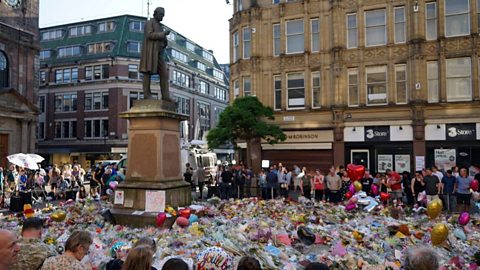
More than 20 years after the song was released it took on a new meaning. Following a vigil for the 22 people killed in an attack on an Ariana Grande concert at Manchester Arena in May 2017, one woman in the crowd began singing Don’t Look Back in Anger. The crowd began to join in and in the following days and weeks, the song became a sign of Manchester’s sense of unity after the event.
Wonderwall: Almost sung on an actual wall
Hello is the first track on the (What’s the Story) Morning Glory? album. Just before its imposing opening chords, a teasing snippet of Wonderwall can be heard, with birdsong in the background.
It’s the only element of an earlier version of the song, recorded in an unusual way, to feature on the album. Noel recalled in a documentary: “I remember saying… I’ve got this song called Wonderwall - and I want to record it on a wall.”
That led to a set-up featuring stepladders and microphones worth thousands of pounds being built around one of the walls outside the recording studio in Wales and Noel performing up there. “I remember a lot of sheep [in the next field] were watching me do Wonderwall,” he said. “I don’t know who was more freaked out, me or them.”

In the end, the outside version of Wonderwall, whose title was inspired by a 1968 film of the same name, was not the one released, with Liam putting down his vocal in the snug warmth of the studio instead. The single debuted at number two in the charts in November 1995, kept off the top by TV stars Robson & Jerome with their version of the 1950s hit I Believe.
The song’s success baffled Noel who recalled finding the song “a bit annoying” when it was first finished. He said he was surprised when their record label was so enthusiastic about Wonderwall’s potential. The record label was proved right in the end and the song became one of the band’s signature tracks.
This article was published in July 2025
How videos and music television changed pop
From MTV to social media, we look at how video unlocked the unlimited access to music we know today.
Can you guess which word is missing from the lyrics in this tricky music quiz?
From pop songs to nursery rhymes, try this BBC Bitesize quiz to test your music knowledge.
Five pieces of classical music that have inspired pop
From Blackpink to the Pet Shop Boys, Little Mix to S Club 7, discover the classical music hidden inside pop.