While all cities, towns and villages across the UK have traditional landmarks which help shape their identity, a great many also have more unusual features which are unique to them.
These alternative symbols are held in great affection by residents - and often attract the attention, and admiration, of those who live elsewhere.
BBC Bitesize takes a look at just a few of these quirky landmarks.
Liverpool: Land of the purple wheelie bin
If you want to find out if a person is really from Liverpool - ask them what the colour of their wheelie bin is!
Why the colour purple was chosen by Liverpool City Council for their household refuse wheelie bins has been a talking point inside and outside the city since 2000, when 260,000 of them were first rolled out.
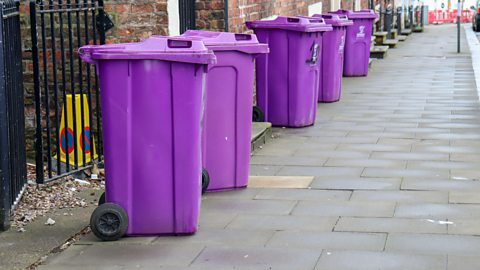
One popular theory is that purple is a happy medium for a city passionate about football. A mixture of Everton FC's blue and Liverpool FC's red is seen as the perfect choice.
But there was plenty of opposition to the colour initially. For example, some residents in areas of south Liverpool said it didn't suit the local Victorian architecture.
Many people, however, embraced the colour from the outset, while others grew to either accept or love the distinctive bins, viewing them proudly as being part of the city's identity. Today, you can even buy souvenir miniature purple wheelie bins in some of the city’s gift shops.
Glasgow: The Duke of Wellington’s distinctive headgear
When does a statue become more than a statue? When late-night revellers spend years placing traffic cones on top of it, and authority figures spend years removing them.
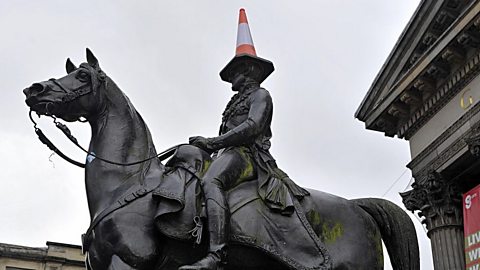
The Duke of Wellington statue outside the Gallery of Modern Art in Glasgow has become a piece of art in its own right - street art, which apparently inspired the legendary Banksy.
The graffiti artist described it as his "favourite work of art in the UK" and said it was the reason he chose to hold his first exhibition in 14 years at the gallery, in 2023.
A sign welcoming people to his exhibit said: "For anyone who isn't aware - the statue out the front has had a cone on its head continuously for the past 40-odd years.
"Despite the best efforts of the council and the police, every time one is removed another takes its place."
In 2005, a Glasgow City Council spokesperson told the BBC that placing the traffic cone on the statue's head was considered "an act of vandalism" and that there was also the risk of injury if someone fell while trying to place a cone on top of the tall structure.
Plans to make the statue's plinth taller in 2013, to stop people climbing up with a traffic cone, were abandoned after a public campaign.
Oxford: There’s a shark in that roof
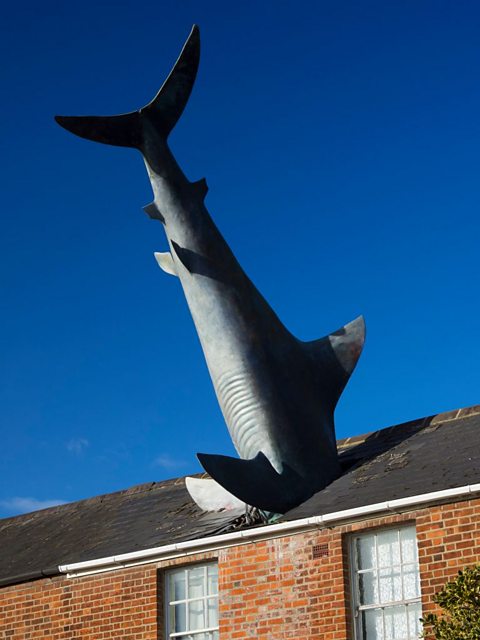
A shark embedded in the roof of a house is not the sort of thing you see every day - unless, that is, you live in a certain suburb of Oxford.
The Headington Shark, officially known as Untitled 1986 after the year it first appeared, has certainly made an impression - and not just in the city it resides. Its fame is now so widespread that it has appeared in a list compiled by The Times newspaper of the best things to see and do in Oxford.
The 7.7 metre-long (25 foot) fibreglass sculpture was created by John Buckley. It is said to represent people's sense of helplessness - it was inspired by the time the then house owner, former BBC Radio Oxford presenter Bill Heine, who died in 2019, heard American warplanes flying over the city.
The Headington Shark was installed without planning permission, and Oxford City Council sought to have it removed - but in 1992, after a six-year legal battle, the Department of the Environment ruled it could stay. In 2022, city planners added it to the Oxford Heritage Asset Register.
Newcastle: A rabbit with fangs
Look up - if you dare - at the Vampire Rabbit, the grotesque gargoyle perched above the rear entrance of the Cathedral Buildings in Newcastle.
The not-at-all furry or loveable bunny has been looking out over the city since 1901, though no one quite knows why the creature with crazed bulging eyes, claws and huge fangs was created.
This has meant people have had the freedom to suggest all manner of theories. Some, for example, suggest he was put there to scare away grave robbers who would sneak into the graveyard opposite late at night, while others say he was actually meant to be a hare (possibly symbolising spring and the coming of Easter) whose ears were put on backwards accidentally.
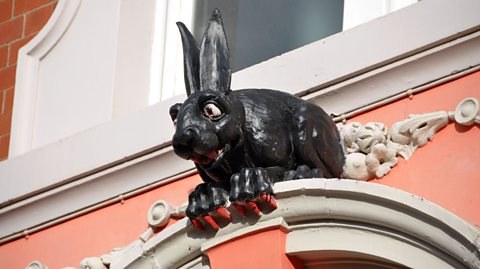
We may never know the truth - but the Vampire Rabbit remains part of the fabric of Newcastle life.
Belfast: Now that’s a Big Fish
What else could this real whopper, that landed in Belfast in 1999, be called other than… Big Fish?
The 10m (32ft) sculpture of a salmon was commissioned to celebrate the regeneration of the River Lagan, and the area's historic importance.
It was created by artist John Kindness and sits on Donegall Quay.
Its blue scales are made up of ceramic tiles, which describe different scenes from the city's history. Big Fish is said to represent Irish mythology's Salmon of Knowledge, which would pass on its education and intelligence to the first person who ate it. And according to locals, kissing Big Fish gives you more wisdom!
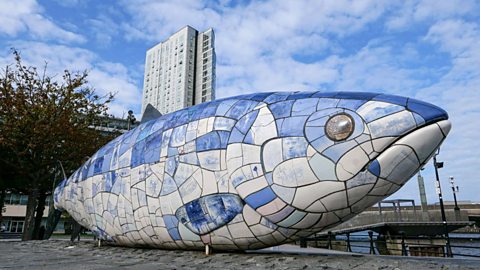
Material for the tiles came from a variety of sources going back as far as Tudor times, while modern-day newspaper headlines were also featured, together with drawings by Belfast school children.
The much-loved piece of street art, which also contains a time capsule storing information, images and poetry about Belfast, has become a popular spot for tourists taking selfies… but kissing the fish is not said to be essential!
Mumbles: The other Big Apple
It looks good enough to eat - almost!
The Big Apple kiosk - located close to Mumbles Pier in Bracelet Bay, Swansea - was built way back in the 1930s to advertise drinks company Cidatone.
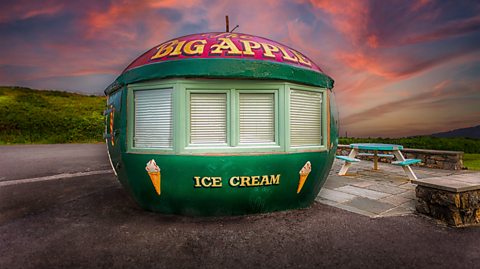
It has since welcomed countless visitors, selling them ice cream, sweets, gifts and drinks. Similar kiosks were erected at other seaside locations in south Wales, including Barry and Porthcawl, but The Big Apple is said to be the last one standing.
A Grade II listed solid concrete structure, it once sported a metal stalk at its apex, as well as the slogan "Drink Your Apple a Day" - a reference to the drink Appleade and company name Cidatone.
The Big Apple has had its fair share of bad luck. In 2006, pranksters painted it orange - then, in 2009, it was shaken to its core when a car ploughed into it, causing extensive damage. But it was rebuilt, with 27,000 people backing a campaign on Facebook to safeguard its future.
It was granted its listed building status in 2019 - the Welsh Government's heritage arm Cadw saying it was a "rare and unusual" example of a seaside refreshment kiosk - and further renovated and repainted in 2022.
This article was published in December 2024
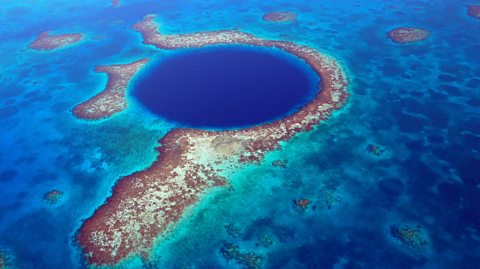
Can you guess the natural landmarks from the aerial photos?
Do you know your caves from your trenches? Take a look at these aerial photos and see if you can figure out which natural landmarks they are.
Twin cities: Where in the world is your town's twin?
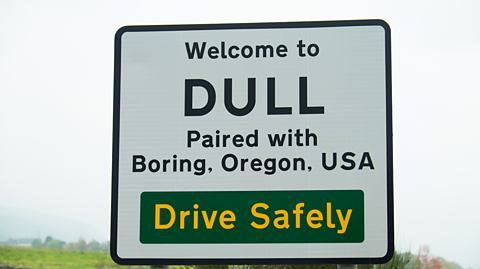
BBC Bitesize explores the curious history of twin cities.
The landmarks under construction quiz
Can you identify these famous structures - even before they were completed?