Cricket is loved by millions all over the globe. It’s played everywhere, from quaint village greens to huge stadiums such as The Oval in London.
And it doesn't get much bigger in men's cricket than The Ashes - the Something which either takes place every two years, or in the case of plants, has a life cycle of two years. series between England and Australia playing out one of sport's biggest rivalries for the right to claim the tiny urn.
However, its language can be hard to crack. Come on - does anyone really know what a googly is?
To help, we’ve taken some popular cricketing terms and found out what they mean, and where they come from so you're fully up to speed for the 2025-26 Ashes series down under.
1. Out for a duck
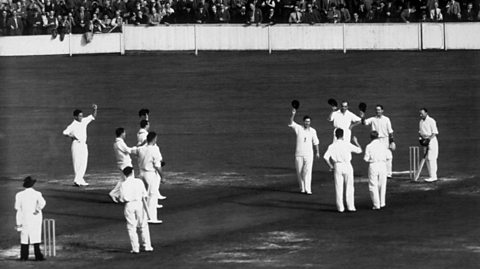
If you hear that a batter is ‘out for a duck’, you might see them looking pretty down in the dumps. That’s because it means that they’ve been bowled out, or dismissed, before getting any runs whatsoever.
The origin of this phrase is simpler than you might think. A duck’s egg is an oval, which is also the shape of the number 0. So, lo and behold, we get the phrase ‘out for a duck’.
There are different types of ducks, too:
- A regular duck - when a batter is dismissed without any runs, but some time after the first ball.
- A golden duck - when a batter is dismissed after the first ball bowled to them in their innings.
- A diamond duck - when a batter is dismissed without facing any legal balls. This would usually happen from the non-striking side, but a batter could get out for a diamond duck after a wide ball on the striking end, too.
- A platinum duck (or royal) duck - when a batter is dismissed on the first ball of the first innings of the entire match. Ouch.
It gets worse - if you get a ‘pair’, you’ll have been out for a duck in both innings of a match. To top it off, a ‘king pair’ is when those are both golden ducks.
2. Sledging
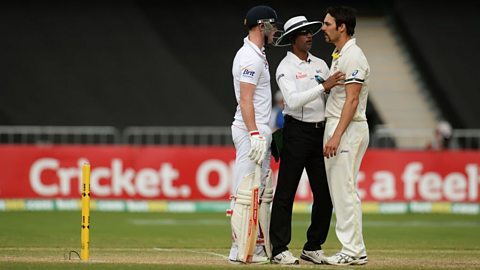
Trash talk is a common part of many sports. Players will often try to use insults and witty put-downs to intimidate their opponents and throw them off their game.
Cricket has a different word for it though - ‘sledging’. There are a few theories about where it comes from. Some dictionaries say that it’s based on a newspaper report that described the term as ‘subtle as a sledgehammer’.
It could also be that it comes from the old English word slecg. This word evolved from slagj, which is also the stem word for slay. If you believe the insults genuinely hurt the players they’re directed at, then this theory could be very plausible too.
3. Wicket
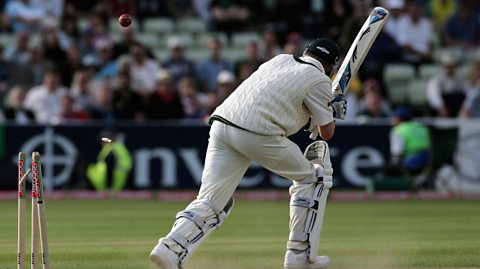
A wicket is a set of three stumps with two wooden bails on top of them. They can be stumped, hit, kept, taken or given away. Sometimes they are sticky, and you always try to take ten of them. However, you might not know how it got its name.
A wicket (or wycket as it used to be spelled) is also a small gate embedded into either a huge decorative door - such as in a cathedral - or a fence. In the early days of cricket, wickets were made of only two stumps and one long bail, so they looked very similar to a small gate.

The third stump was introduced in 1775 after a bowler called Lumpy Stevens (what a name) bowled three balls in a row (see: hat-trick) that went straight through the two stumps rather than hitting them.
4. Yorker
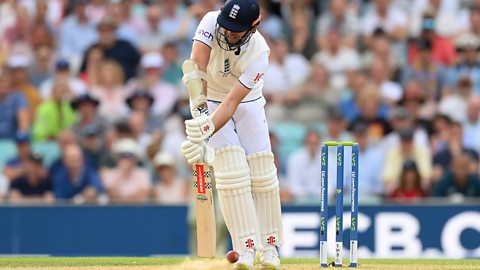
A yorker could be described as the king of all bowls. It’s when the ball lands directly at the batter’s feet, and it’s extremely difficult to hit.
Oxford dictionaries suggests that the term was coined because players from York bowled them so often. Another theory attributes the name to the other meaning of yorker: cheater.
At the turn of the 20th Century, the word ‘york’ was apparently used to mean sharp, or quick-witted. This then evolved over time to mean cheat. For example, someone might have complained “I’ve been yorked”, if they had been swindled by a crook. Not very nice for people from the city!
5. Hat-trick
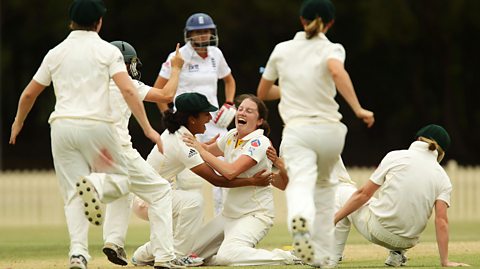
When you hear hat-trick, you might tend to think of football. However, it originally came from cricket.
It’s used when a bowler takes three wickets from three consecutive balls. Traditionally, to celebrate their success, the club gifts the bowler with a hat.
Along with the caps they get for playing international games, cricketers must build quite a collection of headgear.
Quick cricket
Here's a quick fire 'best-of-the-rest' list to get you through the winter of cricket.
Howzat - You may also hear variations such as 'How is he?' or 'How's that?'. Always screamed, frantically at the umpire, this is how players will appeal for a batter to be given out. The appeal is very important - without one, the umpire cannot give a player out.
Carry the bat - If an opening batsman remains not out at the end of a team's innings - with all of their teammates out - they are said to have carried the bat.
Googly - A very handy delivery for a wrist spin bowler to have in their locker. This delivery will spin in the opposite direction than a standard delivery. The finger spin equivalent is a doosra.
Silly - Referring to an official fielding position as silly might not make a huge amount of sense - until you hear the explanation. Silly is applied as a prefix to a number of fielding positions that are exceptionally close to the batter. Given the speed the ball will come towards them, perhaps silly is an understatement.
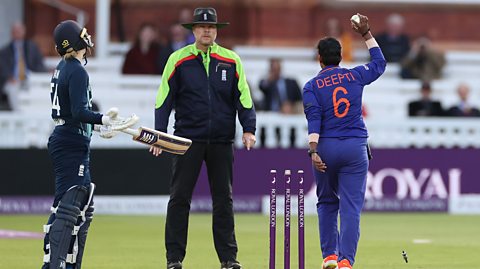
Mankad - A controversial one. This is where the non-striking batter leaves their crease before the bowler releases the ball - the bowler then stops their run-up and runs them out. It's named after Indian bowler Vinoo Mankad who used the method in a Test match and is seen by many as being against the spirit of cricket, even though it's a perfectly legal move. Often, a bowler may threaten to perform the Mankad as a friendly warning to the batter without actually following through with it.
Jaffa - Not an orange-chocolate treat, but the term for an excellent delivery, generally seen to be unplayable for the batsman.
Maiden over - An over (which in itself, is the bowler's standard six deliveries in each turn) in which the bowler concedes no runs or extras.
Duckworth Lewis - While it may sound more like a folk band than a cricketing term (and indeed, there is a band who exclusively produce cricket themed songs of this name), it's actually a rather-complicated mathematical formula designed to adjust targets in limited overs cricket, where playtime has been lost to poor weather.
This article was published in November 2018 and updated in November 2025
From Tests to The Hundred: A bluffer’s guide to cricket’s formats
How one of the oldest sports in the world kept up with the times.
The Ashes: A history of cricketing rivalry
How the England and Australia test series captured the world's imagination.
Quiz: The science of cricket
Test your knowledge of the science behind cricket with this BBC Bitesize quiz, ahead of the men's 2025/26 Ashes.