Christianity is the world’s largest religion with around 2.4 billion followers.
The vast majority of them will celebrate Christmas, but not all in the same ways, or not even on the same day.
There are many different Christian groups and communities, each with its own beliefs, traditions and rituals.
Let's take a look at how four communities choose to mark Christmas.
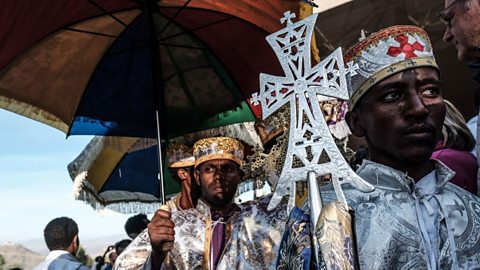 Image source, EDUARDO SOTERAS
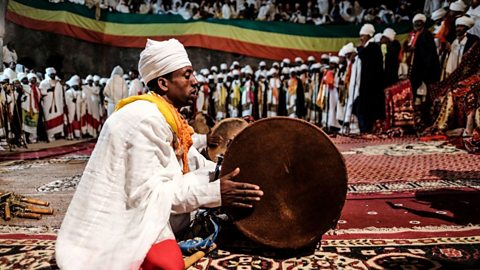 Image source, EDUARDO SOTERAS
The Ethiopian Orthodox Tewahedo Church
In Ethiopia, Christmas is known as Ganna/Gena or Ledet and is celebrated on 7 January.
Thousands of pilgrims travel to the town of Lalibela, the site of 11 churches which date back to the 12th and 13th Centuries. Each church was carved out of its own single rock, connected together by tunnels, and they were designated a UNESCO world heritage site in 1978.
Masses often begin in the early hours of the morning and those who attend wear a traditional robe of white cotton cloth.
Prior to Christmas, believers fast for 43 days, eating only a single meal a day, which must not contain any ingredients of animal origin.
In rural areas of Ethiopia, the traditional game of gena is often played at Christmas. According to Ethiopian legend, when the shepherds heard the news of the birth of Christ they rejoiced and started playing the game with their crooks. It is similar to field hockey and is played on a pitch of approximately 100m by 110m, with the two teams of ten players sometimes having to dodge grazing cattle.
Image source, EDUARDO SOTERAS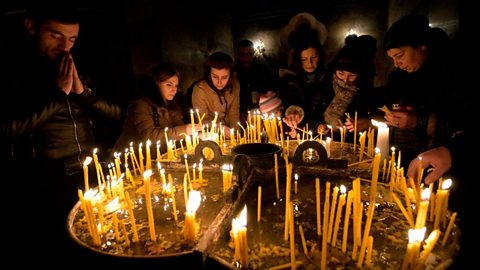 Image source, KAREN MINASYAN
The Armenian Apostolic Church
The Armenian Apostolic Church considers Christmas (Dzoont) to be one of its five major feasts (Daghavar). It takes place on 6 January and celebrates both the birth of Jesus Christ and his baptism by John the Baptist. According to traditions, both events took place on the same day, 30 years apart.
The latter event is known as the Theophany/Epiphany and is not to be confused with the Epiphany celebrated in Western Christianity, which commemorates the visit of the wise men (or Magi) to the infant Jesus.
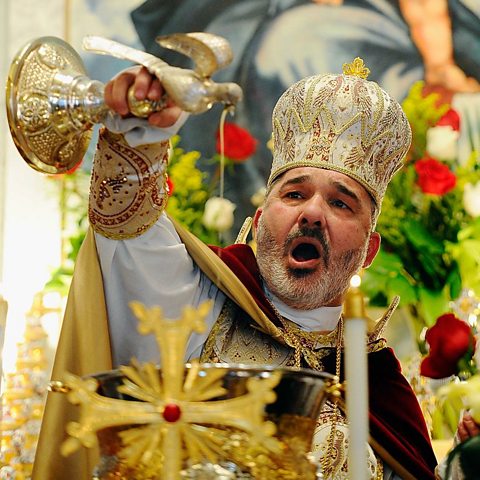 Image source, Kevork Djansezian
As part of the celebrations, there is a Blessing of the Water ceremony (Churorhnek) which takes place following the Christmas mass. To symbolise Christ’s baptism, the Cross is immersed in blessed water and removed again while traditional Armenian hymns are sung. A Special oil used for anointing. known as Holy Muron is poured into the water using a dove-shaped container, symbolising the Holy Spirit’s appearance in the form of a dove at Christ’s baptism.
A separate ceremony takes place on 18 January in Jerusalem, in which the Armenian Patriarch of Jerusalem (a senior religious authority) performs the Blessing of the Water on the Jordan River. This is the river in which Christ is said to have been baptised.
After every Daghavar, the Armenian Apostolic Church observes a day for remembering those who have died. This day is known as Merelots. Christmas is no exception and people will visit the graves of loved ones while priests offer prayers.
Image source, Kevork Djansezian Image source, OZAN KOSE
The Greek Orthodox Church
The Greek Orthodox Church also celebrates Theophany/Epiphany on 6 January with a Blessing of the Waters ceremony, commemorating the baptism of Jesus. In some churches, there is a tradition of throwing a cross into the blessed waters to be retrieved by worshippers. Whoever gets hold of the cross first is said to be blessed for the year to come.
Christmas itself is celebrated on 25 December and is preceded by a 40 day fast, beginning on 15 November, which is split into two periods.
For the first month of the fast worshippers will avoid meat, fish, dairy oil and alcohol products, with certain exceptions. On Tuesdays and Thursdays, wine and oil can be consumed, and then the same again on Saturday and Sunday (and some feast days) but with the addition of fish. The fast becomes stricter from 20 December, when there is only an exception for wine and oil on Saturday and Sunday, and no fish.
Image source, OZAN KOSE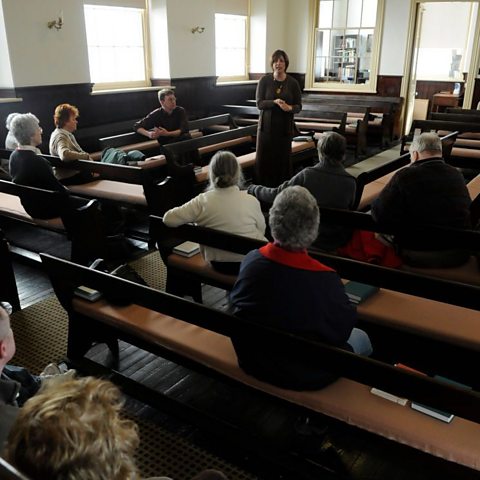 Image source, MediaNews Group
Quakers (Religious Society of Friends)
Historically, the Quakers avoided celebrating any holy day, as they believe no day is more holy than another. This is still a principle that some Quakers continue to follow today but others do celebrate in some way.
Alistair Fuller, from Quakers in Britain, highlights that “around Christmas, there are some Quaker meetings where you’d have a The Quaker term for a worship event, rather than a service or mass. on Christmas Day, and that can often be for the people who would otherwise be alone.”
Typically, Quaker meetings don’t follow any sort of structure. The focus is on being still, waiting for the Holy Spirit and only speaking if you feel moved to do so.
At Christmas though, Alistair explains, the worship may have some elements to focus the community’s thought and reflection. This is not a way of saying that this day is more important, but that “this might be a day when we reflect on that story of what it means for Christ to be born amongst us or God to be present in our midst.”
Image source, MediaNews GroupDreidel, latkes and more
Six words to explore the Hanukkah story and traditions
Four traditional Christmas foods from around the world
Find out which countries hold festive celebrations with fried chicken and bloodsucking fish.
How has Christmas changed over the past 200 years?
The food, toys and decorations of the 1820s, 1920s and 2020s