Researching your family history can reveal all sorts of fascinating and unexpected things about your ancestors - from where they lived and how they worked, to secret siblings and long lost cousins.
As well as hunting through censuses and other records for addresses and occupations, why not check to see if your family had a coat of arms?
To be fair, coats of arms are quite rare so if you do find one, that’s a special occurrence. However, if you don’t have one going back generations, you can always invent your own using the colours and symbols below.
What is a coat of arms?
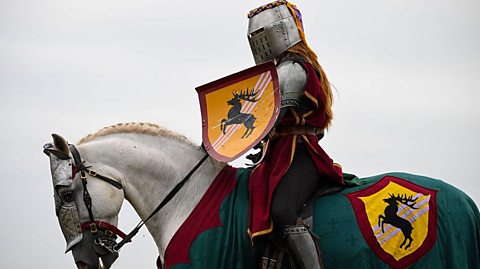
It’s a set of garments originally worn by a knight, decorated with a pattern that is specific to a particular individual. They include a shield, a crest that would be worn on top of a helmet, a wreath - two strips of silk twisted together, and a mantling, which is a cloth to protect the wearer from the sun.
Coats of arms were first used in the 12th Century, across Europe, as a way of identifying soldiers on the battlefield or in a tournament but gradually became more of a status symbol. That’s because only the richest, most well-connected people tended to have crests. Contrary to popular belief, they didn’t belong to a whole family but were passed down from father to son, along with any land and titles such as duke or marquess. Women sometimes had a coat of arms but this was rare.
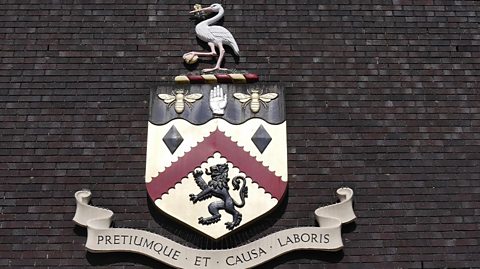
Since the 15th Century, coats of arms have also been granted to towns, cities and companies. Many can be seen today on grand town halls, gates to a city or as part of their branding.
Colours
As well as silver and gold, the shields are usually decorated with up to five colours. Each colour has a meaning and when a colour is used in a coat of arms it is so people associate that meaning with the owner and their actions.
Black, which was called “sable”, means the owner is wise or careful. It could also refer to grief. Green, or vert, means plenty, joy, hope and loyalty in marriage. Red, or gules, represents strength in war. Blue, or azure, is in this context, the symbol of faith, moral strength and loyalty. Finally, purple, or purpure as it was called, means royalty or justice.
Animals
Many shields feature an animal or two, which again symbolise different types of personality and social status. If you want to imply faithfulness you could choose a dog, or pick a lion to suggest courage. Eagles mean power, hares are the symbol of speed and stags of wisdom and long life.
How about a badger? They stand for endurance, although one market town in Germany features a badger on its shield as a pun on the town’s name. The town is called Dachsbach, which means ‘badger stream’.
Religion is sometimes referred to as well. According to legend, the pelican feeds her young with her own blood. This doesn’t actually happen, but in paintings and coats of arms, pelicans are used to symbolise Jesus Christ, as Christians believe he redeemed his followers with his own blood when he died on the cross.
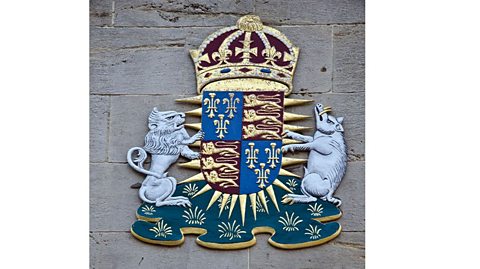
Richard III chose a white boar for his coat of arms. Some believe this was inspired by the badge of Tristan, a knight of the fictional King Arthur’s court. In Richard lll’s library, historians found a copy of the medieval story, one of doomed love between Tristan and Isolde, an Irish princess. However, less romantically, the white boar Richard III used could simply be a reference to his own bravery in battle.
Mythical beasts
Animals don’t actually have to exist to be included in a coat of arms. Many mythological creatures can be found strutting their stuff on heraldic shields. They include brave and clever dragons, courageous griffins, with the head of an eagle and a lion’s legs, and the fierce cockerel and dragon crossbreed - the cockatrice.
Perhaps most terrifying is a manticore, a bizarre mixture of lion’s body, tusks, horns and a man’s face. Less imposing was the martlet, a bird with no legs or beak that is sometimes used to show the shield belongs to a fourth son.
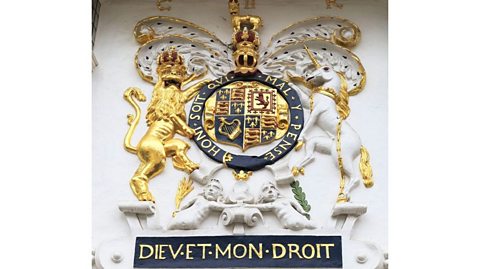
Many countries have a coat of arms too. For Great Britain and the King this features both a mythical beast and a real one - a lion representing England and a unicorn representing Scotland, supporting the shield at either side. Around it is a blue and gold garter that stands for the Order of the Garter, the most senior society of knights in the UK. The king’s motto “Dieu et mon droit”, French for “God and my right” is shown below.
Emblems
Stars, rings, balls, diamonds - there are lots of other symbols used on coats of arms. Some are cleverer than others, for example a chevron, which in French means the rafter or roof of a house, is used to mean protection. However, playwright William Shakespeare’s included - yes you’ve guessed it - a spear.
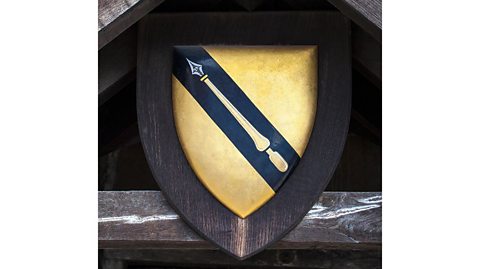
Interestingly, Shakespeare’s coat of arms was not awarded to him because of his brilliant plays or acting skills. It was inherited from his father, John Shakespeare, who was granted it in 1596. At this time many “gentlemen” applied for a coat of arms to show they were important in society. It can be seen on William Shakespeare’s monument in Stratford-upon-Avon where he was born, and on various buildings in the town that are connected with him.
If you’d like to investigate further, English Heritage have this great guide to help decode a coat of arms or to have a go at creating one yourself.
This article was published in August 2025
Five UK castles steeped in folklore
Discover more about the interesting tales behind these buildings
Can you guess the historical event from the art work?
From royal weddings to brutal battles, can you guess the historical event from the artwork?
Six hidden ruins that can be found across the UK
Ancient Roman bridges in Yorkshire, cottages in Wales - and a secluded church in the heart of London