How it all began... Birmingham was first given the right to hold a market in 1166. Most of the market people were gathered close to the church walls and in Spiceal Street. Although not named today this street still runs from the inner ring road. In the 16th century a man called John Cooper was given the right to bait bulls at a site opposite St Martins Church, this became known as the Bull Ring. The statue of Lord Nelson 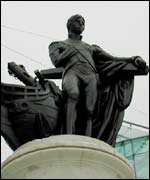 | | Lord Nelson statue |
The great triangle of space with St. Martins as its base, gathered all the outdoor traders of Birmingham. From 1809 the Bullring was made more distinctive by the first statue of Lord Nelson to be put up in Britain. By the 1830's a magnificent market hall overlooked the barrow boys and other dealers. The early 19th century... By the early 19th century the area around St. Martins had become crowded with old buildings, narrow streets and traders stalls. It was decide to open up the area by knocking down the buildings on the east side of Spiceal Street and on the west side of the Bullring. This led to the emergence of the Bullring of memory.
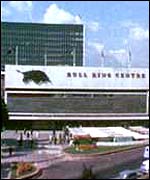 | | The old Bullring |
The original Market Hall, with room for 600 stalls and an ornamental fountain, was built in 1835, again designed by Charles Edge, the man who finished the Town Hall. In 1940 it was gutted after being hit by a German incendiary bomb. It was still in use although roofless until the redevelopment of Birmingham swept it away in the early 1960's. Work began to redevelop the Bullring in 1961, and eight million pounds later the new Bull Ring opened by the Duke of Edinburgh in May 1964. Linked by escalators and stairs was a 23 acre air-conditioned shopping centre and 350,000 feet of retail trading area. It was meant to be the ultimate shopping experience,and was declared to be the biggest indoor shopping mall outside the USA, but many said the feel of the old market had been lost.
Designed in 1964 by James A Roberts, the Rotunda is the most visible symbol of the city centre redevelopment that transformed the Bull ring area in that decade. For many Brummies the Rotunda is a symbol of Birmingham, and stands out as a popular landmark. It was originally planned to be 12 storeys high with a roof top restaurant. There was also talk of a cinema and a crèche. The finished Rotunda is bigger - 25 storeys - but less glamorous. No food, no films, no babies, just offices. The view from the top of the Rotunda is spectacular. Carl Chinn talks about the history of the Birmingham Bullring.  Part One Part One
Part Two Part Three  Watch Carl Chinnas he takes you on a historical tour of the Bullring Shopping Centre. Watch Carl Chinnas he takes you on a historical tour of the Bullring Shopping Centre.
| 




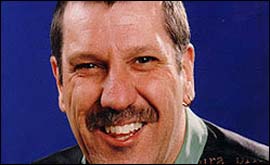
 Professor of Community History at the University of Birmingham