 | | Blue Devil |
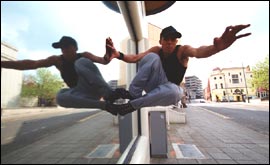
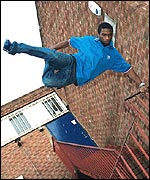
I look up at Paul - or 'Blue Devil' as a lot of people know him - as he stands with his back to me on top of the 8 foot wall in the middle of St Chad's Circus. "You ready?" he asks. Looking up at him through the lens of my camera, I check that everything is in focus and give him the go ahead. Paul crouches briefly before nailing a 180 backflip onto the concrete below. "Nice, mate, very nice. That's gonna look sweet," I tell him. Paul grins and we grab our bags and wander round the corner to some rails to drill some vaults. Birmingham's Traceurs 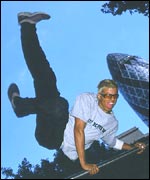 | | Sticky |
'Le parkour' has been growing at a rapid rate in the UK over the course of the last year and as the summer kicks in, it's set to go huge. Birmingham is experiencing the growth first-hand, with the largest collection of 'traceurs' - those who practice parkour - in any city outside of London. If you're not familiar with the Channel 4 documentary 'Jump London', parkour is considered by a lot of us to be an art, more than an urban extreme sport. Moving from A to B with style and fluidity using everything around you probably describes it best, drawing on martial arts, gymnastics, skate boarding, inline skating and break dancing. Deedi is a regular in Birmingham city centre. Hailing from Wolverhampton, he likes to hit a few of the traceurs' favourite Birmingham spots for a bit of variety. Parkour crews 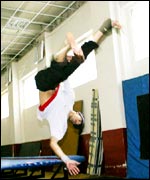 | | Deedi |
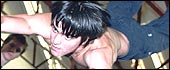
At 6'5 and an ex-high jumper and basketball player, he has a natural ability and, like most of the Birmingham crew, discovered parkour through www.urbanfreeflow.com, and turned up at one of the jams organized by its members through the site. "I used to enjoy the high jump but it wasn't enough," he tells me. "Jumping over a bar isn't creative and parkour challenges me to do something different every time." Around 15 years ago in a little-known suburb of Paris, a few schoolboys used to challenge themselves to do tricks around the local architecture. Through websites, a couple of television adverts the scene in the UK was progressing steadily and then exploded with the showing of Channel 4's 'Jump London'. Following this documentary on France's leading traceurs displaying their skills around some of London's most iconic architecture, Urban Freeflow saw its membership on its message board soar from 250 members to over a thousand in the space of a few weeks. Parkour has always been mindful of safety and the potential for people to try and emulate some of the moves and cause themselves injury has had an influence on the way in which it has developed. The organization of four indoor training days by Urban Freeflow - partly to compensate for the British winter weather and partly to provide a safe training environment - has had huge success. 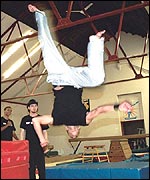 | | 'Sticky' perfects his aerials in an indoor training session |
For the first one, I drove a minibus rammed full with 15 budding traceurs - all hailing from Birmingham's suburbs - down to Kent to take part. "Training indoors gives me a real opportunity to try stuff I wouldn't even dream of doing otherwise," explains Joni 'Sticky Fingers' Budden, a 17 year old parkour enthusiast from Nottingham. "I can now do somersaults, baranis, aerials and backflips with confidence and Birmingham is a great place to come and train." Picturing Parkour When I first met up with the guys from Urban Freeflow, it was simply to take photographs but the temptation to join in was too much and it turns out that it's pretty damn addictive. Partly due to the French influence, there is a philosophy that surrounds parkour - the re-appropriation of urban spaces, the continual journey towards self-improvement and various other parts drawn from Eastern mythology and youthful anarchy. Whatever your take on it, all you need is a decent pair of trainers and a positive attitude. Oh, and a wall to throw yourself off. To see some of Andy's amazing pictures of traceurs click below. All pictures are courtesy of Andy Day and are not to be reproduced without the photographers permission. |