| 13 November 2014 |

| |
| BBC Homepage | | |
| |||
| Contact Us | | |
StoriesYou are in: Birmingham > People > Stories > Worldwide plea over Dudley Zoo buildings Worldwide plea over Dudley Zoo buildingsBy Scott Faulkner Dudley Castle was founded shortly after the Norman Conquest of 1066, and was mentioned in the Domesday book, yet it is the Tecton modernist architecture of the surrounding zoo that preservation groups are trying to save. 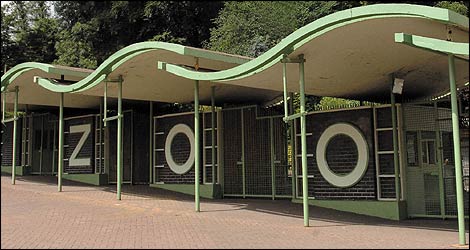 Dudley Zoo's main entrance When Dudley Zoo first opened on May 18, 1937, a reported 250,000 people attempted to visit the site to see exotic animals housed in some of the most futuristic concrete structures in the world. Thousands queued down as far as The Broadway to get into what was then considered the most modern zoo in the world - the zoo without bars! 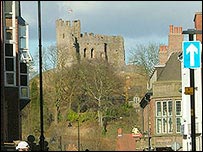 Dudley Castle The weight of the heaving crowds even caused some gates to collapse, which means the official attendance of 50,445 is acknowledged by historians to be well below the actual number of visitors who gained admission. Tecton buildingsNow, more than 70 years after its grand opening caused a stir, preservation group the World Monuments Fund (WMF) has brought global attention back to Dudley Zoo by declaring its architecture an endangered heritage site. It is one of six sites in the country, and only 93 worldwide, to make it onto its 2010 list, which includes Machu Picchu in Peru. The Zoo’s 12 animal display houses are the largest collection of Tecton buildings in the world and some of the most important examples of modernist architecture still in existence. 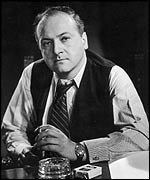 Lubetkin also designed at London Zoo Constructed around the ruins of a medieval castle, the designs are the work of celebrated Russian Berthold Lubetkin, who died in 1990, and his architectural practice, Tecton. Castle HillYet years of under-investment and changing public tastes, which have seen a movement away from austere concrete designs, have contributed to the buildings' slow decline. Criticisms leveled by animal rights campaigners over the enclosures' suitability for animals has also hamstrung Zoo bosses in their planning for the site. Developers St Modwen also pulled out in 2008 of partnering Dudley Council to redevelop a £100m scheme on the site of Dudley Zoo and castle. The council, St Modwen and the Zoo had been working on plans for a leisure and heritage scheme on the 148-acre site at Castle Hill for seven years. Jill Hitchman, who has researched the history of Dudley Zoo, says the announcement is welcome news in helping the attraction obtain funding to preserve the buildings for the next 70 years.  Jill Hitchman in one of the kiosks Criticism from vicars"Fewer and fewer people are around to remember what a buzz the Zoo's opening caused in the country," she adds. "When Dudley Zoo opened the nearest zoo would have been in Chester so it was a major attraction in what was a thriving market town. "At this time nothing opened on Sundays and it came in for criticism in newspapers from vicars because worshippers couldn't wait to get out of church to visit the zoo! "It was the most modern zoo in Europe and it was the first time a zoo without bars had been seen in Europe as before that animals could only be seen in cages." Lion RidgeLubetkin is arguably the most important figure in the British Modern Movement in the pre-war period and as head of the prolific Tecton practice, he brought a Russian's revolutionary zeal to a British architectural scene which seemed to be completely out of step with the development of modernism elsewhere. By the time he had effectively retired in 1950, Lubetkin and Tecton had built everything from zoo buildings to luxury flats, as well as lauded examples of planned social housing estates. 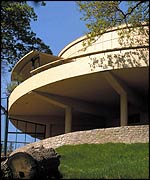 The iconic birdhouse Zoo chief executive Peter Suddock says the Zoo has been working closely with The Twentieth Society and English Heritage for more than two years to get greater recognition for the architectural importance of its Tecton buildings. In Easter 2009 the Zoo opened 'Lion Ridge', a £500,000 wraparound enclosure and paddocks for highly endangered Asian lions, incorporating the site's iconic Tecton Birdhouse, and Mr Suddock hopes more money can now be secured to continue such work. "Our aim now is for the Tectons to become internationally recognised which will help us to secure funding, which was the whole purpose of the World Monuments Fund exercise," he says. "They have long been recognised as architecturally important structures and our much acclaimed launch of Lion Ridge has proved they can be adapted and used for their original purposes; as enclosures and housing for some of the world's rarest animals. "Coupled with a scheduled monument, the 11th century Dudley Castle, and a 20-acre zoo set on an historic wooded hillside of geological importance with limestone caverns, the Tectons make DZG a unique attraction and truly deserving of world status." 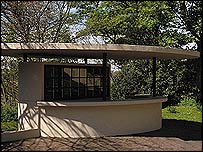 One of the Zoo's disued kiosks Most at riskDr Jonathan Foyle, chief Executive of World Monuments Fund Britain, says its WMF 'Watch for 2010' is an important way of helping to preserve buildings most at risk for future generations. “The aim of the Watch is not simply to raise awareness of the sites most at risk; we endeavour to involve people in their regeneration and development," he says. "We are not anti-progress, we’re in favour of sustainable stewardship and there is undoubtedly a need to balance heritage concerns and other priorities.” 'Heritage asset'Preservation campaign group The Twentieth Century Society has been lobbying for the Zoo's inclusion on the WMF list for some time as it says Lubetkin’s work at Dudley Zoo is underappreciated. The group says because of changing practices of animal management some of the 12 reinforced concrete structures, which were built between 1935 and 1937, can no longer be used to house animals and that they are in urgent need of action if they are to be restored sensitively as a singular heritage asset. In their submission to the WMF the group adds: "The design of the Dudley Zoo ensemble, unique in the UK and rare within Europe, consists of 12 reinforced concrete animal display 'houses' and pavilions, juxtaposed against a natural setting  A snow leopard "The Zoo dramatically communicates the interrelationships of artistic, social, civic, research and natural values which typify the early British Modernist movement. "Its uniqueness and integrity warrant inclusion on the Watch." The Zoo's 12 Tectons include: Queen Mary Restaurant, Elephant House, Kiosks one and two; Sealion Pool, Bear Ravine, Safari Cafe, Reptiliary, Birdhouse, Moat Cafe, Zoo Entrance and the Polar Bear Triple Complex. last updated: 08/10/2009 at 09:47 Have Your SayDudley Zoo's Tecton architecture - love it or loathe it? Nicky Gardner and Susanne Kries Stew Dent You are in: Birmingham > People > Stories > Worldwide plea over Dudley Zoo buildings   |
| | About the BBC | Help | Terms of Use | Privacy & Cookies Policy |