 | 13 November 2014 |

| |
| BBC Homepage | | |
| |||
| Contact Us | | |
Local HistoryYou are in: Birmingham > History > Local History > The pen is mightier The pen is mightierBy Sarah Loat, BBC Did you know that almost everything written in the world during the 19th century was done with a Birmingham-made pen? Explore the legacy of Birmingham's pen trade at the Pen Room museum. 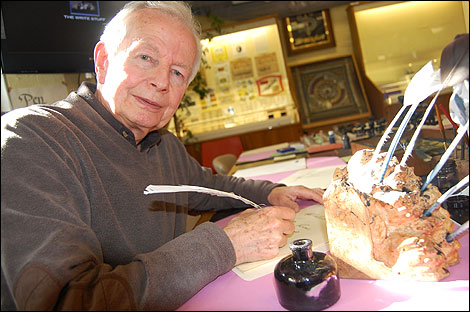 Brian Jones at the Pen Room museum Tucked away in Birmingham's Jewellery Quarter is another little gem that may have passed you by. The Pen Room on Frederick Street is a living museum set in a Victorian pen factory, dedicated to the pen trade. 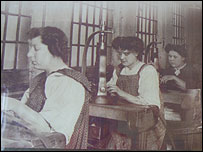 Women work on the presses Birmingham was the centre of the world pen trade for more than a century, with most pens made in the 19th century being produced in Birmingham. During its heyday there were more than 100 companies manufacturing pens in the city. The trade employed thousands of people, pioneered craftsmanship, manufacturing processes and provided employment opportunities especially for women. 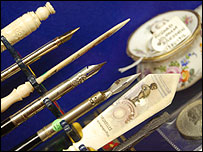 Pen nibs and holders Women workers"All the operatives at the presses were women, they had to make 18000 pens a day," says Brian Jones, Vice President and one of the founders of The Pen Room. "They could earn up to seven shillings a week, but there were rules of course, no talking, no singing, no wasting the metal, no being late or you lost money." "The men were the tool makers and looked after the furnaces but the actual production staff was women. It was unusual to have such a mass employment of women in one occupation. 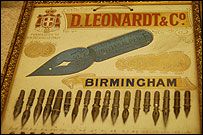 Leonardt - A Birmingham pen-maker Acids, burns and injuries"It wasn't easy for women to get work in those days. Men weren't keen to see them earning in case they earned more than they did. In the late 19th century children were employed, 10, 11, 12 year-olds, ironic really in some ways as there they were producing things for the pen industry and they were illiterate, or semi-literate at best. The poor kids did horrible nasty things with acids, getting burns and injuries." 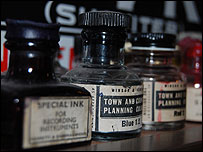 Ink bottles Brian Jones is one of twenty or so volunteers that keep the Pen Museum alive with 19th century tales made all the more atmospheric by actually being told inside The Albert Works, the very place where women toiled to produce thousands of pen nibs for world wide export. The building is a Lombardic renaissance Italian style building built in 1863 as a pen factory. Originally called the Albert works, a sister factory the Victoria works was across the road. When the silversmiths came into the area it became the Argent Centre. Education and literacyThe availability of cheap pens accelerated the development of education and literacy throughout the world, and Birmingham, as the city of a thousand trades was at the centre. 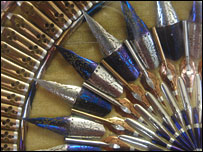 Intricate filigree pen nibs Up to that time metal pens had been quite crude things and fairly expensive about half a crown each. A city of a thousand tradesBirmingham has very few natural resources but the Black country has iron, coal limestone, and canals that could bring the materials into Birmingham. And the real key to Birmingham's domination of the pen trade were the skilled workers says Brian: "The workers had acquired skills, in particular with small metalware. At the time buttons and buckles were all being made here. 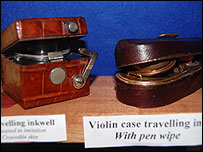 Travelling inkwells "We're talking about a city of a thousand trades and throughout the industrial revolution Birmingham had been developing, especially on the handpress which is one of the most important machines of the industrial revolution in Birmingham. The handpress meant they could make more than 100,000 varieties of pen here in Birmingham." Enter the biroBy the end of the 19th century the number of manufacturers had declined to just 12. Laslo Biro's ballpoint pen invention in 1938 had sounded the death knell for such mass production of traditional pen nibs. 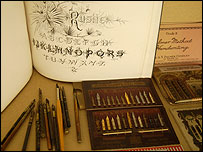 Calligraphy "Labour was so cheap," says Brian" but they never really advanced the technology too much. By 1950 the biro became very cheap and the pen trade went into steep decline." This fascinating part of Birmingham's history is preserved in the Pen Room, where all kinds of writing equipment is available in a hands-on environment. Try your hand at writing with a quill, calligraphy, and go through the production process of making a pen nib. "It's an amazing experience," say Brian "it's unfortunate that we called ourselves the Pen Room, people get the feeling its one little room. As a family it's a great experience, there's a lot of hands on stuff that’s interactive that you can do. You can write with a quill or a pen, you can do things with slate, trails, make a pen, learn braille - you can spend hours here." 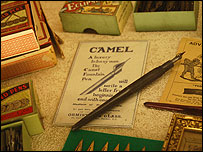 Camel pen Brian and his colleagues certainly bring the history of the pen trade to life and have numerous fascinating stories such as the how a Turkish bath originally operated on the roof of the pen factory using recycled steam from the production processes. Or how Rip Van winkle, written by American Washington Irving was written right here in Birmingham. As for Brian Jones, himself an author, he too chooses to keep the heritage alive and write with a traditional pen rather than a biro, "I do write with a fountain pen, not a quill though. I'm not that eccentric," he laughs. 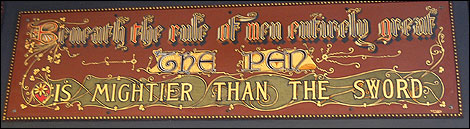 The pen is mightier than the sword Visit The Pen RoomThe Pen Room, 0121 236 9834 Mon- Sat 11am - 4pm Admission is free, but donations are gratefully accepted. last updated: 27/03/2009 at 13:50 SEE ALSOYou are in: Birmingham > History > Local History > The pen is mightier    Nature in Birmingham |
| | About the BBC | Help | Terms of Use | Privacy & Cookies Policy |
