 | 28 October 2014 |

| |
| BBC Homepage | | |
| |||
| Contact Us | | |
Community featuresYou are in: Birmingham > Your Community > Community features > Dub poetry explosion 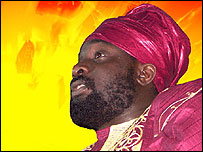 Kokumo Dub poetry explosionBirmingham dub poet Kokumo tells Dr Eric Doumerc how the spoken word is currently taking off in Jamaica. Dr Eric Doumerc is studying Black British performance poetry and looks at poets in Birmingham who have Caribbean heritage. Here he interviews Birmingham-based poet Kokumo. Eric Doumerc: The last time we met, you told me your Rastafarian way of life and beliefs were important to you. There are various Rastafarian sects: the Twelve Tribes of Israel, the Ethiopian World Federation, the Bobo Dreads...Kokumo: I'm part of the Bobo Ashanti. Well, as you can see , the visual representation of wearing a turban, that is one of the main connotations. So you can easily identify a Bobo Ashanti by his turban and so on... Eric Doumerc: And his staff as well?K: And his staff as well! It is a very important part of the grounding as well. ED: Is it the most popular branch of Rastafarianism in Jamaica now?K: I think it is now, I think it is. It wasn't certainly in the 1980s and the 1990s coming up, it wasn't. But I think there has been a kind of surge of the movement. I think it's probably because of the popularity of people like Sizzla, Capleton, Anthony B who've embraced that particular sect. So it has created a kind of surge within the young Rastafarians to become a part of what is seen as militant even though I don't think Bobo Ashanti was seen as the most militant of all. The Nyabinghis were more of a militant sect but I think now the Bobo Ashanti feel that. ED: Are the Bobo Ashanti accepted by the authorities in Jamaica?K: I think they are tolerated; accepted? No. There is still this continuous struggle with authority and one of the main problems for that is the use of the holy sacrament - the herb or marijuana. That still is a big problem, a major problem.  Kokumo - a cultural activist The problem is accepting the system, the Babylonian system. The ways of the Jamaican élite are still there so therefore accepting Rastafari, I don't think Jamaica is ready for that. ED: If you had to sum up the differences between a Twelve Tribes dread and a Bobo Dread, what would these differences be?K: Well, first we drop the dread thing! I think that, apart from the visual representation, I think that the Twelve Tribes are a bit more subtle and a bit more tolerant to certain behaviour or certain systems. To me, they're easier to assimilate or to allow assimilation. With the Bobo Ashanti, we see ourselves as trying to portray this visual image of the positiveness of Rastafari and I think that's what we do. Yes, the militancy is there through the music, through the spoken word. ED: In terms of doctrine, with the Bobo Ashantis and Twelve Tribes, do you all believe in the same god?K: Yes, the basic principles are the same. It is more a matter of representation. The Twelve Tribes were basically formed by what we call middle-class Jamaican youths, privileged, so they were not from the ghetto, so it was a difference. But the important thing that happened was that they allowed some level of acceptance in Jamaican society because most of those guys were privileged to go to university and, even though their parents weren't happy with they're coming on with dreads and stuff like that, they were happy with them having a degree so that was acceptable. So they made their way into professional positions. They created a kind of middle ground. ED: Is it harder to maintain your Rastafarian way of life now that you're in the UK?K: Well, the movement has been tarnished with negative stereotypes, we know that, but I think in today's modern society there is a level of acceptance. So on the surface I don't see a problem, but underneath or behind it might mean that people will have second thoughts but personally I don't think it has affected me in any way. 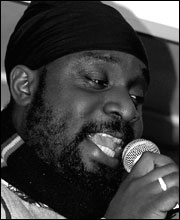 Dub poet Kokumo ED: Your poem entitled "A One Jamaikan Dis" obviously tackles the issue of racial stereotyping.K: What happened was that, you know, I was on the radio, and there was a presenter, and she was supposed to be doing Caribbean news, and unfortunately it was mainly news coming from Jamaica, and in some way, she was kind of reinforcing all the negative stereotypes. So I ended up writing a letter to the chairman, saying I'm disgusted with this. Most of the portrayal on television of what's coming out of Jamaica is negative. I remember there was a film, called The Yardies or whatever, that came out on Channel Four, and it was fuelling all those stereotypes. So that's how that piece came about. ED: You also wrote a nostalgic piece about Jamaica called "Nu Weh Nu Betta Dan Yard". Tell me about that phrase, because I've heard it in many songs.K: Yes, it's been used in so many songs, because there was a song by Ras Karbi using that phrase. It was part of the Popular Song Contest. ED: You're not only a poet, but also a recording artiste. You released a CD entitled Writing's On The Wall. Tell me about the recording process.K: It was recorded here, at Earth Studio, in Birmingham and the guys on the CD were guys I went to college with and we've been kind of jamming and gigging for quite some time; one of the musicians said that I should record an album. So I took the initiative and went into the studio. ED: The title track, "Writing's on the Wall", is obviously a heart-felt piece and a beautiful folk song.K: If there's a topical issue in the news then I feel there's a need to reflect that and "Writing's on the Wall" very much reflects that. There was a famine in Malawi at the time and the Sudan issue came afterwards. ED: The first track on the CD, "Wounded Soldiers", is a powerful piece of political commentary.K: It's a reflection on the whole war situation in Iraq because it was a question of what are we fighting for, how are we gonna benefit as individuals, as persons. 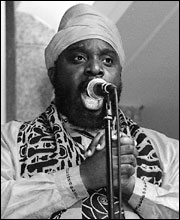 Kokumo ED: You've also recorded a CD single with Yasus Afari, the famous Jamaican dub poet (currently the dub poet in residence at City College, Birmingham). How did you hook up with Yasus Afari?K: I wanted to go back to Jamaica to find out about the dub poetry scene and he became one of my first points of contact. So we did a couple of workshops in schools and then I ended up performing at "Poetry in Motion", his annual poetry event in Mandeville. So when I went back to Jamaica for the Calabash festival, he said that I had to record something before going back to England. ED: The track is entitled "Set it Off". Why such a title?K: It's a slang. It means that we want to create an explosion and if you look at the cover, you see a fire and some flames, so it was that kind of thing. ED: On the track you also use the phrase "bus' out" which reminded me of one of Okuonuora's poems.K: Yes, he's got a piece called "Bus' Out" and I actually love that piece because in one of my poems I wrote "I want to bus' out like Okuonuora". ED: Is dub poetry "exploding" in Jamaica now?K: It is! And that track is fitting, you know, because the American TV channel BET, they have done some work in Jamaica with the dub poetry scene, people like Yasus, and some of the younger guys coming through and they're estimating some two million viewers, so it's huge! All I can say is that dub poetry is certainly "bussing out " in Jamaica right now! ED: Well, thank you, Kokumo!K: Thank you! last updated: 06/12/07 You are in: Birmingham > Your Community > Community features > Dub poetry explosion [an error occurred while processing this directive] |
| | About the BBC | Help | Terms of Use | Privacy & Cookies Policy |
