| 13 November 2014 |

| |
| BBC Homepage | | |
| |||
| Contact Us | | |
FeaturesYou are in: Birmingham > Faith > Features > An introduction to Islam 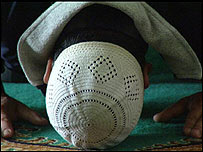 Muslim man praying An introduction to IslamIslam began in Arabia and was revealed to humanity by the Prophet Muhammad (peace be upon him). Those who follow Islam are called Muslims. Muslims believe that there is only one God (Allah). About Islam"Islam" is an Arabic word which means surrendering oneself to the will of God, and achieving peace and security by doing so. A person surrenders to the will of Allah by living and thinking in the way Allah has instructed. 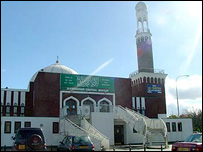 Central Mosque in Birmingham AllahAllah is the name Muslims use for God. The heart of faith for all Muslims is obedience to Allah's will. The Five Pillars of IslamEvery Muslim must perform the duties known as the Five Pillars of Islam. The Five Pillars of Islam are the five obligations that every Muslim must satisfy in order to live a good and responsible life according to Islam. Read more about the Five Pillars of Islam. 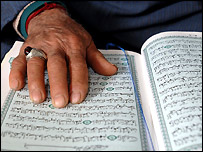 The Qur'anThe Muslim holy book is called the Qur'an, which Muslims regard as the unaltered word of God. It is the word of Allah (God) as told to the prophet Muhammad (Peace be upon him). Place of WorshipMosques are buildings where Muslims gather together to learn about their religion and worship. The buildings often have a domed roof and a tall tower called a minaret. Muslims are called to prayer from the minaret. The man who calls them to prayer is called a muezzin. There are no pictures or statues in a mosque. They are decorated with patterns and words from the Qur'an. 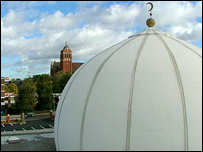 Central Mosque in Birmingham Muslims use prayer mats for prayer, so there is little furniture in a Mosque. Muslims go to the mosque on Fridays - a special day for prayer. When people go into the mosque they take off their shoes. This is to keep it clean for prayer. There is often a fountain or pool, or at least an area with water where people can wash. There is always a quibla wall which faces Makkah (Mecca), it has an empty arch to signify the direction. Large mosques might have an Imam, a prayer leader. If they do not have one any adult male may lead the prayers. 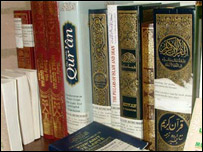 Religious Islamic books Muslim artefactsThe Tigiyha - Male Muslim headwareMany Muslim men wear the tigyha to hold their hair in place while they pray. It is white, crocheted cotton. The Subha - Muslim Prayer BeadsThe subha is made up of three sets of thirty-three beads and one large one, making one hundred in total. They are often made from wood or plastic. The ninety-nine beads are used to say the ninty-nine names for God during prayer. Muslims consider that repeating his name over and over brings them closer to God. They would call him by names such as; the Wise, the Compassionate, the Merciful, the Good or the Eternal. 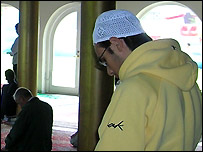 Muslim man praying in a mosque Musalla - Prayer rugThe musalla may be an area, room or prayer rug used by Muslims to provide a clean space to pray. When praying towards the direction of Mecca, Muslims pray by reciting various verses of the Holy Qur'an whilst standing, bowing and prostrating themselves with the thought that God is in front of them. Festivals and holy daysEid ul-FitrAt the end of Ramadan which is a 29 or 30 day fast, there is a big celebration. Muslims go to the mosque to pray together. Special celebration meals are served. Everyone has a holiday and it's a time when families get together. Children are given sweets, presents and often new clothes. Muslims send cards to each other to celebrate this special time. They often make offerings to the poor and sometimes buy each other presents. 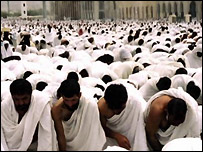 Eid-ul-AdhaEid Ul Adha marks the end of Hajj (the Muslims formal pilgrimage to Mecca). During the end of the Hajj period, Muslims sacrifice either a goat or sheep which signifies the time when Prophet Abraham was about to sacrifice his own son to prove obedience to God, but God replaced his son with an animal. A Muslim must perform the Hajj at least once in their lifetime. Find out more from BBC Religion and Ethics. last updated: 25/08/2009 at 14:30 You are in: Birmingham > Faith > Features > An introduction to Islam 
Podcast[an error occurred while processing this directive] |
| | About the BBC | Help | Terms of Use | Privacy & Cookies Policy |