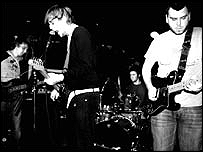
I could tell I was going to like these boys. Anyone who chooses the Goose in Selly Oak as their meeting place is alright by me. £1.70 a pint? How about we do an interview every night? It’s a Thursday and the pub’s reasonably busy. It's smattered with light conversation, faded student jeans and paint splattered workman jackets. My eye found the band straight away, huddled around a small table towards the back of the pub. I knew they were Computer Club. How? Because there was four of them. And they had good hair. I seamlessly slipped into their mesh of denim, hoody and leather. I was given the impression that late night chats around a criminally cheap beer were regular fare for Computer Club. I was never as much interviewing a band as I was acting as the trigger for random conversations about personal memories, both of a recent and distant nature.  | | Paul Hampton does his stuff |
For instance, I asked the mundane yet necessary question about the origins of the band. Synth-boyGuitarist Jon explains that himself and front man Paul were in a band and needed a bassist and a drummer. Cross (he points across the table to the blond and bespectacled Matthew Cross) filled the bass slot while Steve took up the sticks. "Actually, I had two separate emails from two different people both recommending Steve as a drummer," adds Paul. Mundane question asked, mundane answer given. Cue random tangent. "Do you remember synth-boy?" queries Jon. The Killers had just got big and the band had wanted to experiment with a synthesizer. "We thought it would be something that would set us apart. This guy turned up with this Clavinova type thing and just played grand piano stuff." The rest of the band chuckle at the memory, all adding their own interpretations. 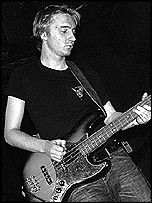 | | Bass guitarist Matt Cross |
Jon then casually adds: "Of course, we had to get rid of our original bass player." You dumped your bass player? "Yeah, he wasn’t very good and we really wanted Cross to join. We just started inviting him to practices and not actively inviting the other guy." "I remember trying really hard to impress Cross," says Steve. "Like really concentrating. The first bassist is in another band now and we’re all good friends." Stella StarrAnyway, what was the original question? "Oh yeah, so we needed a name and we were in the Gunny’s one night and drinking Stella," Steve refers to the Gun Barrels pub in its colloquial form, they are local boys after all. "So we thought of Stella Starr, and we even added an extra ‘r’." Jon puts down his pint and picks up the story. "Then the next thing you know we are reading The Fly and a band called Stella Starr have an album out, they had the extra ‘r’ and everything." So they went with Computer Club, which stems from the "I heart NY" T-shirts which acted as a beacon of the recent 80s revival in high-street fashion. Just swap the NY for a CC and you get the idea. 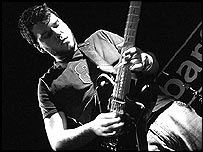 | | Guitarist Jon Baker |
Much like the T-shirts, Computer Club’s sound is full of retro 80’s guitar twangs and driving bass-drum beats. For a likeness of Paul’s vocals look no further than the Futurehead’s Barry Hyde. "As soon as Paul mentioned the T-shirt idea we liked it. It was all for the merchandising. We could see T-shirts, mugs, lunch boxes, the lot," says Jon. This is a joke of course. The band isn’t famous enough to sell T-shirts or lunch boxes. Well, not in a mass produced quantity anyway. But could all that be about to change? Making an albumThe foursome huddled slightly closer together around our modestly small table. We were suddenly penguins gathering to keep warm the sacred information about to flow from their mouths. Jon adopts a sotto voce tone. "There’s this thing in the pipeline. Nothing’s signed yet, but if we can record a good sounding album then there’s big interest in Japan and the States." I pan my eyes across all four of them. Nothing but serious eyes back. If I decided to carry on listening, it was likely I would have to be killed. Steve raises his head, looks towards an imaginary point about a foot above the centre of the table and decides that something somewhere has decreed that I shall live. "We recorded three tracks with Paul Corkett – he’s done Radiohead, the Cure, Placebo – and the record company liked it. They now want a polished album in four months." Is that possible? Paul seems confident. 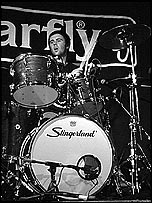 | | Drummer Steve Brookes |
"Most bands take a year and a half to record an album. We’ve got to write half an album and record it in four months, but we can do it." "This is the hardest part. We have to be willing to do our nine-to-fives then get straight into the studio," says Matt. What about the day jobs? How do they fit in? "It’s what drives me," says Jon. "The question "where do you see yourself in ten years?" makes me want to succeed. If I’m still in an office in ten years I might throw myself off a roof." The others seem to half laugh and half agree. A confusion of laughter at the nine-to-five banality and dread of never escaping their working stiff Groundhog days. In short: Office work does not a happy Computer Club make. Fan factorBeyond their tightly knit indie-pop exterior Computer Club possess a talkative charm which has been embraced by local music fans. I felt their eagerness to talk to pretty much anyone and their fan-base seem appreciative of it as well. A minibus of people will often follow them down to London whenever they play there. These are real fans as well, not friends, siblings and workmates, but actual music fans who have embraced their style. "We’ll talk to anyone because we want to have a good time and chat with people after gigs," says Paul, who promptly disappears to re-beer himself. In true form the band take a conversational detour and debate the best place they’ve played at in London. 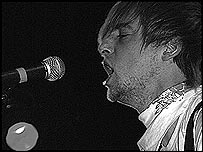 | | Frontman Paul Hampton |
"I preferred Water Rats but the Dublin Castle was probably the most famous place we’ve played," says Jon. A min-argument ensues, not everyone agrees. Paul returns with beer in hand. "The Dublin Castle? No chance, it’s definitely Water Rats." CompromiseAnd that’s Computer Club. So many opinions that exist through co-operation. Styles that exist through compromise. For instance, after being repeatedly compared to Bloc Party, the band simply shifted styles. "We asked ourselves, "do we sound too much like Bloc Party?" so we started writing new stuff," Jon explains. "There’s nothing wrong with being influenced by someone but you don’t want to be labelled a rip-off band." The only labels these boys have to look out for are of the record variety, and they could be demanding Computer Club’s signature sooner rather than later. Computer Club will be playing the Hoxton Square Bar in London on March 13th 2007 and will return to Brum to play the Jug of Ale on March 21st and Barfly on April 21st 2007. Check out their website www.myspace.com/iheartcc for more details. |