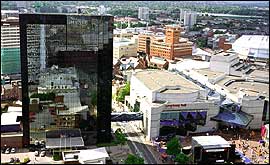
Birmingham has invested heavily in its arts and culture for decades - more than £3 billion over the last 25 years and now more than £80 million annually. The artistic strengths of Birmingham and the region are unrivalled: the City of Birmingham Symphony Orchestra, the Royal Shakespeare Company and Birmingham Royal Ballet; the region's great galleries - the Barber Institute, the Ikon Gallery, the New Art Gallery Walsall; and impressive venues that include the world acclaimed Symphony Hall, the Hippodrome Theatre and The Drum, one of the UK's biggest African, Asian and Caribbean arts centres.
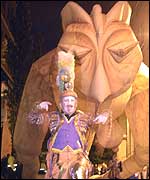 Birmingham's cultural diversity is reflected in the arts: the city is the centre of the Asian music industry, the UK centre for Garage Music and the base for the UK's first South Asian Music Performance and Dance company, SAMPAD. The city celebrates its artistic culture with annual festivals of jazz, comedy, poetry, film, literature and television and not forgetting ArtsFest, an annual arts showcase with the UK's largest concentration of free events.
Birmingham is a city with a passion for sport and Birmingham was awarded the title 'European City of Sport for All' in 1991. Today the region is recognised as a world centre for sport: attracting top events and welcoming the world's best sporting talent and their thousands of enthusiastic supporters to its outstanding venues.
The region successfully  hosts events: The Ryder Cup at the Belfry, The Davis Cup at the National Indoor Arena, Test match cricket at Edgbaston and world championships in gymnastics, netball, table tennis, indoor athletics, judo, archery and even wall climbing. Birmingham recently hosted the World Indoor Championships in Athletics and the World Badminton Championships in 2003.
Birmingham is a city of world cultures: over the decades, successive waves of new people have emigrated to the region from across the globe, bringing with them new talents and skills.The mix of heritage and cultures of these people has formed the distinctiveness of the West Midlands.
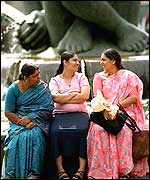 Today, Birmingham is the most culturally mixed city in the UK, a fact which is reflected in many of the region's strengths.
The people of the West Midlands take pride in their cultural heritage, the continual fusion of cultures in the region has created a unique community - our diversity is our strength.
The region of the West Midlands has a distinctive heritage of creativity and innovation in design and manufacturing. Birmingham became known as the City of a Thousand Trades, a title which came about from the thousands of many talented crafts people who worked in the city.
Birmingham's historic Jewellery Quarter is now the largest jewellery making centre in Europe, while Birmingham's School of Jewellery is the first purpose-built jewellery school to be established in Europe for over 20 years.
We are now about to witness the regeneration of Birmingham's Eastside, which includes a vast new creative district, a home for media companies and artists that will continue Birmingham's great creative economy.
Birmingham is responsible for some outstanding innovations in education. In fact, it's seen some of the fastest improvements in educational standards in the nation. Arts education has featured strongly in this success. Working directly in schools and immersing the young in creativity, all 14 West Midlands education authorities ran the Year of Arts, bringing new opportunities for teachers as artists and helping to develop an artist-led city of learning.
 The University of the First Age was conceived and born in Birmingham and is now being replicated in other parts of the country. And the city annually runs Gallery 37, a programme to train young unemployed people in craft skills. 2003: Year of Lifelong Learning is Birmingham's biggest celebration for learning. It is organised with two aims in mind, to raise aspirations forlearning in the city and to celebrate Birmingham as the learning city.
As learning is a key aspect of Birmingham's European Capital of Culture 2008 bid, the 2003: Year of Lifelong Learning campaign will highlight the strength of the city's learners and providers and promote Birmingham as the learning city.
Birmingham and the West Midlands is a mosaic of urban and green spaces. There are more acres of 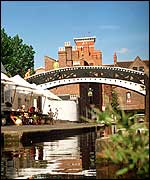 parks and open space in Birmingham than any other UK city, there are eleven National Nature Reserves in the region and the city's Parks Department is blooming having won 14 consecutive Gold Medals at the Chelsea Flower Show. British Waterways promotes Birmingham as Britain's Canal City, with an Inland Waterways Festival taking place in and around the National Indoor Arena.
- The region was once home to William Shakespeare, George Eliot, J R R Tolkien, Charles Dickens and Sir Arthur Conan Doyle. Birmingham and the West Midlands continues to be a hot-bed of talent, a small selection of famous actors and entertainers with roots in the region include: Frank Skinner, Lenny Henry, Jasper Carrot, Julie Walters, Cat Deeley, Tony Hancock, Meera Syal, Jimi Mistry, Robbie Williams, Pete Waterman, Ozzy Osbourne, Led Zeppelin, Ocean Colour Scene, Charles Dance, Goldie, Neil Morrissey, Mark Williams (The Fast Show), Pato Banton, Trevor Eve, Benjamin Zephaniah and Josie Lawrence. Future stars include James and Oliver Phelps (the Weasley twins in the Harry Potter films)
- The Triennial Music Festival, first held in Birmingham during the 19th century, commissioned new works from Mendelssohn, Dvorak, Elgar and Grieg. Sir Edward Elgar was the first conductor of the City of Birmingham Symphony Orchestra. In 2002, the CBSO in its new home of Symphony Hall and under the direction of Sakari Oramo won the most prestigious Record of the Year award at the classical music 'Oscars', the Gramophone Awards. They beat the Berlin Philharmonic, conducted by Oramo's CBSO predecessor Sir Simon Rattle.
- Birmingham Museum and Art Gallery holds one of the world's largest and finest collections of Pre-Raphaelite art. An exhibition of work by the Birmingham-born Edward Burne-Jones, staged jointly with New York and Paris attracted more than 400,000 visitors.
- Oscar Deutsch opened his first Odeon cinema in Birmingham. Now Star City has the UK's largest cinema complex with 30 screens. Six screens are devoted to Asian films, making this the largest Bollywood movie centre in Europe. The Star City complex will soon also boast the UK's largest casino with 40 gaming tables.
- Birmingham is the centre of the UK's Asian music industry, producing almost 90 per cent of bhangra music.
- The Royal Shakespeare Company performs more plays to more people than any other company in the world.