| 24 September 2014 |

| |
| BBC Homepage | | |
| |||
| Contact Us | | |
Local HistoryYou are in: Berkshire > History > Local History > The Real Ballad of Reading Gaol 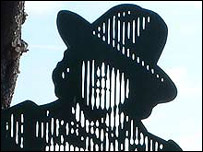 Oscar Wilde memorial gate in Reading The Real Ballad of Reading GaolIt's arguably Reading's most famous building, thanks largely to a poem written from within its walls by Oscar Wilde. But how much do you know about the history of Reading Gaol? Henry Kelly embarks on an educational journey through the prison. When BBC Radio Berkshire's Henry Kelly visited Reading Gaol, now called The Reading Young Offenders Institute, he learnt all about Oscar Wilde's stay, Irish nationalists, the gallows and much more. Listen and read excerpts from his experience below.
Help playing audio/video Leading him round is Anthony Stokes, a senior prison officer and author of Pit Of Shame - The Real Ballad of Reading Gaol. Anthony: "We're standing on a graveyard from the Abbey Ruins - we're at the exit of the actual pedestrian entrance, this is where visitors come into jail and then be allowed into this part." 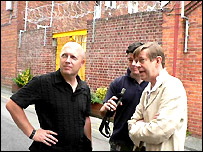 Anthony Stokes and Henry Kelly at Reading Gaol Anthony: "If you look behind you that's where the actual female, or E wing, was and that's where we held all the Irish prisoners and everything else after 1916." Anthony: "One of the beautiful things about Victorian architecture was that everything was built in a perfect compass. B Wing is pointing exactly south, D Wing is pointing exactly north, A wing to the east, C Wing to the west.
"It's designed in such a way that from the gate, every gate that would have been opened you can look straight through the jail." Anthony: "We're now standing in front of the Victorian part of the prison. The Portacabins you can see to your right is actually on the place of the old photographic house, that's where they executed from 1868." Anthony: "In 1877 when they executed the two Tidbury brothers, Henry and Francis, was the one and only time the local press were allowed in to watch an execution. And in the local newspaper the Reading Mercury there's a full and definitive account of the whole process." 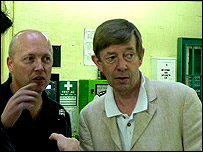 Anthony Stokes and Henry Kelly at Reading Gaol "In the D Wing, this is also the entrance to the 'condemned' wing. From 1900 to 1913 this is where we held prisoners for the last two weeks of their life under sentence of death." Henry: "We have come into a typical cell. Narrow, it is about seven or eight feet wide, two bunks, a television, a proper loo, there isn't a tremendous view." Anthony: "When I first came here in '88 we actually had no in-cell sanitation. When the prison was first built, it was built with in-cell sanitation, and then under the Segment Of Cane act in 1865: Hard fare, hard labour, hard bed - it was actually all taken out." Henry: "We look up to the landing I see a red door, it's the cell of a rather famous prisoner Oscar Fingal O'Flahertie Wills Wilde." 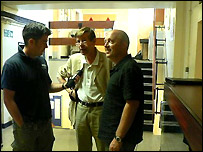 Producer Graham McKechnie records the conversation (In the graveyard) Anthony: "We've got Thomas Jennings executed on 22 March 1845, then you've got a gap of 16 ft 1 to the next grave of William Spicer. Now the reason why there's such a large gap is because of the foundations of the Abbey. "Under the football pitch, when they excavated that, that's where they found the bodies of the headless people from the leper colony from the Abbey times." Anthony: "This is E Wing, in Oscar Wilde's day this is where he took his first bath and had his hair cut. "This is also where we used to have the dark cells - anyone found to break the prison rules would be fed bread and water for three days and kept in a totally dark isolated cell." last updated: 31/03/2008 at 00:31 Have Your Saynigel williams roy phillips Claire VUP 'Nosy' Ann Shaw SEE ALSOYou are in: Berkshire > History > Local History > The Real Ballad of Reading Gaol
|
| | About the BBC | Help | Terms of Use | Privacy & Cookies Policy |