
Hands-on science: Two Ball Bounce

Two Ball Bounce

Two balls bounce higher than one
Here's how to get more bounce from a normal tennis ball - buddy it up with a heavier ball for twice the impact.
Drop them and stand back!
Download the Two Ball Bounce PDF(373 Kb). Adobe Acrobat is required.
Step by step
Yan's video guide
In order to see this content you need to have both Javascript enabled and Flash installed. Visit BBC Webwise for full instructions
Dr Yan shows two young visitors to the Bang Roadshow how to try the Two Ball Bounce
Checklist
| Difficulty: very low | About as simple as it gets |
| Time/effort: instant | Couldn't be much quicker |
| Hazard level: low | Bear in mind one ball will fly in a way you don't expect |

SAFETY: Use soft balls that won't hurt if they hit someone at speed.
Do this outdoors as you may well be very surprised how far one ball flies.
You need
Two balls of different weights and perhaps different sizes, for example a tennis ball and a football
What you do
Hold a ball in each hand and decide which ball weighs more (has greater mass). It might not always be the biggest.
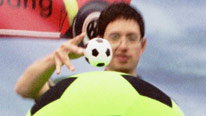
It's not size that matters here but mass
Drop the lighter ball from about shoulder height and notice how high it bounces.
Now support the same ball on top of the heavier one and hold them both out in front of you, with the lighter ball at about the same height as before.
Take both your hands away at the same time so both balls drop.
You might now need to go and ask the people next door for one of your balls back.
What should happen

The upper ball bounces away very rapidly
On the first drop, the lighter ball will not bounce as high as the level it started at.
On the second drop, everything depends on how much the two balls weigh. If the lower ball is significantly heavier than the upper one, the lighter ball will fly back very quickly and bounce much higher.
If it doesn't work for you
There's not a lot to go wrong here.
Check the two balls do indeed differ in weight and make sure that it's the lower one that's heavier.
Position the lighter upper ball centrally on the top of the heavier lower one.
Let the balls drop straight down, don't throw them.
And bear in mind that you don't need to drop from shoulder height. You can often see the effect better when the balls drop just half a metre or so.
What's going on?
Conservation of momentum
This stunt relies on the lower ball bouncing up and hitting the upper ball while it's still on the way down.
When the two balls collide with each other, some of the upward motion of the lower ball is transferred to the upper one.
So the upper ball rebounds not just with its normal (hitting the floor) bounce but also with an extra shove from the lower ball.
The principle here is known as the conservation of momentum. At a simple level, momentum is the amount of motion in one direction. It's related not just to the speed of an object but also to its mass.
When the balls collide, momentum from each ball can be transferred to the other. The two balls have similar speeds but the lower one has greater mass. That means its momentum upwards overwhelms the smaller downward momentum of the lighter upper ball.
If you watch the bounce very carefully, and compare it with dropping each ball separately, you can see that not only does the lighter ball bounce more vigorously; the heavier ball bounces less vigorously as well.
Why don't they fall together?
Here's a teaser though. If gravity is the same for all objects on Earth why does the heavier ball leave the lighter ball behind during the drop?
If the two balls were the same size and shape then you might expect the balls to accelerate downwards together. Clearly that situation doesn't exist here - the two balls experience different drag with the air as they have different surface materials and sizes.
Additionally here, the air moving past the lower ball disturbs the fall of the upper one. And it's hard to ensure that the two balls get released at exactly the same moment.

BBC iD
BBC iDBBC navigation
BBC links

BBC © 2014The BBC is not responsible for the content of external sites. Read more.
This page is best viewed in an up-to-date web browser with style sheets (CSS) enabled. While you will be able to view the content of this page in your current browser, you will not be able to get the full visual experience. Please consider upgrading your browser software or enabling style sheets (CSS) if you are able to do so.

