
Hands-on science: Swap Shot

Swap Shot

Layered not stirred
Vodka and cranberry juice is a classic mixed drink. But here's a pub trick where they don't mix – they swap places.
You don't have to use alcoholic drinks for this demonstration. Water and a sugary juice can work just as well.
Download the Swap Shot PDF (372 Kb). Adobe Acrobat is required.
Step by step
Yan's video guide
In order to see this content you need to have both Javascript enabled and Flash installed. Visit BBC Webwise for full instructions
Dr Yan shows you how to give Swap Shot a go
Checklist
| Difficulty: low | Simple on a steady table |
| Time/effort: wait for it | Takes at least 20 minutes |
| Hazard level: none | But please be sensible with alcohol |

WARNING: There's no risk carrying out this activity but if you are under 18 you must get permission if you want to try it using alcoholic drinks.
Sugary fruit juices (in the upside down glass) and water (lower glass) work as an alternative.
You need
Two identical 'shot' glasses
A strong alcoholic spirit eg vodka, brandy, whisky
Water or a see-through fruit juice like apple
A thin piece of plastic or shiny-surfaced card, large enough to be a lid on one of the glasses
A steady bench or table top
What you do
On a steady surface, fill one shot glass right to the brim with the spirit.
Fill the second shot glass right to the brim with the water or fruit juice.
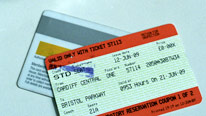
A train ticket or a plastic card like a membership card make a handy divider
Put the card on top of the second (water or juice) glass and hold it there with your fingers.
Turn the card and glass upside down – the liquid won't fall out if you keep pressing on the card – and carefully place them on top of the first shot glass. The card is now sandwiched between two glasses that are brim to brim.
Hold the top glass in place while you gently slide the card that's in between them just a little bit to one side. Slide it until there's a small gap, just 1mm or so, between the edge of the card and the inside edge where the two glasses touch.
Wait and watch what happens over the next 20–30 minutes.
What should happen
Once you open up a gap so the two liquids are in contact, you can see the liquids flowing through each other and collecting at the very top and very bottom.
If the table top is level and not much liquid leaks out, the two drinks swap places completely. The bottom glass will be water or juice. The top glass will be alcohol.
If it doesn't work for you
Check for air bubbles in both glasses before you start the swap going. Try not to lose any liquid from the top glass when you turn it upside down.
The gap that you open up by sliding the card aside needs to be big enough but not too big. Too small and nothing happens. Too large and the drinks will blend into each other.
So if it doesn't go right, have another go, but sliding the card a greater or lesser amount. Look carefully and you can see the liquids flowing as soon as the gap opens up. Keep the gap small and the trick will be slow but predictable.
Not all fruit juices work. It's best to avoid cloudy ones like orange or pineapple.
Water is the most reliable liquid to put in the top glass at the start. In which case, a spirit such as brandy or whisky will show the swap better than colourless vodka.
What's going on
Light drinks and heavy drinks
The effect is down to density, how much does an equal volume of each drink weigh? Alcohol is less dense than water so spirits can float on top of water or juices.
They don't mix because, unless they are stirred up, natural mixing of fluids is actually a very slow process.
In some combinations of liquids, mixing is also affected by their viscosity (stickiness) and whether or not the particles naturally have tiny electrical charges across them.
Out at sea
Layering of liquids happens on large scales too, not just small glasses of drink.
Fjords are coastal inlets that are open to the sea and contain sea-water. But the water at the surface can be drinkable if enough fresh water from rain or ice melt flows in. The narrow fjord slows down mixing between the less dense fresh water and the more dense salt water.
Even in the wide open ocean, there are defined layers where the salinity (amount of salt in the water) varies. The so-called thermohaline circulation of sea-water flows that have differing densities helps to drive global weather patterns.
BBC iD
BBC iDBBC navigation
BBC links

BBC © 2014The BBC is not responsible for the content of external sites. Read more.
This page is best viewed in an up-to-date web browser with style sheets (CSS) enabled. While you will be able to view the content of this page in your current browser, you will not be able to get the full visual experience. Please consider upgrading your browser software or enabling style sheets (CSS) if you are able to do so.

