
Hands-on science: Straw Submarine

Straw Submarine

Control a submarine.
Join Dr Yan in creating and controlling your very own submarine. This might be the only submarine license you ever get - don't let the opportunity float away.
Step by step
Yan's video guide
In order to see this content you need to have both Javascript enabled and Flash installed. Visit BBC Webwise for full instructions
Dr Yan shows you how to create and control your very own submarine.
Checklist
| Difficulty: low | Simple |
| Time/effort: A little bit of elbow grease | Prepare your bottle and straw and then it's all engines go |
| Hazard level: low | Careful with the scissors |
You need
A 2L drinks bottle filled with tap water
A plastic drinking straw
Scissors
Sticky-tack
A cup of water
What you do

The submarine should first sink and then float in the cup of water
Cut a piece of your straw, roughly 5 - 7cm long.
Plug both ends of the straw with quite a lot of sticky-tack.
Drop the sub into the cup of water. Make sure it's heavy enough to sink.
Take the sub out of the cup and remove some sticky-tack before testing it in the cup again.
Keep repeating this process until the sub starts to sink, and then rises and rests at the top. (see image)
Make sure your 2L bottle is flat on a table and not being knocked or turned upside down.
Put your submarine into the bottle of water. Replace the cap.
Let it settle for a moment and then hold the bottle with both hands and squeeze.
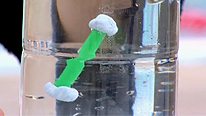
Drive the submarine to where you want it
Increase and relax the pressure you're applying to the bottle. Observe how this changes the movement of the sub.
Pick a spot in the bottle and aim to drive your submarine there.
See if you can park the submarine at your chosen spot. Don't let it move up, or down.
Congratulations, you have your submarine license.
What should happen
As you apply pressure to the bottle, the submarine will travel down through the water. When you release this pressure, it will make its way to the top again. You can use this method to manoeuvre your submarine to exactly where you want it. Note: apply the pressure gently and patiently as the slightest force could change the buoyancy.
If it doesn't work for you
It is very important that your submarine starts off at the right density. It shouldn’t bob straight to the top of your cup nor should it sink. Make sure it moves down a little, and then travels to the surface.
Use tap water only.
Check your straw. If it has a hole in it then it might be allowing in too much air. Equally, it should be adequately plugged with the sticky-tack.
What's going on?
Diving for answers
Squeezing and releasing our hold of the bottle changes the density and the buoyancy of the straw submarine.
When in the water, the straw submarine displaces an amount of water equal to its own submerged volume. The weight of this displaced water is equal to the force that pushes the straw up through the water; the buoyant force. The buoyant force competes against the gravitational pull (weight) that is pulling the straw down. The difference between the two competing forces decides how buoyant the straw is.
and squeeze
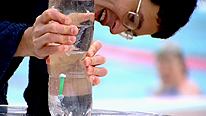
Squeezing the bottle compresses the air
When we squeeze the bottle, we’re not actually changing the water, because liquids are very hard to compress. Instead, we're compressing the air inside the straw. When the air molecules compress, the volume of the straw decreases. This means the amount of displaced water decreases, as does the buoyant force. The straw, now more dense than the water, starts to sink. It is negatively buoyant.
and release
When we release our hold of the bottle, the air molecules, no longer under pressure, expand. The expansion means the straw has extra volume, without adding more weight. The extra volume means a stronger buoyant force which in turn causes the straw to travel up the bottle. It is positively buoyant and so it will float.
and we're even
Through squeezing and releasing the bottle, we can get the straw to a stage where it has just the right amount of air in it to make the displaced water equal to gravitational pull. The straw has the same density as the water and so it doesn't head up or down. It stays in the one place. It is now neutrally buoyant.
Do I really have a submarine license?
Well…no. but you can understand how they move and that’s still something. Real submarines are made to have almost the same density as the surrounding water. They have large tanks on the side (ballasts) that can fill with water to increase the density and so cause it to sink. Equally, it can release this water and inflate the ballasts with compressed air, which lowers the density and makes the submarine float.
Salty sub, anyone?
Salt increases the water's density. Look up information on the Dead Sea to understand more on this. If you add salt to your 2L bottle then you will need to add more sticky-tack to your straw in order to make it the same density as the surrounding water.
Swot fact
A ship can hold more cargo in seawater than in fresh water.
BBC iD
BBC iDBBC navigation
BBC links

BBC © 2014The BBC is not responsible for the content of external sites. Read more.
This page is best viewed in an up-to-date web browser with style sheets (CSS) enabled. While you will be able to view the content of this page in your current browser, you will not be able to get the full visual experience. Please consider upgrading your browser software or enabling style sheets (CSS) if you are able to do so.

