
Dr Yan - Burning steel wool

Dr Yan on burning steel wool

Here's how to safely set steel wool (also called wire wool) alight using nothing more than a 9V battery.
It's not difficult but you must take care as the wool and the dish can get very hot - adult supervision required.
Step by step
Steel wool burning

Steel wool that has been set alight after touching a 9V battery.
Safety

This experiment involves fire and temperatures in excess of 1,000°C.
It’s easy to set fire to other things at this temperature, so make sure that the experiment is carried out in an ovenproof dish, and away from anything flammable. Ideally, experiment outside.
Don’t touch the sides of the bowl once the steel wool begins to burn - it gets hot. Young people will definitely need supervision.
It is very easy to accidentally set fire to all your supply of steel wool if you carelessly brush it with the battery. So keep the two well away from each other until the experiment is set up.
If you accidentally touch the entire supply of steel wool, the best thing is to quickly cover the whole thing with a fire blanket. You could also put it out with lots of water – but that’s much messier.
Checklist
| Difficulty: low | Simple, but don't rush |
| Time/effort: moderate | This might require a trip to the shops |
| Hazard level: medium | Things get very hot - adult supervision required |
You need
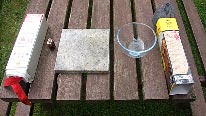
It's best to do this experiment outside.
Fine steel wool (grades 00-0000 work well, but soap-filled metal washing up scrubbing pads probably won’t work)
A heatproof dish (eg a small Pyrex oven dish)
A heatproof surface to rest the dish on (eg a heatproof dish mat)
A 9V battery
A bucket of water or fire blanket (in case of emergencies!)
What you do
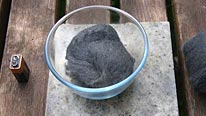
At first, be sure to keep your battery well away from the steel wool.
Set the battery down, well to one side. Take a small ball of steel wool (say 20 grammes), enough to comfortably fit inside your bowl. Depending on your wool, you may need to cut or tear some off a larger bundle.
Place the wool in the bowl, and the bowl on a stable, heatproof surface. Holding the 9V battery, lightly brush the terminals against any part of the steel wool, then take the battery and your hand away.
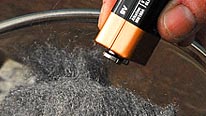
Brush the battery terminals against the steel wool.
To get the reaction really going, try blowing gently on the lit wool. Make sure you don’t blow any hot fragments of metal out of the bowl.
The bowl can get very hot, so don’t touch the sides until about 10 minutes after the reaction has stopped. Once it is cool, you can throw away the spent steel wool quite safely. The battery should have only lost a tiny amount of charge.
What should happen
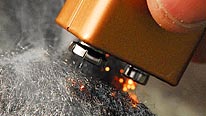
Strands of steel wool are set alight.
The electrical current from the battery should heat up a strand of steel enough to set it alight.
As the burning reaction spreads along the strand, and into other strands, it gives out a lot of heat, some of which is converted to light. So you should see little glowing areas wiggling along the strands of steel.
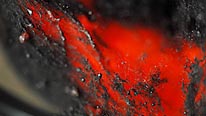
The burning spreads through the steel wool.
With gentle blowing enough heat will be produced to allow the burning to spread through most of the wool in the bowl. You may even see small blobs of metal forming, where the steel has become molten.
The burning shouldn’t give off too much smoke – any produced is likely to be from oil or other chemicals used to coat the steel wool.
You’ll be left with a mix of powdery strands, of a slightly different colour to the original steel wool. These won’t burn any more: the reaction will stop when it runs out of new strands to burn. Once the fire is out, the steel and bowl will slowly cool down.
If it doesn't work for you
Make sure the steel wool is a very fine grade.
Make sure the steel wool is dry, clean, and not rusty.
Your battery may be too weak: try a different or new battery.
What’s going on?
Oxidation
How come steel and iron burn?

Iron readily combines with water and oxygen to form rust.
In nature, you don’t normally find metals like iron or steel (which consists of mostly iron). All the steel you see around you has been extracted by humans from iron ore.
Even once it’s been extracted, iron doesn’t usually stay as pure metal for long. It combines with water and oxygen to form various iron oxides – in other words, rust.
That shows that when there’s oxygen around, the most stable state of iron is not in the form of a pure metal. It prefers to exist in combination with the oxygen, as an iron oxide.
There are various ways this can happen. One set of chemical reactions – rusting – involves water and oxygen, and can happen at room temperatures. But even if there is no water around, iron can react directly with oxygen, which generates heat. This reaction happens much more easily at high temperatures.
So as long as there’s enough oxygen around, the hotter the steel, the more likely the oxidation reaction will happen. If the heat from the reaction then builds up, it can be enough to set neighbouring areas of the steel burning too.
Surface area
Why does steel wool burn, when bigger bits of steel like nails, screws, knives and forks don’t?
It’s a combination of two factors: more availability of oxygen and easier build-up of heat.
In a lump of steel, most of the iron is inside the lump. When the steel is in very fine strands, there’s a much bigger surface area of steel in contact with the air. That means more iron is available to combine with the oxygen in the air, so a lot of heat builds up in a small area.
In fact, the steel stops burning when iron oxide builds up enough to stop oxygen getting to any more of the steel. There may well be some iron inside each burnt strand, but it can’t react because no oxygen can get to it there.
This effect of surface area effect is actually a very general principle. For example, it’s hard to set fire to wood when it’s a big log, but very easy when it’s in the form of paper. The extreme case is a very fine powder. So much of the material is in contact with the air that reactions can happen very quickly. There have been several incidents of explosions in paper mills and flour factories as a result.
But it’s not just availability of oxygen. Although air doesn’t conduct heat very well, metal does. So in a big lump of iron, the heat from a reaction is conducted away quickly into the body of the metal. That means not enough heat builds up in one place to sustain a reaction. In thin strands, the heat can’t dissipate so easily: there’s a small amount lost along the strand, but that just sets off further reactions due to the availability of oxygen there.
Short circuit
How can a battery set it on fire?
Metals conduct electricity very well, which is what happens when you touch the positive and negative terminals of a battery against the steel wool. Lots of electrical current can flow along the short lengths of steel wool which connect the terminals – you’re making what’s called a short-circuit.
Electrical current is actually just a flow of charged particles. When a lot of these move around in the wire, they basically collide with the atoms in the metal, which slows them down (it’s called electrical resistance).
Those collisions also produce heat. With a large current flowing down a small enough wire, there’s enough heat produced to set fire to things. In fact, the hotter the wire, the greater the resistance, so the wire gets hotter and hotter until it melts apart.
A similar thing happens when you use electrical items: they get hot. However, unless there’s a short-circuit, or a defect so that all the current is flowing down one thin wire, most electrical items shouldn’t get as hot as in our experiment. That’s because they are designed to have much thicker wires for a given amount of electrical current.
Burning question

Why is fire orange and yellow?
This was asked by Molly from Leicester - click the link to watch my video answer.
BBC iD
BBC iDBBC navigation
BBC links

BBC © 2014The BBC is not responsible for the content of external sites. Read more.
This page is best viewed in an up-to-date web browser with style sheets (CSS) enabled. While you will be able to view the content of this page in your current browser, you will not be able to get the full visual experience. Please consider upgrading your browser software or enabling style sheets (CSS) if you are able to do so.

