
Hands-on science: Jem's Pykrete Challange

Jem's Pykrete Challenge

Can you make the strongest pykrete in the world?
Jem has set himself another challenge - and this time it requires your help.
Step by step
Jem's video guide
In order to see this content you need to have both Javascript enabled and Flash installed. Visit BBC Webwise for full instructions
Jem has a challenge on his hands - and needs you to help him achieve it.
Checklist
| Difficulty: low | Find a suitable material and make your pykrete bars. |
| Time/effort: | The bars should be frozen for at least 12hours. |
| Hazard level: low | All frozen bars will melt - so make sure you do your tests outdoors. |
You need
An long narrow box (we used an empty cling film box, but feel free to experiment)
Water
Your special 'pykrete' material
A set of bathroom scales
What you do
Choose your material
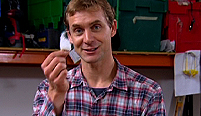
Jem uses cotton wool in one of his pykrete bars.
Jem's entries were cotton wool and grass. If you want to use these options and try and make a pykrete stronger than Jem's, go ahead. (Word of warning, Jem might expect a full mathematical explanation justifying your stronger pykrete... but don't worry, if you've made stronger pykrete then we're sure you can handle it.
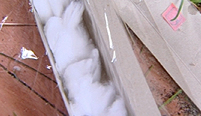
Jem used a small cling film box as a test mould.
Take a few empty narrow boxes. We used a small cling-film box (roughly 30cm in length).
Fill as much, or as little, of the boxes (your choice) with your chosen material.
You might want to make some bars of plain ice, to have something with which to compare the strength of your pykrete.
It is advisable to keep the ratio of material-to-water the same for all of your test bars, so you have clear results at the end of one round of testing. You can always change the ratio for round two.
Take your moulds over to your freezer. Place it down and then fill it with, once again, as much, or as little water as you see fit. This is your finding, your discovery and your pykrete. So go with your instinct.
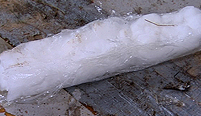
Frozen bars of cotton wool pykrete.
Leave your bars in the freezer for at least 12 hours or until they are completely frozen.
Ready. Set. Pykrete.
The Impact test
Take one bar outside.
Hold it high in the air and- throw!
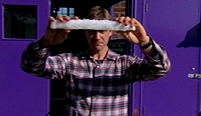
Throwing pykrete.
If it breaks straight away then you can be pretty sure that you don't want to set sail in it. However, if it doesn't break, pick it up and throw it again, this time with a little more force. Relish the moment - there aren't many times in life when your exact objective is to break something.
If your bar of pykrete still doesn't break, then you might be onto a winner. See how many throws it takes to snap ithe bar, and let us know the results.
The Strength test
Take two large books and place them on the ground, leaving enough space to fit your foot between them.
Set the bathroom scales behind the books.
Place your pykrete bar horizontally across the books.
Stand on the scales and wait for the dial to stabilise.
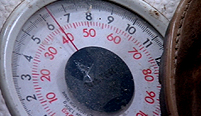
The aim is to transfer your weight from the scales to the bar.
Now, place one foot gently onto the pykrete. You can monitor how much weight you are transferring to the pykrete by seeing how much your weight decreases by on the scales. This is weight loss at its fastest!
Keeping one eye on the scales, slowly increase the weight you place on your pykrete bar. Do this until it breaks.
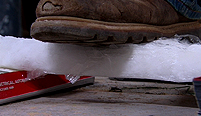
How much weight can your pykrete take?.
If it didn't break under your weight, find someone heavier and see how they do. This could be one for the whole family (not at the same time, of course). What weight could it hold? Let us know.
What should happen
Hopefully, your pykrete bars will be far stronger than your bars of plain ice. How much impact they take and the degree of their strength is something no one knows. So once you have the results, share them with us.
If it doesn't work for you
If your pykrete is as weak as, well, as ice, then it might be due to a few things. The first is that the material you have chosen just isn't right. See below for some tips on things you can try. Or it might be because of your ratio of material to water. If you feel it's worth trying again then have another go and change the ratio around eg try using more water and less material in your mould.
The challenge
Are you ready for the Jem Pykrete challenge?
As Jem mentioned in his video (above) there is no set recipe for pykrete. The world of pykrete is still an unmapped territory. So, if you're up for the challenge - have a go and help us map it! Use Jem's strength and impact tests above and if your results seem truly ground-breaking (or at least, pykrete breaking), then email us your results.
What's going on?
What's wrong with good old fashioned ice?
Ice is not as strong as pykrete because it is brittle.
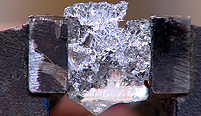
Ice cracks easily because it is brittle.
Material solids are either brittle or malleable. The property comes from the type of chemical bonds in the material. Ice is made up of a 3D crystalline structure with the water molecules interconnected by hydrogen bonds. These hydrogen bonds are relatively weak in comparison to other types of bonds, but because there are a lot of them the ice is able to form and be relatively strong.
In malleable materials, like soft metals or plasticine, the atoms or molecules are able to move under pressure and form new bonds; which means the material doesn’t break. Because water molecules in ice can only arrange into certain structures they can not form different bonds and absorb the energy of the impact. Ice isn't able to yield (stretch like toffee) before it breaks, like malleable substances can. In fact, as soon as a crack appears in ice, it is able to spread through the ice until the whole piece has shattered.
A material being brittle does not mean that it is weak. In fact, even though it is incredibly strong, diamond is a brittle material too. When diamond cutters are shaping diamonds they have to be very careful because hitting it in the wrong place could cause it to break into pieces.
Why does adding a material to ice make it stronger?
The added material increases the tensile strength of the ice.
An increase in tensile strength means that more force is required to break it. When pressure is put on the Pykrete it can distort under the pressure rather than cracking. If a crack does occur, instead of it being able to pass right through the Pykrete, it meets some of the material in the ice and comes to a dead end. It is very similar to how concrete is made (adding sand to cement to increase its toughness).
In addition to this, it is thought that Pykrete may have an element of self-healing ability. There is always a surface layer of water on ice when it is stored at anything higher than, say, around -40degrees. If a crack appears in the Pykrete, water from the surface can seep in and refreeze when it meets the colder core below the surface; effectively sealing the crack.
The added material can also help slow down the rate at which the Pykrete melts by offering a layer of insulation between the ice and the warmer air around it. This means the Pykrete is able to maintain its shape and strength for longer. Ice does not always crack suddenly but can also deform slowly under continued pressure. This is called ice creep. It is thought that the presence of the impurity might help reduce this effect.
What do the experts say?
What is the best material to add to ice for the strongest pykrete?
As Jem mentioned in his video (above) there is no set recipe for pykrete. However pykrete experts do have some advice that might help your tests>:
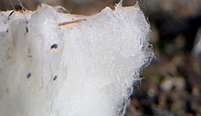
The long fibrous strands of cotton wool are ideal for pykrete.
1: The material should be absorbent. This cotton wool works well because it can soak up a lot of the water. When water freezes hydrogen bonds form between the water molecules. These bonds will form around the material, which will make the material much harder to remove from the ice. As a result, the Pykrete is stronger.
2: The longer the fibres, the better. This means, as we found in our tests, things like breadcrumbs didn't work well. However, cotton wool and hemp, amongst others, did work well (see below for more ideas).
Things to try
Here's a list of some materials that just might work for you.
Hair
Shredded paper
Woodchip
sawdust
Wool
Weetabix
BBC iD
BBC iDBBC navigation
BBC links

BBC © 2014The BBC is not responsible for the content of external sites. Read more.
This page is best viewed in an up-to-date web browser with style sheets (CSS) enabled. While you will be able to view the content of this page in your current browser, you will not be able to get the full visual experience. Please consider upgrading your browser software or enabling style sheets (CSS) if you are able to do so.

