
Hands-on science: Plugholes

Plugholes

Down the drain
Does where you are in the world affect how water goes down your plughole?
Many people say that every plughole in Britain - and all countries north of the Equator - should swirl the same way. Here's how to put the theory to the test for yourself.
Download the Plugholes PDF (377 Kb). Adobe Acrobat is required.
Step by step
Yan's video guide
In order to see this content you need to have both Javascript enabled and Flash installed. Visit BBC Webwise for full instructions
Dr Yan shows you how to investigate Plugholes scientifically
Checklist
| Difficulty: none | Just have a try |
| Time/effort: medium | Half an hour |
| Hazard level: none |
You need
A sink, ideally one with a traditional plug on a chain. Avoid the type with a plug that stays in place and tips on its side to open
A supply of water. (You could reuse washing up water or find another way to conserve tap water)
Optional: Another sink
Optional: Ground pepper or similar fine powder
What you do
Clean the plughole of any obvious muck and hair. Fill the sink with water to a depth of about 10cm and let it stand for at least 10 minutes.
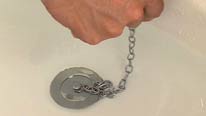
If at all possible, keep your hand out of the water when you pull the plug
Leaving it longer is worthwhile. You could fill a sink before you go out to school or work for the day.
Pull the plug out as gently and vertically as possible. It's important to minimise how much you disturb the water. Don't put your hand in.
As the water flows out, note which way it swirls.
Try it several times, perhaps with different plugholes in different places.
Tip: If it's difficult to see the direction the water is swirling, sprinkle a fine powder like pepper dust on the surface.
What should happen
The simple truth is that no matter where you are in the world, the water could go either way down your plughole and may well disappear without swirling at all.
If that doesn't happen for you
You may find that water does indeed always go down your plughole the same way. If so, you could have detected the Coriolis effect, but to be sure you need to let the water stand for at least a day. You can read more further down this page about how US and Australian physicists tested the theory in the 1960s.
Sadly the more likely explanation is that something about your sink is encouraging the water to flow in one direction.
There are plenty of reasons why your sink may favour one direction:
where the tap is (left, right or central)
whether the water is at room temperature
using your right or left hand to pull the plug.
So do what you can to repeat the experiment while changing only one thing at a time. And of course you might like to get in touch with anyone you know in a country on the other side of the world.
What's going on?
Random movements
The Earth's rotation does influence how fluids move, but has such a small effect that it's only apparent for movements over large distances or that take a long time. It plays a part in the direction that storm winds blow and ocean currents circulate.
In a typical sink at home, the spinning Earth doesn't change anything.
Instead, random currents are generated in the water when you fill and use the sink. The gentle flows around the sink end up encouraging the water to swirl one way or the other. That's why it is important during the experiment to wait at least 10 minutes for the water to settle and also why you should open the plug carefully.

Has this got you curious about any other natural phenomena? Ask Bang Goes The Theory's online experts.
Coriolis effect
So many people say that plugholes flow a different way north and south of the Equator (the line of 0° latitude around the middle of the Earth) that it's become an accepted notion. The belief is sparked by the Coriolis effect (or Coriolis force), an apparent deflection of moving objects which is related to the Earth's daily rotation on its axis.
The effect kicks in when someone on a rotating surface watches an object move across the same rotating surface. Think about spinning on a playground roundabout and throwing a ball to another rider. To people on the roundabout the ball appears to follow a curved path. Anyone on solid ground sees it go in a straight line.
The Earth spins much more slowly (once in 24 hours) so the apparent force its rotation generates only becomes significant over large distances or long times. You don't worry about the Earth's rotation when you play tennis or take a football penalty.
Finding the force
So your sink is too small and drains too quickly for the Earth's spin to control how the water flows. But the effect could possibly happen, in a big enough bath. How big?
Research done by Ascher Shapiro in the early 1960s in Boston, USA did report a tendency for water to swirl anti-clockwise (viewed from above). Scientists in Sydney, Australia copied his method and described seeing clockwise swirling.
The experimental baths were perfectly circular and nearly 2m in diameter. The water was 15cm deep and Shapiro allowed it to stand for 24 hours so that any currents from filling would die down. The plug was on the outside and could be removed without disturbing the water. A small outlet meant the water took about half an hour to drain away.
By eliminating all the other disturbances that they could, the two research teams at 42°N and 33°S of the Equator did find an apparent influence from the Coriolis effect.
BBC iD
BBC iDBBC navigation
BBC links

BBC © 2014The BBC is not responsible for the content of external sites. Read more.
This page is best viewed in an up-to-date web browser with style sheets (CSS) enabled. While you will be able to view the content of this page in your current browser, you will not be able to get the full visual experience. Please consider upgrading your browser software or enabling style sheets (CSS) if you are able to do so.

