
Hands-on science: Lightspeed

Lightspeed

The fastest thing in the Universe
Light travels incredibly quickly. But just how fast is it?
Microwaves and light waves move at the same speed, so if you have a microwave oven, you can work out the speed of light yourself.
Download the Lightspeed PDF (382 Kb). Adobe Acrobat is required.
Step by step
Yan's video guide
In order to see this content you need to have both Javascript enabled and Flash installed. Visit BBC Webwise for full instructions
Dr Yan shows you how to try Lightspeed for yourself
Checklist
| Difficulty: advanced | Some big ideas to grasp and care is needed for an accurate measurement |
| Time/effort: quite quick | There's maths help available (see list on right of this page) |
| Hazard level: very low | Follow normal microwave advice |

WARNING: All the standard guidance about microwave ovens applies here. Do not run the oven when empty or with anything metal inside.
Adults should supervise any children trying this who are not old enough to use a microwave oven on their own.
You need
A microwave oven
A plate that is microwave-safe
Possibly: a microwave-safe cereal bowl
4 similar slices of bread, as square as possible
Margarine, enough to cover the bread thickly
A buttering knife
A ruler
Pen and paper
Optional: a calculator that can cope with 10-digit numbers
Optional: download our Lightspeed Calculator spreadsheet
What you do
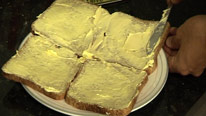
Spread margarine thickly and evenly
Place the four slices of bread on the plate in a square pattern touching each other as closely as possible.
Spread margarine thickly and evenly over the entire top surface of the bread slices and any gaps in between.
Find a way to remove the microwave oven's turntable or to stop it rotating. Often you can take everything out and put the bread plate on the base of the oven.
If your oven has a rotating drive in the base that always spins, cover it with something like an upside-down cereal bowl and balance the plate centrally on that.
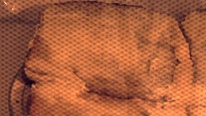
Watch closely for melt patches
With the bread inside, set the oven to run on full power for 30 seconds.
Start the oven and watch closely for areas in the margarine where it melts first. Depending on the power of your oven, melting should start after about 15 seconds.
As soon as you have three or four melted patches, stop the oven and take the plate out, without moving the bread around.
Decide where you think the centre of each melt patch is and measure the distances between adjacent patch centres. Write them down and work out the average (also termed the mean value).
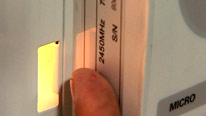
Look for a label with a figure followed by either MHz or GHz on it
Now search inside or around your microwave for a label that says what the frequency of the microwaves inside the oven is. It may be on the back of the case or just inside the door. Look for a figure followed by either MHz (for megahertz) or GHz (gigahertz). Don't worry if you can't find one as you can estimate the frequency instead.
You've finished using the oven now, so if you took things out to disable the turntable, don't forget to put them back how they were.
Lastly, prepare for some mathematics. It's straightforward multiplication but does involve very big numbers. Go to our helpful webpage that does the sums for you and has an explanation of the maths too.
What should happen
The margarine should melt in small patches. The gaps between them should be roughly 5-7cm.
Do the maths - try this help page - and the figure for light speed that you are aiming for is around 300,000,000 metres per second.
To put that another way, the speed of light is about 1 billion kilometres per hour.
If it doesn't work for you
Try as hard as you can to get an accurate measurement of the average distance between points where the margarine melts first.
Use a plate that is as flat as possible - you may find the oven's own turntable is better than a plate.
Use bread slices that are the same thickness.
Cutting the crusts off the bread slices (so they make one big slice) can help.
Don't let the margarine soften too much before you spread it. Keep it cool if you can, as long as it spreads evenly.
Be extremely careful to spread the margarine to an even thickness across all four slices of bread.
Some microwave ovens have extra functions to stir the waves around. They are designed to heat food evenly (a good idea) but the exact opposite of what you want here. If yours has a 'stirrer fan', a 'chaos mode' or something that sounds similar you may need to try a more basic oven.
You could also try melting other foods instead of margarine.
Slices of processed cheese are easy to lay out in an even pattern.
Bars of chocolate work as well, if you choose a type that's not too chunky.
If you use other foods, make sure you watch closely what's happening inside the microwave oven and be ready to stop it running.
What's going on
Mapping high energy points
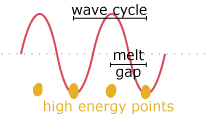
The wave is most energetic at the high and low points of the curve
Microwaves (and light) are energy waves. The waveform repeats along its length at intervals, each known as a cycle. The cycle has a wavelength. Each wave cycle has two points of high energy and two of low energy.
The points of high energy are where the margarine will melt first.
So measuring the average gap between the centres of adjacent patches gives us a distance that is half the wavelength.
The wavelength is a distance in metres, the length of one cycle.
The frequency is the number of those cycles per second.
Multiplying them together gives a figure that has units of metres per second. That means it is a measurement of speed.
Ask Yan

Heard the one about switching on the headlights of a car travelling at the speed of light? Dr Yan hits the racetrack to bring you an explanation.
BBC iD
BBC iDBBC navigation
BBC links

BBC © 2014The BBC is not responsible for the content of external sites. Read more.
This page is best viewed in an up-to-date web browser with style sheets (CSS) enabled. While you will be able to view the content of this page in your current browser, you will not be able to get the full visual experience. Please consider upgrading your browser software or enabling style sheets (CSS) if you are able to do so.

