
Hands-on science: Forensic Detective

Forensic Detective

Find a pen's fingerprint
Can you really solve a crime just by studying some ink in a note? Join Dr Yan as he uses a little forensic science to help catch a thief.
Step by step
Yan's video guide
In order to see this content you need to have both Javascript enabled and Flash installed. Visit BBC Webwise for full instructions
Dr Yan shows you how to use forensic science to solve a colourful mystery.
Checklist
| Difficulty: low | Simple |
| Time/effort: a little patience... | Takes at least 10 minutes |
| Hazard level: low | Unless someone really does nick off with your doughnuts |
You need
Absorbent paper (kitchen towel/coffee filters)
Some felt-tip pens
A tray filled with a little water (0.5 cm deep)
A table
A hand-written note
What you do
Ask someone to write you a note on some absorbent paper using one of the felt-tip pens you intend to test (don't let them tell you which one).
Ensure that the note contains an inky dot, like at the bottom of a question mark.
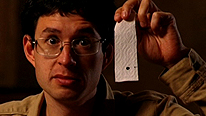
Make sure the strip has no markings on it, other than the dot
Cut a strip out of the note. This strip should be clear of any ink except that of the dot. Leave 1cm space between the dot and the bottom of the sheet (see image).
Take a clean sheet of absorbent paper. Draw three dots, using the three different felt-tip pens (hopefully including the pen used to write your note).
Leave 1cm space between each dot and between the dots and the bottom of the paper (see image).
Pour a little water into a tray (0.5cm deep is enough).
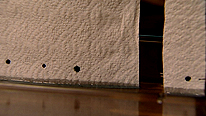
Lightly dip the paper into some shallow water
Take your sheet of suspect dots, and your strip from the note, and dip them into the water. Be careful not to let the water hit the ink directly. This is why you need the space between the ink and bottom of the paper.
Hold the paper in the water for a few minutes. The water will rise up the paper in a column, separating the ink on its way. This should create a pattern for each pen.
Compare the pattern from your tester sheet to the strip from the note. Which patterns match? Which pen was used to write the note?
Try using a range of different felt-tips. Do some colours work better then others?
What should happen
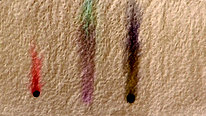
As the dyes in the ink separate, a pattern forms
As the water moves up the paper, some of the ink should move with it. Depending on the make-up of the ink, this could separate out into a number of bright colours. The pattern from the note should match a pattern created by one of the tested pens. This should be enough evidence to confirm which pen wrote your note... and maybe even help you get your stolen goods back!
If it doesn't work for you
It is important that the ink moves in a steady upward column only. If the dot itself is submerged in the water, then the ink will run and it will hamper your results.
We use felt-tip pens because they are water soluble and so will separate out in water. If you're using a ballpoint pen, or a permanent marker, water is probably not the right solution. You might need to try methylated spirit. Warning this substance is poisonous. Please ask an adult to assist.
Absorbent paper is essential. If you are trying this on ordinary paper then you are clearly too advanced for Yan and need to read onto the next section.
The paper challenge
Worth your weight in ink
Ordinary paper is not absorbent so it will not work in the water stage of this experiment. So, what do you do if your note has been written on say, a note-pad? Well, you need to transfer the ink from the note-paper to some absorbent paper, and then continue to test it as we do above.
Pull up a chair, take a deep breath, and channel your favourite TV detective. Here's what you do:
As above, use felt-tip pens and look for an inky dot in your note.
Cut this out, being careful to exclude the white bit of the paper.
Cut it up into tiny pieces and place all pieces into a spoon.
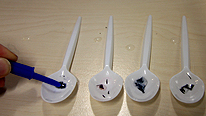
Put a drop of water into the spoons
Take the pointy end of a pen lid. Dip it into water. Hold it over the spoon and let a drop of water fall onto the inky fragments. Use the lid to mash the water and inky bits around so the water starts to becomes dark and concentrated with the ink. Leave this for a little while.
Take another sheet of paper.
Make a very inky dot with your suspected pens.
Cut out each dot and repeat the process above, for each pen. You should be left with four spoons, filled with inky water and fragments from four cut-outs.
When you have all four complete, take the (clean) lid to the first spoon and hold it in the ink and put a drop onto a piece of absorbent paper. Clean the lid and repeat for each spoon of ink.
You should have one sheet with four ink dots on it.
You're now ready to dip the bottom of the paper into a tray filled with a little water. Follow the instructions above to complete the experiment.
What's going on?
Separating compounds
It is very hard to know how many components a mixture is made of, because the parts are impossible to distinguish separately. This is where chromatography can help. Chromatography, meaning colour-writing, is a lab technique that can separate a mixture into its individual parts based on their chemical characteristics.
The idea behind this experiment’s use of paper chromatography is that as the ink is carried up the paper by the water, the different dyes in the ink will separate depending on how much they interact with the paper.
This works because some molecules, (in this case, the ink dyes) are happier in the water, while others are more attracted to the paper. As the water moves up the paper, the molecules separate based on how much they like water, or paper. The separation creates a pattern that, in Yan’s case, can be used to help identify the doughnut thief.
To catch a thief
Forensic scientists rely on chromatography to analyse fibres that are found in a crime scene. For example, if someone breaks into a house by smashing a window, there is a chance that some of the fibres from their clothing were caught on the smashed glass. If so, chromatography is used to reveal the dye pattern in the fragments, just like the pen ink in Yan’s note. If the dye pattern of the crime scene fibre matches another sample taken from a suspect's clothing, then this evidence might be enough to help identify the intruder.
Swot fact
In 1952 two British researchers, Martin and Synge, were awarded the Nobel prize for using paper chromatography to separate the amino acids in a protein.
BBC iD
BBC iDBBC navigation
BBC links

BBC © 2014The BBC is not responsible for the content of external sites. Read more.
This page is best viewed in an up-to-date web browser with style sheets (CSS) enabled. While you will be able to view the content of this page in your current browser, you will not be able to get the full visual experience. Please consider upgrading your browser software or enabling style sheets (CSS) if you are able to do so.

