
Hands-on science: Fizzy Extinguisher

Fizzy Extinguisher

A science experiment to get you all fired up.
Join Dr Yan for some fire-fighting fun.
Step by step
Yan's video guide
In order to see this content you need to have both Javascript enabled and Flash installed. Visit BBC Webwise for full instructions
Dr Yan shows you how to make your very own carbon dioxide fire extinguisher
Checklist
| Difficulty: low | Who hasn't been sprayed by a shaken bottle of fizz before? |
| Time/effort: medium | Mineral water will make less of a sticky mess |
| Hazard level: low | Be careful with lit candles |

SAFETY: This experiment involves the use of lit candles. Young children should be supervised when lighting, and extinguishing, these candles. Please ensure other materials used in this experiment are non-flammable.
You need
A bottle of fizzy drink (lemonade, mineral water)
A handful of candles (tea-lights work well)
DVD cases (10-20)
Something to light the candles with (matches/pilot light)
What you do
Find a location that offers you a bit of space and very little breeze. It should probably be indoors unless you are banking on a very warm and still day.
There are two things to aim for in this experiment: 1) To extinguish the candle flames and 2) to show that carbon dioxide (CO2) is so heavy that it can travel downhill.
In order to demonstrate the second part of the experiment, you will need to set up your candles so that they are staggered on tiny steps.
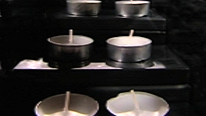
DVD cases work well when staggering the candles.
Dr Yan did this by using a number of DVD cases. Create four steps by stacking the DVD cases length ways. This can be done using one DVD case for the first step, and then two DVD cases for every step after that (see image). You will need at least five DVD cases for the necessary steps.
Use two extra cases to create a steep top step so that the CO2 won't flow backwards.
You'll also need something to stop the CO2 from escaping at the sides. Dr Yan used mirrors but more DVD cases will work just as well.
When your steps are built, add the tea-light candles. Two per step is ideal. Don't light them yet - wait until you have a fire extinguisher at the ready. Here's how you can get just that:
Take your bottle of fizzy drink and head outdoors or somewhere you can get really wet (or near someone else that you want to make really wet!).
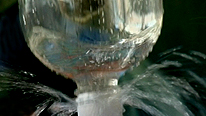
Shake the bottle and release the lid
Turn the bottle upside down, so the lid is on the bottom.
Shake it!
Now, open the lid just a tad. The fizzing liquid should be squirting out, drenching yourself and your surroundings (hopefully you're outside or at least standing in the bath!).
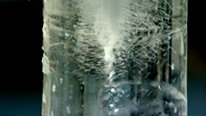
All shook up.
Keep shaking the bottle and swirling it from side to side.
Try to keep it going until all the liquid has fizzed out and then quickly tighten the lid (it will make a great hissing noise when you do this).
Emptying the bottle is quite tricky, so don't worry if you end up with a bit of liquid left inside. It shouldn't harm your experiment.
You now have a CO2 fire extinguisher!
Return to your candles (you might need to drying off first), fire extinguisher in hand, and now you can light your candles.
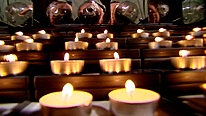
Hold the extinguisher above the lit candles.
When all the candles are lit, hold your extinguisher just above the top step. Tilt the lid down towards the candles.
Carefully open the lid... and then SQUEEZE the bottle.
What should happen
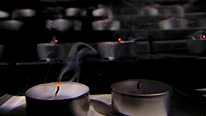
Let there be lights - out!
As you crush the bottle, the candles flames should go out - top step down to bottom step. You should feel a great sense of relief and are perhaps even toying with the idea of joining the fire brigade after all! Or you might just be thinking up a very inventive way to blow out the candles on your next birthday cake...
If it doesn't work for you
Before you open the lid, make sure the bottle is turned upside-down (lid on the bottom).
Keep shaking and swirling the bottle until the last of the liquid has fizzed out.
Try to tighten the lid quickly so you don't let too much CO2 escape.
To ensure the gas moves over your candles and doesn't escape out the sides, you should try and copy Dr Yan's set-up. Make sure that:
The steps are quite narrow. The wider they are the more chance the CO2 will move outwards rather than downwards. Equally the sides need to be blocked off. Dr Yan used mirrors but DVD cases or something similar will be just as effective. Just make sure whatever you use is non-flammable (ie no cardboard). Lastly, the top step needs to be tall enough to stop the CO2 moving backwards.
Don't create too much distance between each step. The candles should be quite close together. A difference of one to two DVDs per step is perfect.
What's going on?
Burning questions
The candle flames went out because a blanket of carbon dioxide left the bottle and covered the flames as it flowed down the steps. But how did we manage to get a 2 litre bottle full of CO2? What did shaking the lemonade have to do this with? And why did it roll over the candles in that way, extinguishing all flames as it moved? Lastly, can this be kept in the kitchen as a real CO2 fire extinguisher?
The fizz in fizzy
Well, it was all possible because we used a bottle of carbonated drink. All soft drinks contain a gas called carbon dioxide, CO2. In fact, it's the CO2 that puts the fizz in the fizzy drink and bubbles in the bubbly. There's loads of CO2 compressed into these drinks. There’s so much that, as Dr Yan said in the video, if you were to take all the CO2 out of a 2 litre bottle of lemonade, it would fill a space much greater than 2 litres.
Shake it all about
You can’t see that there's that much CO2 in the bottle, because it’s under pressure, which keeps most of the gas dissolved in the liquid. Release the pressure by opening the top, and the CO2 starts leaking out of the liquid into the atmosphere. That’s why open drinks eventually go flat. What happens when you shake it? Well, as long as you keep the lid closed, not very much. You’ll see lots of bubbles being put into the liquid, but these just gradually float to the surface, where they pop. In a few seconds, the sealed bottle is back to the state it was in before.
Growing bubbles
However, if you open the top while there are still a lot of little bubbles in there, something very different happens. The CO2 now starts to come out of the liquid. And each of these bubbles acts as a 'nucleation site' - a place where the CO2 can easily come out of the liquid and turn into gas. So each little bubble gets more CO2 in it, expands in size, and rises. Normally that sudden expansion inside the bottle shoots a load of bubbles and liquid out of the neck. But in this experiment, we've cleverly flipped the bottle upside-down. The bubbles still grow in size, forcing liquid out of the neck, but as they rise and pop, they get trapped in the bottle instead. As more liquid is squirted out of the bottom, more gas gets trapped in the top. In the end we are left with one bottle of gas-no-liquid!
Fire eater
Carbon dioxide was described in the video as an invisible and suffocating gas. This is true for a few reasons. Firstly, in great quantities it can choke people (but don’t worry - not in the amount we used). But also because CO2 actually chokes fire. That’s how it puts out flames. The carbon in the CO2 replaces the oxygen in the fire. Like people, fire needs oxygen to breathe. If you take the oxygen away, the fire cannot burn and it goes out.
CO2 is a gas that is heavier than oxygen. This means it literally falls downward as it is released from the bottle. It lands on the top of each candle like a blanket and in doing so, extinguishes all the flames.
Fireman Sam?
No, this bottle of fizz should not be mistaken for a real fire extinguisher. While it did act in a similar way (tightly packed CO2 is released into the atmosphere) there was nowhere near the quantity required to for an effective CO2 fire extinguisher that you would use to fight large (chemical) fires. A small amount of tea-light candles are just enough fire for this bottle. But don't let it stop you dreaming about sliding down poles and driving a red truck - you've got to start somewhere!
BBC iD
BBC iDBBC navigation
BBC links

BBC © 2014The BBC is not responsible for the content of external sites. Read more.
This page is best viewed in an up-to-date web browser with style sheets (CSS) enabled. While you will be able to view the content of this page in your current browser, you will not be able to get the full visual experience. Please consider upgrading your browser software or enabling style sheets (CSS) if you are able to do so.

