
Hands-on science: Egg Sucker

Egg Sucker

Science that won't leave you with egg on your face.
Dr Yan shows you how to get a whole egg into a glass bottle. A cracking experiment!
Step by step
Yan's video guide
In order to see this content you need to have both Javascript enabled and Flash installed. Visit BBC Webwise for full instructions
Dr Yan performs some eggstra-ordinary science with an egg and a bottle.
Checklist
| Difficulty: low | Just make sure you have a good supply of eggs! |
| Time/effort: | Boil and peel the eggs. |
| Hazard level: low | Careful with the boiling water. |

SAFETY: This experiment uses hot water and glass. Young children might need supervision- especially when hard boiling eggs.
You need
1 egg (at least!)
1 glass bottle/flask
Hot and cold water
What you do
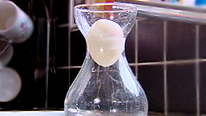
Make sure the neck isn't too narrow.
Hard boil some eggs and, once they have cooled down, peel off the shell.
Take a glass bottle or flask. Make sure the opening is only a little narrower then the middle of the egg. Test this by sitting the egg in the opening of the bottle. Half of the egg should fit in easily.
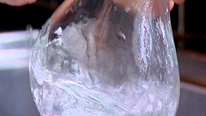
Heat up the air inside.
Remove the egg. Place the bottle under a hot tap.
Leave it there for a minute or two (but don't scold your finger's in the process!).
Swirl the hot water around the bottle and pour it out. Do this quite a few times and then turn the tap off and empty the bottle.
Sit the egg back onto the opening of the bottle.
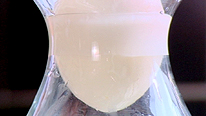
Marvel at the moving egg.
It should, slowly, start to move down the bottle. If it needs a little push, like Dr Yan's egg, take the bottle (with egg still trying to move into it) and hold it under a cold tap.
The egg should squeeze its way through the neck of the bottle and make a nice popping sound as it lands in the bottle.
What should happen
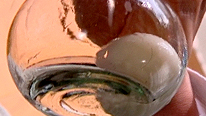
Seeing is believing: an egg in a bottle!
The egg should fall into the bottle, whole and unmarked. This situation makes a great party trick, but isn't so helpful when wanting some breakfast. So have a go at getting the egg out of the bottle. Here's how:
Turn the bottle upside down. A bot of the egg should be poking out from the neck of the bottle. Try and nudge it away from the opening and then quickly blow as hard as you can into the bottle.
The egg should pop out of the bottle. This might take a number of goes (and a good set of lungs). If not, you just might need to consider scrambled eggs instead.
If it doesn't work for you
The trick is in the bottle. If the neck of the bottle is too narrow then the egg just won't be able to go in, no matter how persuasive you are. Try a larger bottle. We found Hyacinth vases from a garden centres to be ideal as are some pear juice bottles.
Make sure you heat up the air inside the bottle. This means ensuring the tap water is hot enough and the bottle is held under it for long enough (before you tip the water out).
What's going on?
Pressing matters
The egg moved into the bottle because of the change in air pressure.
The air in the atmosphere exerts atmospheric pressure. It does this all the time. You are resisting this pressure right now as you read this page. You just don't feel it because the pressure is pretty much the same from all directions. However, when you create a difference in pressure from one place to another, well that’s an another eggy story.
Full of hot air
When we heat up the bottle with the hot water, the air inside it heats up. This causes it to expand. Given it is inside the bottle and can't keep expanding, it exerts pressure. Air moves from high pressure to low pressure so the natural reaction is for the heated air to move outside the bottle where the pressure is lower.
Cool It
Now, when the air inside the bottle cools down again (helped along by holding the bottle under the cold tap), the pressure inside the bottle drops. There is now higher pressure outside the bottle. This means the air outside really wants to travel back into the bottle. Only now it can’t. There is an egg in the way. One egg has never been much of a match for atmospheric pressure, and so the air keeps pressing on the egg until it is literally pushed it into the bottle.
Can you 'ear that?
A change in air pressure isn't only responsible for getting eggs into bottles (although that's definitely the most fun part of it). We all encounter changes to air pressure around us in many ways. In fact, its something our ears often feel before we do. Have you noticed how they pop when you go up in a plane? Orwhen driving up a mountain? Or when diving in deep water? That’s all because of the difference in pressure between the outside environment and your eardrum. Popping is merely a way to equalise it. It's our bodies own 'egg in the bottle' so to speak.
Flying high
When you go up in a plane your ears tend to pop on the ascent and the landing. This is because it is at these moments that the difference in air pressure is most strongly felt. The higher through the atmosphere you travel, the lower air pressure. Equally, the lower down you go, the greater the pressure. On a passenger flight the cabin is pressurised so that it can try and keep pressure at the same level as you experience on the ground. However, the rate of this change when ascending and landing is a little too rapid for our ears to adjust to and so you often feel the difference as a discomfort, or even pain, in your eardrum. This is eventually relieved when the pressure is equalised by allowing air to 'pop' into or out of our ears.
Here’s something to think about: If your ears pop when you drive up a mountain, why don't they pop if you were to walk up the same mountain?
Top of the pops
There are many more examples. See if you can work out what is going on in each case:
The popping of the cork in a champagne bottle.
The fizzing of a carbonated/pop drink.
Why a lid makes a popping sound when you first open a jar.
BBC iD
BBC iDBBC navigation
BBC links

BBC © 2014The BBC is not responsible for the content of external sites. Read more.
This page is best viewed in an up-to-date web browser with style sheets (CSS) enabled. While you will be able to view the content of this page in your current browser, you will not be able to get the full visual experience. Please consider upgrading your browser software or enabling style sheets (CSS) if you are able to do so.

