
Hands-on science: Acid Cabbage

Acid Cabbage

Make an acid-base indicator.
Dr Yan uses some very colourful science to find out what's acidic in his kitchen.
Step by step
Yan's video guide
In order to see this content you need to have both Javascript enabled and Flash installed. Visit BBC Webwise for full instructions
Dr Yan uses a red cabbage to measure the acidity of different foods in his kitchen. Be prepared: this experiment contains very colourful results!
Checklist
| Difficulty: low | Just pour and observe |
| Time/effort: Cutting a red cabbage is no mean feat | Prepare your cabbage and get ready to shout - the colours are striking! |
| Hazard level: medium | Cutting and mashing the cabbage require concentration |

SAFETY: Children may need an adult to help them cut and mash up the red cabbage.
You need
A red cabbage
A lemon
Bicarbonate of soda
Tomato ketchup
Cola
Soap
A wooden spoon
7 clear cups
A bowl
A sharp knife
A jug of water
What you do
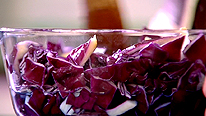
Place the chopped cabbage in a bowl.
Take 1/4 red cabbage.
Finely slice the cabbage.
Put all the chopped-up cabbage into a bowl.
Add a cup of water (roughly 250ml).
Take the wooden spoon and smash up the cabbage in the water.
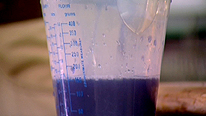
The vibrant purple liquid.
When the water in the bowl has turned a vibrant purple colour, sieve it into a pouring jug.
Pour approx. 1cm of purple liquid into 6 glasses/plastic cups.
Put one glass to the side. This will remind you what the original colour was. Compare the changes to this. It is your 'control'.
Prepare all the items you wish to test. If you want to replicate Dr Yan's demo then look to the list above for ingredients.
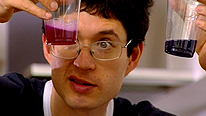
Compare your results to the 'control'.
Squeeze some lemon juice into cup #1. Note its colour change.
Put a teaspoon of bicarbonate of soda into the second cup. Is there a colour change? Compare it to the control.
Squeeze some ketchup into cup #3.
Pour some cola into the fourth cup and finish up by squeezing some soap into the fifth.
That's all Dr Yan tested in his demo, but the list is endless - see what else you can test in your kitchen.
What should happen
Acidic substances should make the cabbage indicator turn bright pink. The basic, bicarbonate of soda, should turn dark blue. There is some vinegar in tomato ketchup so that should turn a little pink, as should the cola. The soap will depend on the type of soap you are testing. Some are neutral, some are acidic. See what it says on the label.
If it doesn't work for you
Make sure the cabbage is red. Other varieties of cabbage will not work.
Mash up the red cabbage so the water you have added really does turn very purple. The more concentrated, the more noticeable the colour change.
What's going on?
Colour me happy
Red cabbage changes colour in the presence of acids and bases because it contains a pigment called Flavin, which belongs to a family of water-soluble molecules called Anthocyanins. These pigments are responsible for the red, purple and blue colours in some plants, including leaves, flowers and fruits.
A very significant fact about acids and bases is that they both affect the number of hydrogen ions (H+) in a solution. Acids produce hydrogen ions whereas bases remove them. Bases do this by producing hydroxide ions (OH-) which work to neutralise hydrogen ions. It is the ratio of hydrogen ions to hydroxide ions that determine the how acidic a solution is.
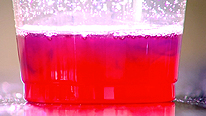
The greater the concentration of hydrogen ions, the pinker the solution becomes.
Now, the colour of Flavin (found in the cabbage) is entirely dependent on this ratio. At higher concentrations of Hydrogen ions, the pigment has a red/pink appearance. This explains the bright result of our lemon juice test. Equally, at lower concentrations the pigment breaks up and looks blue. Look at the bicarbonate of soda result to see this in action.
The concentration of hydrogen ions is also used to create the scale by which we measure acidity: the pH scale. The scale spans from 0 to 14, with pH 7 being neutral (water). Substances with pH lower than 7 are considered acidic and anything with a pH higher than 7 is basic. Our test implies that lemon juice has a low pH whereas bicarbonate of soda has a high pH.
Swot fact
When combined in equal amounts, hydrogen and hydroxide ions neutralise each other. This is why bases are often called "antacids". Your small intestine produces a base, sodium bicarbonate, to neutralize the hydrochloric acid from your stomach.
BBC iD
BBC iDBBC navigation
BBC links

BBC © 2014The BBC is not responsible for the content of external sites. Read more.
This page is best viewed in an up-to-date web browser with style sheets (CSS) enabled. While you will be able to view the content of this page in your current browser, you will not be able to get the full visual experience. Please consider upgrading your browser software or enabling style sheets (CSS) if you are able to do so.

