Councils 'let us live in blocks that may collapse'

Lesta Hall and Rochelle Wright-Clarke say they were not told the extent of the risks in their building, which is made with Large Panel System (LPS) concrete
- Published
"I feel disgusted. To dupe someone into buying something and make them think it's in good condition, in good nick and worthy of buying, and then to find out that's not the case - I don't have words."
Teacher Rochelle Wright-Clarke is a leaseholder in the 23-storey Walbrook House in Edmonton, north London, but has been asked to move out because it was built with prefabricated concrete panels known as a Large Panel System (LPS).
After a similar block partially collapsed in 1968, safety risks were repeatedly flagged about LPS buildings, but she and other residents claim they were not fully informed about them.
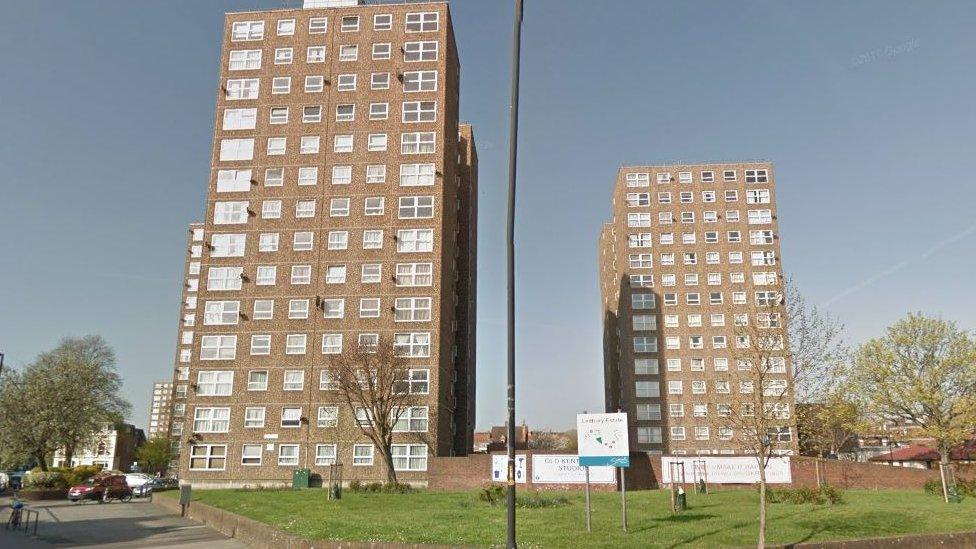
In south London residents of the Ledbury Estate in Peckham - another LPS building - say they have also been told to leave due to safety risks - the second time people have been moved out. Former resident and campaigner Danielle Gregory says she feels "frustrated and upset" at the situation faced by current tenants.
Enfield Council said it is supporting the remaining residents in Walbrook House but rejected claims of "misinformation by council officers".
Southwark Council said the Ledbury Estate buildings "at that time were safe to live" until a recent inspection.

Ms Wright-Clarke said she thought "it's in good condition, in good nick and worthy of buying, and then to find out that's not the case - I don't have words"
Ms Wright-Clarke bought her property in 2017 using the Right To Buy scheme having lived there since 1999.
She was told to move out soon after residents in a neighbouring high-rise LPS block, Cheshire House, suddenly had their gas supply turned off in 2022 following a leak.
Not long after, Enfield Council also switched the gas off at Walbrook House and replaced it with electric heating.
'I can't afford to move'

Mr Hall said: "I've worked hard all my life and I'm mortgage free, I don't want another mortgage"
Her neighbour and fellow leaseholder Lesta Hall, 65, has lived in the block for more than 30 years and also purchased under the Right To Buy scheme.
Mr Hall, a bus driver, had to pay for a new boiler when the heating system was changed but he too claimed he was never told the building was an LPS structure or that there were risks associated with having a gas supply in the building.
"It makes me feel really bad to know it was unsafe and no-one told me it was unsafe when I was buying the place," he said.
"When they turned off the gas they said it was something to do with Grenfell and fire safety."

Lesta Hall said: "When they turned off the gas they said it was something to do with Grenfell and fire safety"
In April, Enfield Council decided to decommission all the LPS blocks in the borough and either demolish or sell them to a developer because remediation works on the estate was said to be more than £30m.
Tenants have been moved out of Walbrook House and leaseholders are in the process of being bought out.
However they say they have not been offered enough by the council for their properties to purchase a similar home in the local area.
"I can't afford to buy in the local area," Mr Hall said.
"I've worked hard all my life and I'm mortgage free, I don't want another mortgage."
Ms Wright-Clarke added she has felt anxious due to constant communication with the council and eventually sought help from her GP.
"My mind is in a scared place. How will they deal with us moving forward?" she said.
Bullying claims rejected
An Enfield Council spokesperson said refurbishing the blocks to an acceptable standard "would have been extremely expensive for both the council and leaseholders and very disruptive" and decommissioning them "is the only viable and feasible option".
The council added that it had received "overwhelming support" from residents for the move.
"The buyout deal from Enfield Council to leaseholders offers good market value plus a home loss and disturbance payment, and all fees are compensated for".
Shared equity options and support was also available where applicable, it added.
"We absolutely reject the claims of bullying and misinformation by council officers and will always endeavour to communicate with our residents with dignity and respect for the choices they must make."

Danielle Gregory was among the residents told to leave her block on the Ledbury Estate and is now campaigning on safety issues
At the Ledbury Estate in Peckham, former resident Danielle Gregory was told to move out in 2017 following fire safety checks carried out on four LPS blocks in the borough in the wake of the Grenfell fire.
Residents were told to evacuate after the council found cracks in the walls, and a fire risk assessment said it discovered "thermal movement of the large concrete panels" and "widespread cracking had led to the breakdown of compartmentation of fire safety".
It also said the communal entrance and hallway, made of aluminium composite insulated roof panels, was assumed to be "combustible unless confirmed otherwise" and an additional risk existed if e-bikes and e-scooters with lithium batteries were being stored in the blocks.
The gas supply was suddenly turned off to prevent potential explosions and residents were told to evacuate. The heating system was made electric and gas bottles were banned.
'After Grenfell, they listened to us'

At the entrance to one of the Ledbury blocks multiple white warning signs state "no e-scooters, no e-bikes" and "no gas bottles"
A waking watch was introduced but about 200 tenants were eventually moved out by Southwark Council, including Danielle and her family.
She said that prior to this, residents had long been documenting problems in a residents' action group, such as gaps big enough to fit a hand through in the walls and ceilings of many flats.
"We had concerns for many year about the safety of these blocks and how they would perform in a fire, and the council never took our concerns seriously," Ms Gregory claimed.
"After Grenfell happened, they started listening to us."
But the council continued to use the blocks to house those who had been living in emergency accommodation and they too complained of cracks, cold, water leaks, electrical issues and damp.

A fire risk assessment for the Ledbury Estate said Southwark Council discovered "thermal movement of the large concrete panels" and "widespread cracking"
Then in 2021, all the LPS blocks on the Ledbury Estate were earmarked for demolition after Southwark Council said the structural problems and fire safety defects were too costly to fix.
The temporary residents continued to live there until last August when they were told by Southwark Council the latest fire risk assessment, external showed the safety risks had increased so they had to move out as soon as possible.
Ms Gregory, who now works with the campaign group Tower Blocks UK, said it was "upsetting and frustrating" to see people again being told to leave "when the council knew these blocks were dangerous".
One temporary tenant said many of the families had become part of the local community, with many of their children at local schools.
"Sometimes you just feel it's not fair what they've done to the families," she said.
"The council knew it was not safe, so why did they move people here?"

Enfield Council said it is supporting the remaining residents in Walbrook House but rejected claims of "misinformation by council officers"
Councillor Sarah King, cabinet member for council homes at Southwark Council, said the decision to demolish the towers on the Ledbury estate was made "following a ballot of residents who chose that option".
"The buildings are at the end of their life, but at that time were safe for people to live in while they found a new home, with mitigating safety measures in place," she said.
"However, a recent fire inspection highlighted a new safety issue in relation to the storage of lithium batteries, meaning that it's best for people to move out more urgently, as quickly as they can find new homes with our support."
'Vulnerable to collapse'
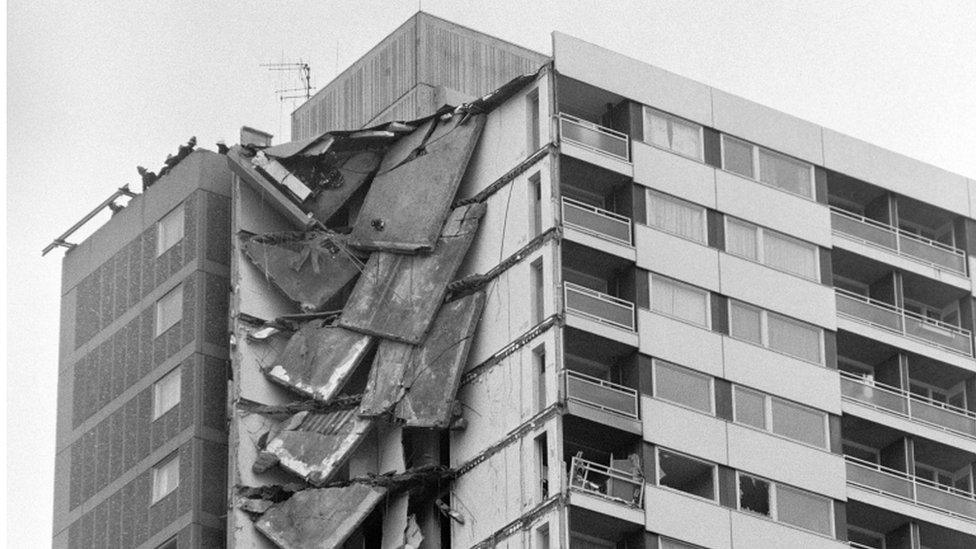
The decision to ask residents to leave these two tower blocks comes after Ronan Point in Newham, east London, partially collapsed after a gas explosion in 1968, in which four people died.
That same year the government advised councils that buildings of a similar construction should be strengthened, external as they were vulnerable to collapse if there was ever an explosion, but a number of buildings did not have this work carried out until recently.
Since then some LPS buildings have degraded and cracks have developed in the panels, causing years of issues with damp, water leaks and mould. This also poses a fire safety risk as the compartmentation fire containment system could fail.
Following the Grenfell Tower fire in 2017 which claimed the lives of 72 people, risks in LPS buildings were raised in a letter sent that year from government to local authorities, and again in 2018 in the Hackitt Review, external.
Listen to the best of BBC Radio London on Sounds and follow BBC London on Facebook, external, X, external and Instagram, external. Send your story ideas to hello.bbclondon@bbc.co.uk, external
- Published15 June 2018
- Published20 August 2018
- Published21 June 2018
- Published10 August 2017