Doctor Who - Regeneration

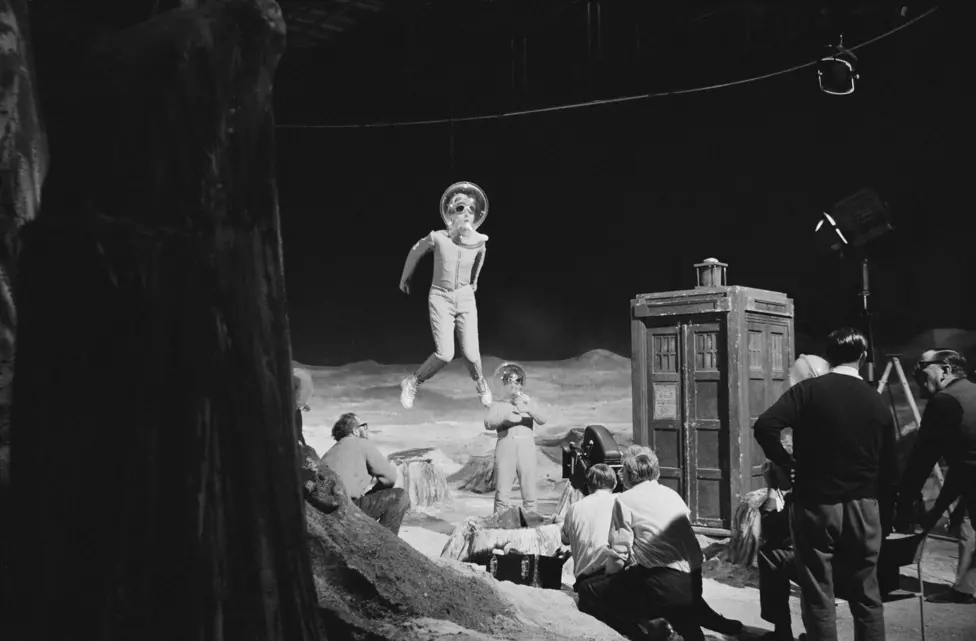
Anneke Wills (Polly), Patrick Troughton (The Doctor) and Michael Craze (Ben) in the TARDIS (1967)
- Published
Originally just a clever solution to the problem of the first Doctor William Hartnell leaving the show, regeneration has now become a key part of Doctor Who's mythology.
While the concept of regeneration and a new actor playing The Doctor is familiar to audiences today, back in 1966 it had never been done before.
“Life depends on change and renewal”The Second Doctor (1966)
Once the production team had decided they wanted to use regeneration to replace their leading actor, they then had to work out how much the character should change and how it should look on screen.

Document describing the appearance and manner of ‘The New Dr Who’ (c 1966)
Sadly, the final episode of The Tenth Planet no longer exists. While we can’t watch the build-up to that first regeneration, we can see the moment itself thanks to a 1973 episode of Blue Peter from the archive.
Clip of the first regeneration, shown as part of Blue Peter (1973)
“The problem was how to change from one Doctor to another. I think the producer came up with quite a clever solution”
Although regeneration was new, much like today, there was still debate over which actor should play the new Doctor, as former companion Anneke Wills explains in this unedited interview from the archive. She also describes the process of filming The Doctor’s regeneration.
Anneke Wills remembers the first regeneration, from an unedited interview for The Story of Doctor Who (2003)
“And history was being made"
While Anneke remembers Patrick Troughton being quickly accepted as The Doctor, an audience research report held in the BBC Written Archives tells a slightly different story.
![A typewritten document that reads: "British Broadcasting Corporation Confidential AN AUDIENCE RESEARCH REPORT (Week 47) [Reference number] DR VR/66/635 DR. WHO The Power of the Daleks, by David Whitaker Part 3 Designer: Derek Dodd Producer: Innes Lloyd Director: Christopher Barry Saturday, 19th November, 1966. 5.50-6.15 pm, BBC 1 1. Size of audience (based on results of the Survey of Listening and Viewing). It is estimated that the audience for this broadcast was 14.9% of the popu1tion of the United Kingdom. Programmes on ITV at the time attracted 20.8%. There was no transmission on BBC-2. 2. Reaction of audience (based on questionnaires completed by a sample of the audience. This sample, 217 in number, is the 11% of BBC 1 Viewing Panel who saw all or most of the broadcast). The reactions of this sample of the audience were distributed as follows:- A+ = 3% A = 17% B = 45% C = 22% C- = 13% giving a REACTION INDEX of 44. Figures for the first two episodes in this particular sequence were 43 and 45. Previous episodes of Dr. Who televised during the year have averaged 47. 3. Viewers in the sample who were enthusiastic about this episode in the new six part adventure featuring the Daleks, were confined to a minority, less than a quarter of the sample finding it appealing to an appreciable degree. There was, however, a warm welcome from these viewers for the 'over popular' Daleks whose doings ensured plenty of entertainment and excitement. 'This is supposed to be for the "kids", but I must confess that I found the programme quite gripping', a Senior Clerk wrote. 'As an ardent sci-fiction fan I think the Daleks are the most sinister "aliens" I've come across'. 4. More often viewers in the sample reported a very moderate degree of enjoyment, and a number were scarcely interested at all. Quite a few said they did not care for the new-style 'doctor'; he 'didn't seem right somehow', and they now liked the series less than before. 'Once a brilliant but eccentric scientist, he now comes over as a half-witted clown', a Teacher maintained, another viewer writing: 'The family have really "gone off" Dr. Who since the change. They do not understand the new one at all, and his character is peculiar in an unappealing way'. Then some of the sample said they were tired of the Daleks who were no longer a novelty ('they have made their impact, served their usefulness, now they just seem hackneyed and more unreal than usual'). The series in general was not as good as it used to be, in quite a few opinions - 'At one time we used to hate to miss it; now we are quite indifferent'. However, some of those who got little entertainment out of the episodes themselves were willing to admit that the children liked it, although criticisms were also made by several to the effect that it was rather complicated for them, and a bit frightening as well."](https://ichef.bbci.co.uk/ace/standard/480/cpsprodpb/3a6e/live/5261dc50-6e9d-11ee-9f0b-8b00f9b347c3.jpg.webp)
Page 1 of Audience Research Report for The Power of the Daleks part 3 (1966)

Page 2 of Audience Research Report for The Power of the Daleks part 3 (1966)
“[He] brought a new dimension to the character”
However, many viewers did like the new Doctor, including a young boy named Russell growing up in South Wales.
Russell T Davies describing his memories of the first regeneration, from Doctor Who Confidential(2007)
And so regeneration became part of the fabric of Doctor Who. Generations watched as The Doctor changed physically, while essentially remaining the same person.
When the show returned in 2005, the need to change the lead actor at the end of the series wasn’t an obstacle to overcome, but another part of the Doctor Who mythology, as executive producer Jane Tranter and directors James Hawes and Euros Lyn explain in this archive radio clip.
Jane Tranter, James Hawes and Euros Lyn talk about the 2005 regeneration from radio programme Doctor Who: Regeneration (2005)
“And that's part of the joy of the format, that you get this ability to move from one actor to the next in the same role and it's not a problem, it's not an obstacle you have to overcome, it's a rebirth for the series”
Related topics
Explore more about Doctor Who from BBC Archives
- Published1 November 2023
- Published7 May 2024
- Published19 January 2024