|
 |
 | | | | | | ||||||||||||||||||||||||||||||||||||||||||||||||||||||||||||||||||||||||||||||||||||||||||||||||||||
| | | You are in: UK: Wales | ||||||||||||||||||||||||||||||||||||||||||||||||||||||||||||||||||||||||||||||||||||||||||||||||||||||
|
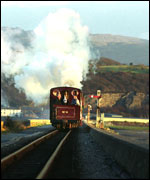
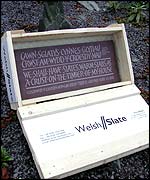
| | Friday, 17 January, 2003, 16:42 GMT Steam train transports Millennium slate  The slate is placed aboard a train
An inscribed slate block is in transit from its quarry of origin in Bethesda, Gwynedd, to its future home. En-route we stop briefly at Dduallt. This deserted little halt was once home to the Welsh poet and stationmaster Gwilym Deudraeth. He often complained of the depression that working in so isolated a spot caused him. Today he'd probably sue his employers for negligence and get to appear on Kilroy. But this was before World War One, and long before the days when stress-counselling became a bigger industry in Wales than slate. Looking around the station, I can see that the poet must have had a point.
It's a lonely spot all right. Even today, when even the most remote and inhospitable ruins seem to be attractive renovation properties for people looking to cash their city home in for a rural idyll, Gwilym Deudraeth's house is still an empty shell - no new hardwood window frames, no flower baskets, and no shiny 4x4s. Perhaps his brooding spirit still keeps them away. We did not linger at Dduallt long enough to feel any depression. Certainly any such emotion seemed far from the mind of Paul, who, when he's not renovating 19th Century Welsh rolling stock, has a full-time job researching and developing their 21st century equivalents. I reflected that at least this 19th Century train was running on time, was cheap, and you could get a seat. "You can't do this anywhere else in the world," Paul tells me happily as the engineless train gathers pace down a long incline into Penrhyndeudraeth.
"Perhaps no-one else is mad enough to want to," I suggest. Paul's smile suggests that he doesn't envy them their sanity. At Minffordd Station we stop - the braking system does work - and we transfer to an ordinary steam train of the kind familiar to tourists who use this stretch of the renovated Ffestiniog Railway. This takes us across the Cob into the town of Porthmadog, once a major slate port and shipbuilding centre, now reinvented as a tourist and yachting haven. Transferred Here the slate, in its packing crate, is transferred to the Vilma, a restored 1930s schooner which is to take it on the final and longest stage of its journey round the Welsh coast to Cardiff. It is quite extraordinary how this slate seems to have captured people's imaginations. Media and public attention has exceeded all expectations. Perhaps the use of this stone, so long regarded as a rather workaday domestic material, seems to have provided some belated artistic and civic validation of the centuries of industry which brought this product to light. Hard work The slate industry may have brought these communities little material wealth, a lot of hard work, and, in the days before "health and safety" were the watchwords, too many untimely deaths from injury or dust-related illnesses. Even into the 20th Century, slate company medical officers, with a nerve of which any spin-doctor today would be proud, were still describing the effects of silica dust on the lungs as "beneficial". But despite all that, this industry also brought its communities the hard gifts of solidarity, resilience, and creativity even in the most unpromising of circumstances. People in the slate districts of north Wales treasure the memory of the cultured quarrymen whose breaks from their labours in their hillside 'caban' would be filled with literary discussions and exercises in Welsh poetry. In an echo of that memory, the Millennium Centre's slate is inscribed by the sculptor Ieuan Rees with a couplet from the 15th Century poet Guto'r Glyn, a couplet which makes mention of slate as a building product to be treasured. It is a link with a long tradition which fused industry and culture into a single enterprise.
Perhaps that why the slate is treated like a kind of silica celebrity as it makes its progress through the Gwynedd hills. It's clearly more than just an inscribed piece of mineral. It represents a way of life which grew out of a community's intense shared industrial experience. And by extension it represents the aspirations of a people who have always prided themselves on taking the hard facts of their experience and shaping them into something durable and valuable. Slate makes for a hard, grey beauty. But it is beauty all the same. And you can read more of Grahame Davies's journey with the slate block destined for the Wales Millennium Centre on Friday. | | See also:  15 Jan 03 | Wales 23 Jan 02 | Wales 22 Jan 02 | Wales 22 Jan 02 | Talking Point Internet links: The BBC is not responsible for the content of external internet sites Top Wales stories now: Links to more Wales stories are at the foot of the page. | ||||||||||||||||||||||||||||||||||||||||||||||||||||||||||||||||||||||||||||||||||||||||||||||||||||
 | |
|  E-mail this story to a friend E-mail this story to a friend |
| |
| Links to more Wales stories |
| | | ||
 | ||||
 | | Back to top
| ||
| ---------------------------------------------------------------------------------- To BBC Sport>> | To BBC Weather>> | To BBC World Service>> ---------------------------------------------------------------------------------- © MMIII | News Sources | Privacy |