|
 |
 | | | | | | |||||||||||||||||||||||||||||||||||||||||||||||||||||||||||||||||||||||||||||||||||||||||||||||||||||
| | | You are in: UK: Wales | |||||||||||||||||||||||||||||||||||||||||||||||||||||||||||||||||||||||||||||||||||||||||||||||||||||||
|
| | Thursday, 16 January, 2003, 18:52 GMT Slate travels by horse and train  Soon, slate will cover the centre's walls
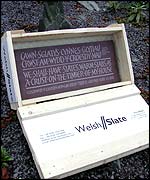
A symbolic journey for an inscribed slate block is inl transit from its quarry of origin in Bethesda, Gwynedd, to its future home. Blaenau Ffestiniog was the epicentre of a Welsh slate industry which once employed thousands of people; sending its product around the world by rail and sea; making some investors fabulously wealthy and many others bankrupt. In the industry's heyday in the late 19th Century, the huge profits to be made from slate turned large areas of the north west into a kind of Celtic Klondike, with speculators, companies and small groups of enterprising workers opening up scores of new diggings in the hopes of making their fortune from Gwynedd's grey gold. 
With that frontier-town history in mind, perhaps it's appropriate that we used horsepower to take the Millennium Centre's block of Penrhyn slate on the first stage of its journey. But no ordinary horse; this one boasted a pedigree that would have been the envy of one of the princes of Gwynedd. This was Seiont Gwrtheyrn, a product of John Williams' Seiont breeding centre near Caernarfon. Seiont Gwrtheyrn is, of course, a Welsh cob, one of the native breed which have become popular around the world in recent years.
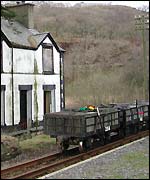
This nine-year-old, 15-hand stallion pulled Mr Williams, the slate and myself in a renovated 100-year-old rally trap from the McAlpine quarry headquarters - one of the area's few remaining slate works - down to Blaenau Ffestiniog station. There, an even stranger form of transport was waiting - a gravity train. It works on the simplest of principles. A row of trucks is loaded up and pushed off in the direction of its destination. Then, as Scotty used to say in Star Trek, the laws of physics do the rest, and the whole train, unchaperoned by a locomotive at either end, rolls down to the end of the line. It's literally downhill all the way. The task of the train crew is to apply the brakes at strategic points to keep the whole affair on the rails. At the height of the industry, such trains would carry up to a hundred trucks. A single brakeman - even in those days, the employers didn't believe in over-staffing - would run the length of the train across the top of the wagons, applying or releasing the brakes as he went. Slate magnates Today's journey, on a train of 25 laden trucks lovingly restored by a group of young enthusiasts from all over Britain, is a bit more labour-intensive. The train's carrying 15 crew. That's generous staffing compared with former times. But then, there's no wage bill to worry about as they're doing it for the sheer love of it.
The train is pulled initially to the top of the incline by an old steam locomotive, and then it's uncoupled and allowed to roll away. The volunteers do have their hands on the brakes, but the whole arrangement still bears an unnerving resemblance to a runaway train, at least to someone whose knowledge of mineral railways is confined to the chase sequence in Indiana Jones and the Temple of Doom.
Communication is by a combination of yellow and red flags. As we rattled through the narrow cuttings, I asked my minder for the journey, Paul Molyneux-Berry from Derby, what the yellow flag means. "It means: 'Put the brakes on,'" he replies. And the red one? "Oh, that means: 'PUT THE BRAKES ON!'" Fine. And you can read more of Grahame Davies's journey with the slate block destined for the Wales Millennium Centre on Friday. | | See also:  15 Jan 03 | Wales 23 Jan 02 | Wales 22 Jan 02 | Wales 22 Jan 02 | Talking Point Internet links: The BBC is not responsible for the content of external internet sites Top Wales stories now: Links to more Wales stories are at the foot of the page. | |||||||||||||||||||||||||||||||||||||||||||||||||||||||||||||||||||||||||||||||||||||||||||||||||||||
 | |
|  E-mail this story to a friend E-mail this story to a friend |
| |
| Links to more Wales stories |
| | | ||
 | ||||
 | | Back to top
| ||
| ---------------------------------------------------------------------------------- To BBC Sport>> | To BBC Weather>> | To BBC World Service>> ---------------------------------------------------------------------------------- © MMIII | News Sources | Privacy |