 | Blowing up the trees was deemed better than using a chainsaw 
|
The tranquillity of one of Scotland's oldest forests has been shattered by ancient trees being blown-up. Explosive experts detonated charges on 10 Scots pines in RSPB Scotland's reserve at Abernethy, near Aviemore.
The society said the dramatic action has been taken to help boost a rare wildlife habitat.
It said the ragged stumps resemble storm damage and will play a more vital role in the forest's ecosystem than if they were cleanly cut by a chainsaw.
Abernethy is home to the Scottish crossbill, a bird which the RSPB recently identified as having its own distinct "Scottish accent".
The conservation body decided that blowing up the trees was the best way to increase the amount of dead wood.
Experts said explosive charges exposed raw wood in a similar way to a tree being torn down in a storm or lightning strike.
The RSPB said the stumps could take as long as a century to decay.
During that time they will become a home for insects, fungi, mosses, lichens, birds and small mammals such as bats.
Sixteen bird species use dead wood including tree-nesting swifts, crested tits, redstarts and flycatchers.
The trees picked out were aged between 100 and 200.
Desmond Dugan, site manager for the Forest Lodge section of Abernethy, said, said the RSPB intends to leave more fallen trees to be recycled by nature.
 The forest is home to Scottish crossbills |
He said: "Dead wood habitats, particularly large volume dead wood, are in short supply at Abernethy forest.
"It may seem ironic but dead wood is a key driving element of our forest ecosystem.
He added: "Explosives may seem extreme but the effect will be no less catastrophic than a wind snapped, lightning struck or avalanched tree."
The Abernethy reserve is the largest remaining expanse of the once sprawling ancient Caledonian pine forest and contains about 3.5 million Scots pines.


 One-Minute World News
  News services
 E-mail this to a friend
  Printable version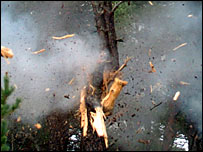
 Enlarge Image
 Explosives may seem extreme but the effect will be no less catastrophic than a wind snapped, lightning struck or avalanched tree

 Highlands & Islands


