 A memorial garden to the victims of the blast now stands on the site |
Risk assessments on buried gas pipes at a Glasgow factory where nine people died in an explosion were carried out by a student on a holiday job. The High Court in Glasgow also heard that it would have cost just �405 to replace the pipes which corroded and caused the blast. ICL Plastics and ICL Tech admitted breaching health and safety laws. They await sentence after pleading guilty to four breaches in relation to the incident in May 2004. On Monday, the court was told that the supplier of propane gas to the Stockline plastics factory did not know that the pipelines had not been inspected professionally. A decision had been taken by the firms operating the factory in Maryhill not to employ an outside consultant.  |  Inspection from within the basement at any time would have revealed an absence of wrapping on the pipework which entered through the bricked-up window Inspection from within the basement at any time would have revealed an absence of wrapping on the pipework which entered through the bricked-up window |
The judge, Lord Brodie, heard that the leaking pipe which caused the explosion was put into the plastics factory in 1969 without corrosion protection. He was told that in addition to body armour and internal items for aircraft, the factory also manufactured plastic coatings to protect underground pipes from corroding. Angus Stewart QC, prosecuting, said that once the criminal proceedings were completed a fatal accident inquiry would be held into the deaths. The explosion happened after propane gas from a corroded pipe leeched into an underground basement and was ignited - possibly when a builder who rented it for storage switched an electric light on. The blast caused the total collapse of the former four storey Victorian mill. Mr Stewart said most of the casualties had been working on the second floor. Relatives and survivors crowded the court as he outlined the four-day rescue operation. It took half an hour to read out the roll call of 54 people who died, were injured or escaped unharmed. | GLASGOW BLAST VICTIMS Margaret Brownlie, 49, Strathaven Annette Doyle, 34, Glasgow Peter Ferguson, 52, Kilbarchan Thomas McAulay, 41, Mount Florida, Glasgow Stewart McColl, 60, West Kilbride Tracey McErlane, 27, Possilpark, Glasgow Kenneth Murray, 45, Paisley Timothy Smith, 31, Johnstone Ann Trench, 34, Colston, Glasgow |
Mr Stewart said a catalogue of errors over more than 30 years had led to the tragedy. The firm which laid the pipeline in 1969 had no previous experience of laying buried pipelines on land and no record of their specifications existed. Mr Stewart told the court that the fittings were not wrapped or corrosion protected, contrary to then and now industry guidelines. In 1972, because of flooding problems, the pipeline's level was raised and the last section concreted over. Again there was no corrosion protection. In 1980 a steel floor was installed over the basement area, sealing it off where the LPG pipeline entered the building. Mr Stewart said: "All risk assessments were done without the assistance of competent outside persons. "The Crown view is that ICL Tech Ltd and ICL Plastic Ltd were simply not entitled to assume that the underground pipework had been installed to an acceptable standard of corrosion protection. "Inspection from within the basement at any time would have revealed an absence of wrapping on the pipework which entered through the bricked-up window." | Rescue workers searched for 72 hours for survivors 
|
Mike Jones QC, defending the two companies, said the tragedy was attributable to "inadvertence rather than anything more blameworthy". He said the fact that no-one smelled gas indicated that the filling up of the basement area had been "rapid". He said that culpability normally ranged from wilful disregard to the law down to a non-negligent or inadvertent breach. He added: "This is not a case of the type, for example, in which dangers were deliberately courted, or obvious risks were taken for the sake of profit which, rightly, attracts very severe penalties." He claimed the two companies sought advice from their gas supplier in late 1988 who advised that Health and Safety Executive recommendations that the pipe be excavated and examined need not be followed. Mr Jones asked Lord Brodie to set the fine at a level which would prevent the companies from going bust so that continuing employment could be secured for its workforce. He added: "No amount of fine will bring back those who died. Many who were injured still rely on these companies to provide for them and their families. "It would only add to the tragedy if further hardship was inflicted on the survivors and their work colleagues."
|  BBC NEWS CHANNEL


 E-mail this to a friend
  Printable version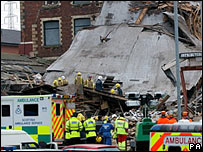
 In pictures

 Explosion explained
  BBC News


Bookmark with:
What are these?