Mr Williams said Scotland's emergency services could cope |
Geoff Williams, chairman of New Dimension in Scotland, said the country's emergency services are well placed to deal with a terrorist attack. But Mr Williams said more had to be done to adequately protect the public following the terrorist attacks in New York in September 2001.
Fire brigades and other emergency services had to be more robust in the event of a terrorist attack, he said.
New Dimension was launched after September 11 to review fire and rescue service preparedness against a potential terrorist threat.
Mr Williams said the operational capabilities had been sharpened by the introduction of a national co-ordination centre in West Yorkshire.
This allowed emergency services to call on neighbouring services and also for national help if and when required.
Urban centres
Much of Scotland's resilience equipment to cope with any terrorist attack is centred on the largest urban centres.
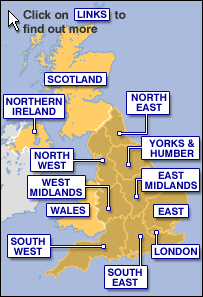
 | SITUATION AROUND THE UK |
The Scottish Ambulance Service (SAS) serves all of Scotland - which is an area of 30,414 square miles and a population of just over five million. It has about 500 Accident and Emergency vehicles and two emergency helicopters.
The SAS has 1,000 PPE suits and 16 Plysu mobile decontamination units.
It operates eight Special Operations Response Teams (SORT) across Scotland who are trained and equipped to deal with major incidents and CBRN.
They have trained 400 staff in Scotland in the use of the suits.
Factory blast
There are 81 people in the SORT teams and they are strategically located across the country to provide a swift response to major incidents.
They were deployed to good effect to help in the plastics factory blast in Glasgow in May.
The country has major incident units (MIUs) which are multi-purpose vehicles but do not ordinarily carry decontamination equipment.
Scotland has four MIUs located at: Grampian Fire Brigade (covering Aberdeen), Lothian and Borders Fire Brigade (covering Edinburgh), Strathclyde Fire Brigade (based at Clydebank) and Central Scotland Fire Brigade (based at Falkirk).
'Operational reasons'
However, there has been no increase in staffing or additional funding for new equipment and training.
Glasgow is the country's biggest population centre, with a population of 1,168,270.
There are four A&E departments in the city, one paediatric A&E department and one casualties unit which can take in walking wounded.
A Strathclyde Police spokeswoman said it had conducted emergency planning drills with a number of its officers.
But she could not reveal the exact number of personnel who had been trained or what equipment they had used due to "operational reasons".
Glasgow has concentrated its decontamination facilities at one hospital either side of the River Clyde - the Royal Infirmary and the Southern General.
There are two plysu decontamination units in the city at the two hospitals.
 Chemical attack drills are carried out in Scotland once every two years |
About 48 suits have been delivered to hospitals in the city and allocated according to risk analysis.
Chemical attack drills are carried out once every two years.
The type of CBRN equipment and the training being provided for the Scottish Fire Service is the same as the rest of the UK and is allocated on a risk basis.
An additional 400 gas suits have been provided across Scotland, along with six mass decontamination units and 20 interim shower systems.
Training concerns
Shower systems and specialists detection and monitoring equipment such as radiation dosimeters, survey meters and gas detection has also been provided.
The new appliances provided are designed to enhance resilience across Scotland to deal with a range of incidents including CBRN.
Alex Macleerie, the regional safety co-ordinator for Scotland, highlighted safety and training concerns when he visited four fire brigades.
After visiting the Strathclyde, Grampian, Lothian and Borders, and Central brigades to assess their Mass Incident Units (MIU), he found only Grampian had the ability to effectively deal with a terrorist attack.
CBRN attack
He found that firefighters within the Strathclyde brigade had not received sufficient training on mass decontamination procedures and staff had difficulty in answering safety questions on how to respond to an attack.
Mr Macleerie said the MIU should be removed until such time as staff had received proper training and stopped playing "Russian roulette" with people's lives.
Similar failings were found at Lothian and Borders, and Central Scotland brigades.
Only Grampian Fire Brigade had adequately trained staff on mass decontamination response drills.
In conclusion, most fire brigades in Scotland appear unprepared to respond effectively to a CBRN attack.
This article is intended as an overview for Scotland. For further information visit the related internet links on the right hand side of the page.


 One-Minute World News
  News services

 E-mail this to a friend
  Printable version