 Arms fairs should be monitored more closely, the MPs said |
Laws controlling arms exports are not being enforced strictly enough, with weapons too often falling into the wrong hands, MPs have said. The Commons Quadripartite Committee said recent years had seen improvements in regulation of arms exports.
But it urged the government to "plug the holes in the controls", and called for closer monitoring of arms fairs.
The committee recommended that all UK residents and British citizens abroad need a licence for weapons trading.
The committee made 96 recommendations and conclusions in its report into the review of the government strategic exports legislation, carried out by the now-renamed Department for Trade and Industry.
"The committee calls on the government to use the review to plug the holes in the controls on arms exported from the UK and to keep a tight grip on those trafficking and brokering arms between countries outside the UK," it said.
The committee heard from journalist Mark Thomas, who said he had seen electronic stun guns, used for torture, openly exhibited at an arms fair in Birmingham last year.
 | ARMS EXPORTS RECOMMENDATIONS Prevent re-exporting to countries under an arms embargo Establish a register of arms brokers Greater policing of arms exhibitions by Revenue and Customs Review fines and punishments for breaching controls Include more weapon types that require licences |
Committee chairman Roger Berry said: "We have serious concerns about arms fairs held in the UK.
"We need to see HM Revenue and Customs attending more of these events - physically patrolling during opening hours, inspecting the goods being displayed and putting difficult questions to those on stalls to ensure that export controls are not being breached."
The committee said the Sentencing Guidelines Council should review sentences for those who break the controls.
Mr Berry said that penalties ranging from a warning letter to 10 years in jail "lack a strong deterrent".
He added: "In serious cases it can be very difficult to obtain evidence from abroad to put before the British courts and those cases that go to court can result in fines worth only a fraction of the goods seized."
| READ THE REPORT
Most computers will open this document automatically, but you may need Adobe Reader |
The committee said a system of licences for all UK weapons traders should be introduced - currently, a licence is only required for trade in certain arms, such as long-range missiles.
The MPs also predicted that terrorist threats and the changing way weapons of mass destruction were procured could lead to regular amendments to arms export law.
Overseas production
Among the gaps identified by the committee was overseas production of arms under agreement with a UK company or where a UK company was the parent company.
| Map showing values of UK's exports of military equipment in 2006 
|
The committee said it wanted legislation to prevent such arms being exported to countries where the UK would not licence them.
"The current controls over licensed production overseas are inadequate and need to be extended to cover not just products with an easily recognisable military end use," Mr Berry said.
He highlighted the example of Turkish supplied and built Land Rover Defender vehicles being used in the Andijan massacre in Uzbekistan in 2005.
Re-exports
The committee was also concerned about "re-exporting" where arms exported from the UK were then sold on to countries under an embargo, often years later.
The committee said several non-governmental organisations had reported the proposed transfer to Burma of a military helicopter containing components and technology from as many as six European Union countries, including the UK, that threatens to undermine an EU arms embargo on Burma.
It said re-exporting should be prevented.
A register of arms brokers should also be established so that they meet defined standards, as well as deterring people with certain criminal convictions from applying.


 One-Minute World News
  News services


 E-mail this to a friend
  Printable version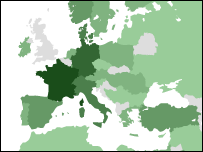
 Enlarge Map


