|
 |
 | | | | | | ||||||||||||||||||||||||||||||||||||||||||||||||||||||||||||||||||||||||||||||||||||||||||||||||||||||||||||||
| | | You are in: UK: Politics | ||||||||||||||||||||||||||||||||||||||||||||||||||||||||||||||||||||||||||||||||||||||||||||||||||||||||||||||||
|
| | Friday, 15 November, 2002, 20:41 GMT Scent of possible compromise 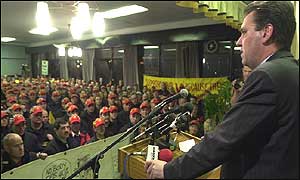 Gilchrist addresses striking firefighters in Belfast
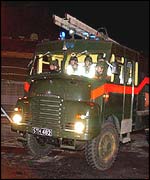
The troops have returned to barracks and the picket line braziers have been extinguished. But as the smoke clears at the end of the firefighters' first strike, there appears little sign of hard progress towards staving off next week's eight-day walk-out. There is, though, a tangible scent of possible compromise in the air. Both the government and the Fire Brigades Union desperately want a resolution to the dispute, with neither having relished the 48 hours they spent teetering on the brink of potential disaster. Those 48 hours saw each side brandish their strength without putting all their weapons to use, as a warning to the other as to how much further they could go. Tube trouble After some initial hesitation, the government made clear it certainly would be willing to send troops across picket lines to use red fire engines and modern equipment housed in fire stations.
As Tony Blair put it, the government would do "everything we can" to protect the public - and he meant everything. Meanwhile, the dispute looks set to spill over onto London's Tube, with the RMT union announcing its own strike ballot in a row directly related to the firefighters' action. Like the FBU, the rail union is one of the last bastions of full-strength, old-style trade unionism - and is led by Bob Crow, a close political ally of firefighters' leader Andy Gilchrist. Conciliation hints Ministers are in little doubt an RMT stoppage would be secondary action by any another name, and the spread of the fire strike to the Underground would raise yet more unwelcome memories of the "winter of discontent" that killed off the last pre-Blair Labour government. The all-round escalation cannot be dismissed as mere posturing. But there are also distinct signs of a more conciliatory approach.
He reaffirmed his commitment to further talks with the government to avert next week's second, eight-day stoppage. Earlier, he made clear that thought his unions viewed plans to train troops to use red fire engines as "desperate measures", firefighters would not block them from crossing their picket lines. The term "40%", meanwhile, has been dropped from the FBU vocabulary after realising the PR blunder of framing their pay claim in such terms when "�8.50 an hour" or "�30,000 a year" sounds much more sympathetic. Even then, there have been hints from the union that a headline salary of �25,000 a year, or a 16% rise, might be acceptable as a basis for talks. At the same time, Deputy Prime Minister John Prescott has been making noises that the Bain report's 11% rise with strings, already rejected out of hand by the FBU, need not be the last word on the issue. So while things could get a lot worse in this dispute, both sides are keen to move back from the prospect of all-out war. They now have a breathing space of seven days in which to sue for peace before the next phase of the battle is due to start. | |
Internet links:  The BBC is not responsible for the content of external internet sites | ||||||||||||||||||||||||||||||||||||||||||||||||||||||||||||||||||||||||||||||||||||||||||||||||||||||||||||||
| |
|  E-mail this story to a friend E-mail this story to a friend |
| |
|
| | | ||
 | ||||
 | | Back to top
| ||
| ---------------------------------------------------------------------------------- To BBC Sport>> | To BBC Weather>> | To BBC World Service>> ---------------------------------------------------------------------------------- © MMIII | News Sources | Privacy |