|
 |
 | | | | | | ||||||||||||||||||||||||||||||||||||||||||||||||||||||||||||||||||||||||||||||||||||||||||||||||||||||||||||||||||
| | | You are in: UK: Politics | ||||||||||||||||||||||||||||||||||||||||||||||||||||||||||||||||||||||||||||||||||||||||||||||||||||||||||||||||||||
|
| | Monday, 30 September, 2002, 15:00 GMT 16:00 UK Labour guru's verdict on Blair 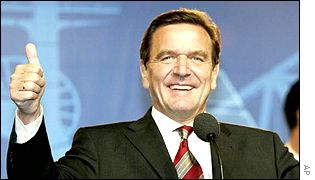 Schroeder's victory has buoyed the centre left
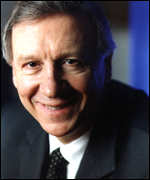
As he speaks to BBC News Online, Giddens, director of the London School of Economics, has good reason to be pleased. Not long ago Schroeder was tipped to be the latest centre-left casualty in European elections in a trend some commentators saw as the end of the road for the Third Way.
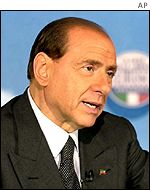
"I see it as a welcome reversal from my point of view, coming with the Swedish result, on recent victories of the centre right - but I never thought there was an ideological move towards the right in Europe," he says. A mixture of factors accounted for centre- right successes, he suggests: Bush's US triumph, like Bill Clinton's in 1992; and particularly the left losing out when it was fragmented against a united centre-right. That was most famously true of France "where I don't think you could really get a bigger screw up in history than the French Left managed then". And the Italian Left could have done far better had they formed a common front against Silvio Berlusconi. "I went there to talk to them only about a month before the election," Prof Giddens continues. "They just couldn't agree on even a policy programme, let alone reconcile their individual differences." Countering critics In the UK, Giddens has been dismissive of left-wing critics like former deputy Labour leader Roy Hattersley who have accused the Third Way of being vacuous or incoherent. He says: "To me, the term Third Way is not just a label that Peter Mandelson or somebody invented. As I would see it, it rests on a fairly deep structural analysis of social change." He lists as the key factors driving that change as: globalisation; the emergency of a "knowledge economy"; the strains produced by rapid population growth and other changes; and the weakening of voter loyalty to one political party.
There is "no silver bullet" for solving labour market problems, for example, and "trade-offs" are needed to get more people into work, he argues. But does he worry that by creating a political philosophy which is difficult to define he has added to the problem of low voter turnout? Giddens points out that he only works at the "margins of politics" and his job is to provide a throw a good analysis of social changes into the political debate. "I'm not a politician," he says, arguing that it is not his job to make slogans. More debate In any case, he urges caution over talk of apathy - the reasons for the 2001 low turnout are complex, he argues In fact, even people with relatively little education are able and willing to talk about a lot of issues in a way that simply they would not have done 20 years ago. Giddens has criticised New Labour for not setting out its vision for society clearly enough. He admits he sometimes feels frustrated that New Labour have picked up on his intellectual "back drop" but not managed to communicate it clearly enough to voters, although he stresses he is not the only person contributing ideas.
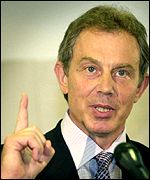
"I think they are trying to develop that now - what the country should be like, what devolution really means, of what relinquishing control to local autonomy actually implies - the conflicts it implies, the kind of local populist figures it throws up and so forth." Spin too was a mistake, he says. But Giddens is generally very positive about New Labour's achievements and says a lot of the changes made have shifted the Conservatives to the margins. "If people really trust Labour to run the country on an economic level they could keep them there for a fair while," he says. "And I think during that time a lot of good can be done. It's perhaps never going to be enough for some people on the Left but certainly enough to make society a more decent balance of effectiveness and social protection." University role Tony Blair has quipped that world leaders say they do not need to meet him because they have already met Giddens. But despite the weight given to his ideas, Giddens principal role is still as director of a top-ranking university. He sees universities as prime examples of how the Third Way impacts on public institutions.
The fact that universities and other public institutions are no longer predominantly funded by the state does not make them any less public institutions. That may well be the stance Labour ministers take up as they face pressure at this week's conference over using private money in public services this week. Giddens nevertheless believes the government does need to look at helping universities to set up endowments for their future funding. Funding plans British universities are currently "run on the margins", he says, and the levels of pay for academics compared to other professionals is a "bit of a scandalous thing" causing a major recruitment problem. This autumn will see the government unveil its plans for the future of higher education funding. There has been speculation that top universities could be encouraged to expand while some lower ranking institutions go to the wall. That is not an idea Giddens finds attractive. "Some of the so-called lower ranking universities actually have probably got quite a lot of demand over the medium term and to allow them to close would probably be a mistake," he argues. The top universities would also have problems in expanding significantly - both because of geography and their efforts to protect the quality of their degrees. Giddens says he does not want to sound gloomy about higher education, especially as he is delighted by the LSE's current success. Nor does he think the government's targets for increasing the number of young people going into higher education to 50% is unrealistic. He retires from the LSE next year but it is unlikely that joining the ranks of the "third age" will stem the flow of ideas from this Third Way thinker. | |
See also:  27 Sep 99 | Politics 06 Jun 02 | Politics 24 Mar 99 | Politics Internet links: The BBC is not responsible for the content of external internet sites | ||||||||||||||||||||||||||||||||||||||||||||||||||||||||||||||||||||||||||||||||||||||||||||||||||||||||||||||||||
| |
|  E-mail this story to a friend E-mail this story to a friend |
| |
|
| | | ||
 | ||||
 | | Back to top
| ||
| ---------------------------------------------------------------------------------- To BBC Sport>> | To BBC Weather>> | To BBC World Service>> ---------------------------------------------------------------------------------- © MMIII | News Sources | Privacy |