
|
 |
 | | | | | | |||||||||||||||||||||||||||||||||||||||||||||||||||||||||||||||||||||||||||||||||||||||||||||||||||||||||||||||||||||||||||||||||||||||||||||||||||||
| | | You are in: Politics | |||||||||||||||||||||||||||||||||||||||||||||||||||||||||||||||||||||||||||||||||||||||||||||||||||||||||||||||||||||||||||||||||||||||||||||||||||||||
|
| | Tuesday, 13 August, 2002, 16:09 GMT 17:09 UK Cynics to get the vote? 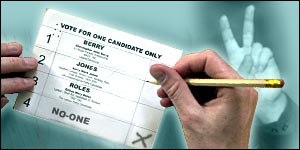
The idea, by the Electoral Commission, is designed to boost falling turnouts. But it could spell trouble for smaller parties such as the Liberal Democrats, who have traditionally been thought to have benefited from protest votes. 'Spoiled ballots' Paul Tyler MP, Liberal Democrat Shadow Leader of the House, attacked the proposal as "yet another gimmick". "The present electoral system already effectively wastes two thirds of votes cast.
"The Electoral Commission needs to consider what would happen if the majority of voters in one or more constituencies spoiled their ballots." 'Positive abstentions' Just 59.6% of the electorate bothered to vote at last year's general election, compared to 71.4% in 1997, which was itself a post-war low. The Electoral Commission, which has been given the job of trying to boost turnouts, believes disenchantment with the political choices on offer is as much to blame as "voter apathy". Allowing people to make "positive abstentions" could give an option to those who stay at home in protest at the policies of the main parties, it argues. But Robert Worcester, chairman of pollsters MORI, said the idea would reinforce negative attitudes. "It is going to pander to the irresponsible voter, who will say that they are never satisfied. "There are those in the electorate who will never feel the government has done enough for them," he told BBC News Online. Blair 'still popular' Mr Worcester put the blame for low turnouts firmly at the door of the politicians - and, in particular, the Tory party.
"What they are doing is engendering abstentions." He said the electorate at large would have preferred Michael Heseltine or Kenneth Clarke as Tory leader. Tony Blair continued to be relatively popular, but "as long as they don't have effective opposition, Labour will continue to be returned on reduced votes from an ever smaller share of the electorate," Mr Worcester added. 'Marginal seats' The idea was also attacked by campaign group Charter 88. Policy officer Dr Andrew Holden said: "In a system where voting is not compulsory, staying away from the polling booth will remain a form of positive abstention. "Counting "none of the above" votes will not tell us how unpopular political parties are, or why people don't vote for them." He said millions of people did not vote at the last election because they did not think their vote would count. "In a system where only a few votes in a few marginal seats make a difference, it is our electoral system more than our ballot paper that needs to be reformed," he added. In recent years, the mainstream parties have been losing more votes to small single issue groups, such as the Wyre Forest hospital campaigners in the Midlands. Voters have also been more inclined to vote for fringe candidates, such as monkey mascot Stuart Drummond, who beat the Labour candidate to become mayor of Hartlepool. Postal vote success A spokesman for the Electoral Commission told BBC News Online that one way of reducing frivolous or wasted votes would be to call for fresh nominations if "none of the above" received the most votes. The proposal is one of a raft of ideas being considered by the Electoral Commission to modernise the electoral process and boost turnout. Other proposals includes putting the candidates on the ballot paper in a random, rather than alphabetical, order. Trials of postal voting at this year's local elections were judged to be a success, leading to calls for it to be adopted for general elections. Online and electronic voting at the local elections produced mixed results but trials are expected to continue. The Electoral Commission is reviewing all proposals and will make final recommendations to government early next year. | |
See also:  05 Aug 02 | Politics 17 Jul 02 | Politics 17 Jul 02 | Politics 04 Apr 02 | Politics 18 Dec 01 | Business 08 Aug 01 | Politics Internet links: The BBC is not responsible for the content of external internet sites | |||||||||||||||||||||||||||||||||||||||||||||||||||||||||||||||||||||||||||||||||||||||||||||||||||||||||||||||||||||||||||||||||||||||||||||||||||||
| |
|  E-mail this story to a friend E-mail this story to a friend |
| |
|
| | | ||
 | ||||
 | | Back to top
| ||
| ---------------------------------------------------------------------------------- To BBC Sport>> | To BBC Weather>> | To BBC World Service>> ---------------------------------------------------------------------------------- © MMIII | News Sources | Privacy  |








 TALKING POINT
 None of the above