|
 |
 | | | | | | ||||||||||||||||||||||||||||||||||||||||||||||||||||||||||||||||||||||||||||||||||||||||||||||||||||||||||||
| | | You are in: UK: Politics | ||||||||||||||||||||||||||||||||||||||||||||||||||||||||||||||||||||||||||||||||||||||||||||||||||||||||||||||
|
| | Thursday, 18 July, 2002, 12:08 GMT 13:08 UK A long hot summer of strife? 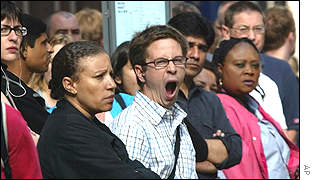 Londoners queue for a bus during the Tube strike
We can all sit back and giggle at the fashion nightmares of platform shoes, velvet flares and perms on men.
We may not actually be in a 1979-style summer of discontent - summer would be a good start - but after five years of best behaviour the unions are starting to flex their muscles once again. But this time, instead of a "sunny Jim" Callaghan blundering about, we have a New Labour prime minister whose approach to the unions comes more from the Margaret Thatcher school of thought. Irritated by RMT Downing Street emphatically denies any suggestion that Tony Blair wants to pick a fight with the unions. And if that is not right, then it should be. Mr Blair may not like or understand trade unionism - he is pretty uncomfortable with the whole Labour movement thing - and he has been particularly irritated by the RMT�s loyalty pledge and the withdrawal of donations from some unions.
But he also knows that, if the unions were ever to comprehensively withdraw financial and political support, he would be in serious trouble. And, as industrial unrest shows signs of a comeback and the left appears back on the march, he knows a full scale fight with them can only lead down one of two roads. Concessions? He either ends up caving in after a long and bruising battle or he again follows the Thatcher route and declares all out war on them with echoes of the miners' strike. And, at a time when he already has enough battles on his hands, it seems unlikely he would want to follow either of those two paths. Many in his party are, therefore, urging him to offer the unions some concessions now - possibly with new laws similar to those in Europe and being demanded by the TUC. Mind you, the unions have their own problems as well. Their members are increasingly fed up with "their" government failing to deliver and are putting their leaders under pressure to do something about it. Arthur Scargill The more realistic leaders know that, politically, however, they have nowhere else to go. The downside of that, of course, is that they can't just walk away from Labour and start supporting, say, the Liberal Democrats or Arthur Scargill's "barmy army".
Instead, they have to use all their influence to change Labour from within. And that is a recipe for conflict. The result is that Mr Blair's union troubles are now coming on several fronts. Wednesday saw the first mass strike by the public sector since the infamous winter of discontent in 1979. Strikes a chord Thursday has seen both London pitched into commuter chaos by another tube strike led by left winger Bob Crow and the victory of his comrade Derek Simpson as leader of the giant Amicus union. Simpson's victory may have a lot to do with the fact that the current leader and ultra Blair loyalist, Sir Ken Jackson, has hit 65 but refused to resign.
But there is more to it than that. As the GMB�s John Edmonds pointed out, every trade unionist who has recently won an election has done so after attacking New Labour. Such rhetoric strikes a chord with union members nowadays. None of this should come as a huge surprise to anyone. The prime minister has spent many words attacking "wreckers" and "forces of conservatism" and allowed his spin doctors to then identify the unions as his target. He has poured money into the public services, which are staffed by some of the poorest paid workers in the land, insisted the cash should go into front line services not pay deals - and then declared the industrial action is none of his business. Let down But this has been building for years. The unions were hugely loyal to New Labour in two general elections. After two decades of the Tories no one wanted to risk a Labour defeat in 1997. The prime minister promised them only "fairness not favours" and, in return for their loyalty, they were given the minimum wage and some more union-friendly laws. But large numbers of union members, possibly even the majority feel let down, even put upon by the government. And, of course, they are always more likely to take on a Labour government which they believe should be putting their interests high on the agenda than challenge a Tory administration from whom they expect nothing. Long hot summer It must also be noted that all this activity comes just weeks ahead of the conference season. Union leaders are bound to face pressure from their membership at the TUC in Blackpool in September and there is always a flurry of activity before the conference as the leaders attempt to woo their rank and file. But, whereas it has previously been mostly talk, this time the anger at the government and Blairite leaders is leading to action. And it is highly likely there will be more to come. So, if the weather doesn't provide a long hot British summer, it is quite possible the unions will. | |
Internet links:  The BBC is not responsible for the content of external internet sites | ||||||||||||||||||||||||||||||||||||||||||||||||||||||||||||||||||||||||||||||||||||||||||||||||||||||||||||
| |
|  E-mail this story to a friend E-mail this story to a friend |
| |
|
| | | ||
 | ||||
 | | Back to top
| ||
| ---------------------------------------------------------------------------------- To BBC Sport>> | To BBC Weather>> | To BBC World Service>> ---------------------------------------------------------------------------------- © MMIII | News Sources | Privacy |