|
 |
 | | | | | | ||||||||||||||||||||||||||||||||||||||||||||||||||||||||||||||||||||||||||||||||||||||||||||||||||||||
| | | You are in: UK: Politics | ||||||||||||||||||||||||||||||||||||||||||||||||||||||||||||||||||||||||||||||||||||||||||||||||||||||||
|
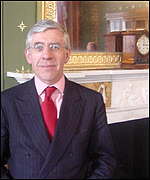
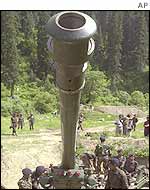
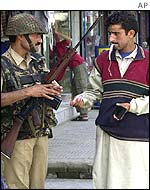
| | Tuesday, 9 July, 2002, 07:47 GMT 08:47 UK Straw answers your Kashmir questions Indian forces are still on high alert As tensions between India and Pakistan continue over the Kashmir region, UK Foreign Secretary Jack Straw is due to visit Islamabad and New Delhi again this month for talks. In an interview with BBC News Online, Mr Straw has answered some of your questions about the fragile situation. A.H. Cemendtaur, from the US, asked how Mr Straw could convince the leadership of the two countries to resolve their conflict once and for all, and start working for the betterment of their people.
"What we can do is to encourage both sides initially to take steps to de-escalate from the tension along the line of control and then, over time, to encourage them to dialogue. "In the end there can only be an agreement if Pakistan and India wills it. What we can do is try and create an environment in which that is easier." Many BBC News Online users asked what could be done to verify that cross-border terrorism has stopped at the line of control through the Kashmir region. Mr Straw said: "There has been some progress. It is an inherently intrinsically difficult issue. "There are various approaches one can use and what we try and do is pool all available information to make the best judgements that we can, but it is difficult.
"There may come a time when there is a ceasefire and there is a benign environment to monitor when there could be a role for the UN observers. "Such an observer force requires the consent of both sides and at present that has not been forthcoming." Mr Straw was also asked by hundreds of BBC News Online users about democracy in Kashmir, post-war UN resolutions for a plebiscite over Kashmir and a question from Istiaq Ahmed about whether there would ever be an independent Kashmir. He replied: "I am not going to predict the future. "The first stage of this is for there to be free and fair elections to the state assembly in Jammu and Kashmir.
"It was a very important announcement which may help ensure that there is a proper focus on the fairness of the elections. "Of course that has to go alongside a security situation which needs to be improved if people are able to feel free to vote." So what of the UN resolutions asked about by, among many others, Rahul Shah and Naseem Khan from the US, Parvaiz Ahmadzai and Nasim Zehra from Pakistan, Raza Effendi and Shakeib Arshad from the UK and Amir Ali, from Norway? "There is a series of UN resolutions from 1948, 1949 and 1950. They call for a variety of things, amongst other things for a plebiscite to determine whether Kashmir should be Indian or Pakistani.
"The resolutions themselves are the subject of diplomatic argument between India and Pakistan. "Pakistan says they are the basis for any settlement. India says they were superseded in their effect by a bilateral agreement in 1972. "We regard all UN resolutions, however what we have to do is look forward as well as back and take account of existing realities. "The straightforward reality is that, as then by the way, the resolution to this lies in the hands of India and Pakistan." Massarat Hussain, from the Republic of Ireland, said that at the very least Mr Straw should apologise for the UK's role at the time of partition. "For me to apologise for what the British government did when I was two would sound rather laughable, but there are for sure legacies of Britain's colonial past all over the world in which we deal. "Some are good and some are not so good. The legacy of Kashmir is in the category of being not so good." Radha Krishnan from the US and Bilal Patel from India asked about arms sales to the region by the UK. Mr Straw said he understood why some people found it difficult to appreciate why the UK was involved in arms sales to India and Pakistan.
"I have thought about this by the way, because my father was a conscientious objector who went to prison for his beliefs in the war. (the Second World War) "I have great respect for him but I have really thought it through and I don't take that view." He added: "Our arms exports are more strictly controlled than almost any other country in the world, along with the United States and Sweden. "We have clear criteria predicated on the basis that we will only export arms when the criteria are met." So what will the UK do in the future? "Our engagement is going to continue.
"And on the Pakistani side, action to deal with the terrorist camps and on the Indian side more action to deal with the human rights deficit in Jammu and Kashmir." | |
See also:  03 Jul 02 | South Asia 04 Jul 02 | UK Politics 06 Jul 02 | South Asia 01 Jul 02 | South Asia 28 Jun 02 | South Asia Internet links: The BBC is not responsible for the content of external internet sites | ||||||||||||||||||||||||||||||||||||||||||||||||||||||||||||||||||||||||||||||||||||||||||||||||||||||
| |
|  E-mail this story to a friend E-mail this story to a friend |
| |
|
| | | ||
 | ||||
 | | Back to top
| ||
| ---------------------------------------------------------------------------------- To BBC Sport>> | To BBC Weather>> | To BBC World Service>> ---------------------------------------------------------------------------------- © MMIII | News Sources | Privacy |