
|
 |
 | | | | | ||||||||||||||||||||||||||||||
| | You are in: UK Politics | ||||||||||||||||||||||||||||||||
 | | Monday, 18 March, 2002, 19:57 GMT The Falklands: 20 years on 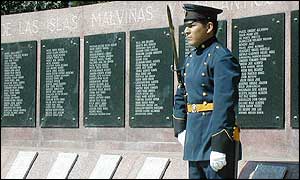 Guard at Malvinas war monument in Buenos Aires
In the centre of Buenos Aires, British and Argentine flags fluttered side by side above a monument built to commemorate a war fought between the two countries just two decades ago. When the British Defence Secretary, Geoff Hoon, arrived to lay a wreath to 652 Argentine soldiers killed in the Falklands war, his visit attracted just three flag-waving protesters. And yet, Argentines remain utterly committed to the islands they call the Malvinas.
"They are ours. Definitely," says retired Lieutenant Colonel Carlos Doglioli, who in 1982 was aide de camp to the island's military governor, Major General Mario Menendez. "They were, they are and they shall be. That's a fact." But Argentina, Mr Doglioli insists, will never again go to war to retrieve the islands. He believes a solution has to be found which, as he puts it, achieves "the miracle of you staying but leaving". He believes the current negotiations between Britain and Spain over the future of Gibraltar point the way forward. And even if Argentina wanted to retake the islands by force, it could not. Outdated military "There doesn't exist such a capability," he says, pointing out that Argentina's army has been cut from around 100,000 in 1982 to just 40,000 now. Missile systems which were relatively new in the early eighties and, in the case of the Exocet, lethally effective, are now mostly outdated. A policy of deliberate disarmament, carried out by a succession of civilian governments precisely to prevent any future adventurism by the armed forces, has been compounded by the impact of Argentina's recent economic crisis.
Now 20 years on, the graffiti on the walls is all about the present crisis. With the currency devalued and people unable to retrieve their money from the banks, there are more important things to think about than the Falklands. Speaking to an audience that included officers involved in the 1982 conflict, Mr Hoon said: "It grieves the UK to see Argentina and its indomitable people suffering the deep and prolonged... crisis that it has been going through." Across the chilly waters of the south Atlantic, Britain's military presence on the islands is rather more imposing now than it was 20 years ago. 'Anxious future' When Argentine forces invaded, they encountered fewer than 100 lightly armed Royal Marines. Surrender was swift. Now the islands are home to around 2,000 military personnel based at the sprawling Mount Pleasant Airbase. Incoming aircraft are accompanied on their final approaches by Tornado F3 jets.
The government spends at least �70m a year to run the islands' defences, roughly equivalent to Argentina's entire annual military budget. But if islanders no longer live in fear of Argentina's military intentions, that does not mean the future is necessarily assured. Don Bonner, who as Governor Rex Hunt's chauffeur in 1982 briefly wielded an empty shotgun in the face of Argentina's invading soldiers, admits to feeling anxious. Tiny population "Lots of people say the way Gibraltar will go, we might go," he told me over a drink in The Upland Goose, one of Stanley's two hotels. And the island faces another fundamental problem - its tiny population of around 2,500. "The thing we lack is people," says Mr Bonner.
"That's why we have British forces based here, why we support the Falkland Islands to the extent that we do," he said. "And that will continue." The last 20 years have been largely successful ones for the islands. Tourism and the sale of fishing licences have brought in a measure of wealth unknown before the war. "General Galtieri really did us a favour when he invaded," said Mr Bonner, who says the war helped to put these far flung scraps of British soil on the map. War memorial "It wasn't a very nice thing to do, but I think we were the luckiest people that was ever mixed up in a war." A long-running dispute over the size and design of an Argentine war memorial, near Darwin, was finally resolved earlier this month. Islanders had objected to earlier Argentine designs, which they condemned as inappropriate. Behind a white picket fence, 231 crosses are adorned with plastic flowers, rosary beads and crucifixes left by visiting Argentine relatives. It is a desolate, windswept place, an eloquent testament to one of recent history's more bizarre and unnecessary wars. | | See also:  Internet links: The BBC is not responsible for the content of external internet sites Top UK Politics stories now:  Links to more UK Politics stories are at the foot of the page. | ||||||||||||||||||||||||||||||
|
Links to more UK Politics stories |
 | | ^^ Back to top News Front Page | World | UK | UK Politics | Business | Sci/Tech | Health | Education | Entertainment | Talking Point | In Depth | AudioVideo ---------------------------------------------------------------------------------- To BBC Sport>> | To BBC Weather>> ---------------------------------------------------------------------------------- © MMIII|News Sources|Privacy  |




 E-mail this story to a friend