The population of sparrows is falling in UK cities with numbers thought to have halved in the past 25 years, a new survey reveals.Picture courtesy Steve Knell
There are huge variations in sparrow numbers across the UK 
|
The study, conducted in gardens across the country, found Lincoln had the highest proportion of sparrows while London had the lowest. About 250,000 households across the UK took part in the survey conducted by the Royal Society for the Protection of Birds (RSPB).
They counted the number of sparrows in their gardens between 3 May and 11 May, during the bird's breeding season.
The population is thought to have slumped to between six and seven million pairs since a high of 12 million in the early 1970s.
League table
The survey found an average of 7.3 sparrows were seen at homes where food was provided year-round, but the average fell to only 3.8 at homes where food was not provided.
In Lincoln, there were 9.41 sparrows per garden compared to 4.53 in London, bottom of the RSPB's league table.
Manchester, Glasgow, Edinburgh, Birmingham and Liverpool also recorded low numbers.
 |  If you do have house sparrows we urge you to look after them If you do have house sparrows we urge you to look after them  |
Richard Bashford, RSPB house sparrow survey co-ordinator, said: "This survey gives us a better idea of where house sparrows are in the UK. In turn this should help us to identify the factors behind the decline." The survey was carried out by the RSPB after reports a few years ago that numbers were falling.
This prompted the RSPB to organise a pilot survey in London in 2002 which showed a large decline in the "cockney sparrow".
Mystery decline
The results of this latest survey will be used to help piece together the reasons behind the decline of house sparrows, and to also offer guidance to people wanting to help them.
| 1950s UK house sparrow population estimated at 9.5 million pairs Increased to 12 million by early 1970s, then declined Population crashed during the 1990s and now stands at six to seven million pairs Now red listed as a species of high conservation concern |
> Mr Bashford said: "Now that we've established the pattern of house sparrow distribution, we want to look in more detail at what factors are responsible for the variations. "Once you've lost house sparrows it's not easy to encourage them back as we know they tend to stay within a mile or so of where they hatched.
"However, they are thought to have three basic requirements to keep populations healthy: nesting sites, adult food, which is a year round supply of seeds, and chick food, consisting of a range of small insects.
"So if you do have house sparrows we urge you to look after them."
The RSPB has a simple three point plan to help house sparrows:
Put up nest boxes. Many new houses and home improvements have restricted the number of suitable nooks and crannies for house sparrows to nest in Feed sparrows throughout the year and supply clean water. They feed mainly on seeds, especially cereal grain, but also seeds of grasses, polygonums, mouse-ear and chickweed Leave wild, weedy or shrubby areas in the garden that provide a natural seed source and supply of small insects. 


 One-Minute World News
  News services

 E-mail this to a friend
  Printable version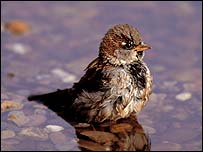
 In detail
![House sparrow [picture courtesy Andy Hay and rspb-images.com]](http://newsimg.bbc.co.uk/media/images/39262000/jpg/_39262737_sparrow286901_203.jpg)
