|
 |
 | | | | | | ||||||||||||||||||||||||||||||||||||||||||||||||||||||||||||||||||||||||||||||||||||||||||||||||||||||||||
| | | You are in: UK: England | ||||||||||||||||||||||||||||||||||||||||||||||||||||||||||||||||||||||||||||||||||||||||||||||||||||||||||||
|
| | Wednesday, 7 August, 2002, 17:19 GMT 18:19 UK Mobiles may help find missing girls 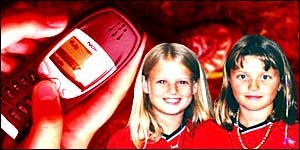 Holly (left) and Jessica had a mobile phone with them As the search for 10-year-olds Holly Wells and Jessica Chapman intensifies in the UK, communications experts explain how important the girls' mobiles phones may be in the investigation. Thanks to the latest technology, emergency services can now track a person using a mobile telephone to within metres. In big cities, that can mean pinpointing someone to within 40 metres but in the open country, that stretches to a much wider area.
Even if Jessica's phone was switched on, if the battery was charged and if she had sufficient credit to make or receive a call, the possibility of picking up a good enough signal to track them down to an area smaller than Soham is remote. Bryony Clow, a mobile phone tracking expert from Vodafone, said there was one mobile base station in the town, one about six kilometres south east and one six kilometres north west. Between them they would cover Soham and up to 20 miles around it, though the signal would fade substantially the further it was from the mast. She said: "If there is a telephone in that area, and it is switched on, hypothetically it will be picked up by one of them but of course that depends on whereabouts it is and whether it has credit.
There is also the possibility of accessing Jessica's last call and text message records, she said. Forensic engineers are already searching through messages the missing children may have sent in the hope of finding clues to their whereabouts. Vodafone keeps call and text records for over a year, Ms Clow explained, and has cooperated with police inquiries of this kind before. Battery "Whether it was the Jill Dando murder or a missing person, mobile phone companies have often been able to help. "Even in car chases, if a criminal has left his or her mobile on in the car, we can follow the vehicle across counties in a way, sometimes even the police can't," she added. Attempts were made to ring Jessica's mobile on Sunday when the girls were first reported missing but there was no response. Cambridgeshire Police are still trying to establish whether it is because the battery is dead or whether the credit on the pre-paid phone is empty.
The parents of missing teenager Amanda Dowler also tried to find their daughter through her mobile phone. The 14-year-old - known as Milly - vanished in March while walking home from the train station in Walton-on-Thames, Surrey. Traditional methods Her mother sent a flurry of text messages in an attempt to contact her - but to no avail. Ian Brown, director of the Foundation for Information of Policy Research, said that while currently mobiles can be used to pinpoint people to about 15 metres, when so-called Third Generation phones become more prevalent finding someone will become easier, quicker and more accurate.
"In the future, mobile companies will develop many more location-based services, so not only will they be able to tell exactly where someone is standing but they will also be able to send you a recommendation for the restaurant you may be standing opposite." Mr Brown explained that lawmakers in American were planning to introduce legislation that meant mobile companies would be obliged to introduce such technology within two or three years, specifically to help the emergency services. Called the e911 (enhanced 911) project, the idea is that all phones will have the capacity to send a signal back to police, fire or ambulance staff telling them exactly where they are. Until then, police, it seems, will have to rely on more traditional methods of searching. | |
  Internet links: The BBC is not responsible for the content of external internet sites Top England stories now: Links to more England stories are at the foot of the page. | ||||||||||||||||||||||||||||||||||||||||||||||||||||||||||||||||||||||||||||||||||||||||||||||||||||||||||
| |
|  E-mail this story to a friend E-mail this story to a friend |
| |
| Links to more England stories |
| | | ||
 | ||||
 | | Back to top
| ||
| ---------------------------------------------------------------------------------- To BBC Sport>> | To BBC Weather>> | To BBC World Service>> ---------------------------------------------------------------------------------- © MMIII | News Sources | Privacy |