|
 |
 | | | | | | ||||||||||||||||||||||||||||||||||||||||||||||||||||||||||||||||||||||||||||||||||||||||||||||||
| | | You are in: UK: Education: Mike Baker | ||||||||||||||||||||||||||||||||||||||||||||||||||||||||||||||||||||||||||||||||||||||||||||||||||
|
| | Saturday, 8 June, 2002, 06:42 GMT 07:42 UK Concerns over AS-level demands
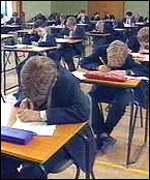
It was like 'Groundhog Day'. Just as they had done exactly a year ago, head teachers spent much of their annual conference this week complaining about the chaos being caused in schools by the new AS-levels. It seems this year's overload is just as bad as it was in the first year of the new examination last year. How could this be so? After all have we not just had a government review of the AS-level? Did it not make recommendations which, we were assured, would iron out the teething problems of the first year? The horror stories abounded. There was the school which is having to stage so many exams this summer that each day it is using up to 19 different rooms as temporary examination halls. Normal activities in the gymnasium and the assembly hall have been suspended for the duration. Another school had as many as 10 different examinations - GCSE, AS and A-level - to run in a single morning or afternoon session. Inevitably there have been timetable clashes and some students have had to be supervised overnight in teachers' homes so they can be isolated until they can catch up with the papers they should have taken earlier. Cost of fees There has been another problem: The rising cost of examination fees. The arrival of the AS-level has boosted a typical secondary school's exam entry fees from around �65,000 a year to more like �90,000.
It is like a horse facing the first hurdle before it has got into its stride and rounded the first bend. So what is to be done? Just scrapping AS-levels would be a mistake. There had for a long time been a need to broaden the range of A-level studies in sixth forms in England and Wales. Gold standard The traditional three subjects was just too narrow for most young people who will need a wider variety of skills and knowledge in today's much more varied work-place. So the principle of the AS was good. But, of course, it was a compromise born out of politicians' fears about tampering with what Lady Thatcher had called the "gold standard" of A-levels. My daughter, currently deep into her GCSEs, has already had to make her AS-level choices. Like most 15 year olds she is still far from clear what really interests her or where her future studies will take her. She has played safe and plumped for four AS-level subjects with which she feels comfortable: History, economics, sport studies and biology. No foreign language Now that is not a very broad range. If she had been required to take a fifth subject, she would probably have added a foreign language.
Yet on the Continent, baccalaureate-style studies usually encompass six subjects with a requirement to range across the arts, sciences and humanities. So where have we gone wrong? We have managed to over-load our students with examinations: national tests at seven, 11 and 14, followed by formal qualifications at 16, 17 and 18. Yet we still have a very narrow curriculum after 16. GCSE obstacle The problem is that we do not have a coherent view of education from age 14 to 18. Instead we have a rigid system from 14 to 16, followed by an almost unrelated system from 16 to 19. And what is the big obstacle? Why, of course, it is the GCSE, taken at age 16. In the distant past there was a need for a final set of examinations at the point when the majority of youngsters left full-time education. But today only a tiny minority leave school, or full-time education, at 16. Abolishing GCSEs Now, if we could shift, or abolish, the GCSE it would be possible to create space for a three-year sixth form. This would allow time for genuine breadth with students taking five or six subjects. The AS could remain, but would be examined after two years not two terms, and students could drop one or two subjects for their final A-level year.
The GCSE should be brought forward a year, to the end of Year 10. After this point students could choose either the three-year AS and A-level route or a two or three year vocational route. The national tests at 14 should also be brought forward a year. New look timetable So the new secondary school pattern might look like this. Year 7 to settle into the new pattern of secondary schooling. Year 8 should lead to the national tests in English, maths and science. Year 9 and 10 would be a two-year run-up to GCSEs. With Years 11, 12 and 13 for vocational or AS and A-levels. This would bring us closer to continental Europe where the academic/vocational pathways branch out earlier. Of course, there should be a common core of skills to both pathways, so pupils can move between them or even mix-and-match vocational and academic courses. There are some problems with all this. The standard of GCSEs would have to be lowered if pupils are to take them a year earlier. Wary politicians This would make year-on-year comparisons difficult. Politicians are wary of taking such actions. The Labour government, in particular, does not want to give any ammunition to critics who might say they are being soft on standards by downgrading an important examination. But, if they believe in broadening sixth form studies for the good of young people and for the health of the economy, it is perhaps a risk worth taking. Schools and parents are, understandably, wary of major upheaval and there is a risk of creating another generation of guinea-pig pupils. Unlike recent educational change, any changes to the GCSE should be piloted and evaluated carefully before being implemented. But to do nothing will leave us with the worst of both worlds: over-tested students who abandon a broad range of subjects too early in their lives. We welcome your comments at educationnews@bbc.co.uk although we cannot always answer individual e-mails. | | See also:  06 Jun 02 | UK Education 06 Jun 02 | UK Education 21 May 01 | UK Education Internet links: The BBC is not responsible for the content of external internet sites | ||||||||||||||||||||||||||||||||||||||||||||||||||||||||||||||||||||||||||||||||||||||||||||||||
| |
|  E-mail this story to a friend E-mail this story to a friend |
| | | ||
 | ||||
 | | Back to top
| ||
| ---------------------------------------------------------------------------------- To BBC Sport>> | To BBC Weather>> | To BBC World Service>> ---------------------------------------------------------------------------------- © MMIII | News Sources | Privacy |