By Justin Parkinson
BBC News Online education staff |

Loved only by rats and scavenging birds, kebab wrappers have become an urban pariah to rank with panpipe players and street charity promoters.
The meaning of kebab wrappers in Adam O'Meara's own words 
|
But a young artist has taken pity on the fallen doner, elevating its remains to the status of a document of our times.
Adam O'Meara wandered the early-morning streets of England for months, collecting hundreds of wrappers to snap for his photography degree.
He said: "In their own way they are beautiful. The bits of vegetables, meat, fat stains, pitta bread and sauces show traces of the people who have eaten them.
"The kebab paper is like a photograph of what happened last night and it even looks a bit like a negative."
'Milder in the South'
According to Adam, 32, wrappers differed widely from town to town.
In the North, customers liked hot chilli sauce, while those in the South preferred dainty mint sauce.
In some towns papers were quite pristine. Elsewhere they had been driven over or ripped to shreds in an alcohol-induced frenzy.
 |  My main rivals were crows. They didn't like me taking their dinner and let me know it My main rivals were crows. They didn't like me taking their dinner and let me know it  |
Adam said: "The variety of wrappers is immense. No one is ever the same as another.
"I can't explain the general trend. Perhaps the weather in the North makes people prefer hotter sauces."
He added: "The idea for studying them came to me one Saturday night after going out drinking. I was definitely under the influence of alcohol.
"The whole experience of going into kebab shops at two in the morning after the club is something I quite enjoy. The wrappers are a reminder of that.
"I just looked at them on the floor and saw the kebab bits lying there. They looked beautiful."
'Lovely grub'
Adam, then a postgraduate student at De Montfort University in Leicester, visited 13 towns, collecting around 300 wrappers.
He later submitted photographs of some of them for his final degree project.
 Britons are eating - and disposing of - more and more kebabs |
Adam said: "I always went out at about four or five in the morning on a Sunday, when no one else was around. I had to, because street cleaners are up pretty early.
"In fact, my main rivals were crows. They didn't like me taking their dinner and let me know it. It felt like a Hitchcock film at times."
Kebabs were developed by nomadic Turks hundreds of years ago when they learned to grill and roast meat over camp fires.
Doner kebabs are made by stacking alternate layers of ground meat and sliced leg of lamb.
Adam, who passed his course and has started working as a lecturer at Lincoln University, said: "Kebab-eaters in the South are getting a more authentic version, as Turks prefer them with milder sauces.
"Either way, they are lovely to me."


 One-Minute World News
  News services

 E-mail this to a friend
  Printable version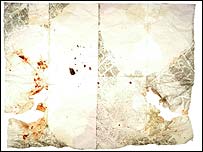
 In pictures
