
|
 |
 | | | | | | ||||||||||||||||||||||||||||||||||||||||||||||||||||||||||||||||||||||||||||||||||||||||
| | | You are in: UK: Education | ||||||||||||||||||||||||||||||||||||||||||||||||||||||||||||||||||||||||||||||||||||||||||
|
| | Wednesday, 20 November, 2002, 12:08 GMT Infant class sizes rise 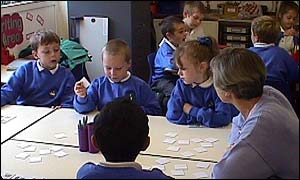 There are more adults per pupil, with many teaching assistants The number of infants in England being taught in classes of more than the legal limit of 30 pupils has shot up by almost a third in a year.
These amounted to less than 1% of the total number of classes, 62,200 - but the average infant class size has also increased slightly, from 24.4 to 24.5. Backing up one of its main election pledges, Labour legislated to outlaw classes of more than 30 for children aged five, six and seven after coming to power in 1997. The latest figures mean it has missed its target of eliminating classes of more than 30 by 2002. It has now decided to stop counting the children each September. Checks continue Exceptions are permitted and government statisticians say 269 classes contained 31 or more pupils where children had been admitted as "excepted pupils", compared with 150 a year earlier.
Some schools stagger their intakes during the first few weeks of the autumn term so infant classes might be even bigger than on the census date of 19 September. There was at least one teaching assistant as well as the teacher for 85% of the children in classes of 31 or more pupils, compared with almost 77% in September 2001. On average there were 13.7 pupils to every adult compared to 14.1 in September 2001. Raising standards The Education Secretary, Charles Clarke, said: "Since 1998, we have massively reduced the number of infants in classes of more than 30. "This year, we have sustained this policy: nearly every five to seven year old is still being taught in smaller classes. "Reducing class sizes has played an important part of our strategy to raise standards." He said the government would continue to concentrate on recruiting more highly skilled teachers, supported by an increased number of teaching assistants. 'Hollow' pledge His Conservative shadow, Damian Green, said: "Parents will rightly be worried by this trend towards higher class sizes, which is a betrayal of one of the government's original five pledges." The problem was "the culture of setting far too many targets" - so that when ministers' attention moved on to new targets, "slippage" often occurred. "We have already seen serious failure to hit the targets for literacy and numeracy standards among primary school pupils," he said. "The government's claim to have 'sorted' primary education looks pretty hollow today." Counting change The September count of class sizes was introduced in 1998 to monitor the reduction of infant classes following the government's pledge to reduce them. But from now on it is going to monitor class sizes instead through the annual January census of schools. The figures mean the government just failed to meet its target that by 2002 infant class sizes would be 30 pupils or fewer. The School Standards and Framework Act 1998 required all infant classes to meet the limit from the start of the 2001-02 school year. The associated regulations allow the limit of 30 to be exceeded for children who:
A spokesman for the Department for Education said some of the oversize classes were now "compliant with the law" but edcuation authorities would discuss with the remaining schools ways in which they could meet the limit. "We will work with schools to help resolve the situation," he said. "If schools don't meet the legal limit on infant classes and do not have a permitted exception, they may receive a direction from the secretary of state to reduce the class sizes and this may be enforced by the courts." No schools were prosecuted last year. | | See also:  01 May 02 | Education 05 Feb 02 | Wales 15 Nov 01 | Education 24 May 01 | Education Internet links: The BBC is not responsible for the content of external internet sites Top Education stories now: Links to more Education stories are at the foot of the page. | ||||||||||||||||||||||||||||||||||||||||||||||||||||||||||||||||||||||||||||||||||||||||
| |
|  E-mail this story to a friend E-mail this story to a friend |
| |
| Links to more Education stories |
| | | ||
 | ||||
 | | Back to top
| ||
| ---------------------------------------------------------------------------------- To BBC Sport>> | To BBC Weather>> | To BBC World Service>> ---------------------------------------------------------------------------------- © MMIII | News Sources | Privacy |





