
|
 |
 | | | | | | ||||||||||||||||||||||||||||||||||||||||||||||||||||||||||||||||||||||||||||||||||||
| | | You are in: UK: Education | ||||||||||||||||||||||||||||||||||||||||||||||||||||||||||||||||||||||||||||||||||||||
|
| | Wednesday, 7 August, 2002, 10:45 GMT 11:45 UK US push for school voucher expansion 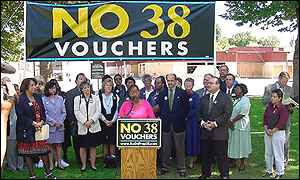 Vouchers were rejected in a California referendum School vouchers are back on the agenda in the United States. Up to 20 states across the country could be facing attempts to introduce voucher schemes which would give parents public money to pay for private education. But a court has blocked a voucher scheme in Florida, despite the support for vouchers of the state governor, Jeb Bush. The state will now appeal against a judge's ruling that the Florida state constitution forbids using public funds to pay fees for religious schools. Many local schemes had been delayed by doubts over the legitimacy of using state funding for religious schools - which critics had claimed breached the constitutional separation of state and religion. Court support But a landmark ruling by the Supreme Court, earlier this summer, allowing school vouchers for religious schools has given a fresh impetus to those campaigning for their introduction. And state legislators will now be considering attempts to push through voucher schemes. In Kansas, Republican Senator Kay O'Connor is planning to introduce a voucher bill in January 2003. "This is the first year that there seems to be a real surge of interest in school choice, so I hope to be able to take advantage of it," she said. Another Republican, Kevin Glynn, is intending to introduce a voucher bill in Maine next year. Right wing School vouchers have long been a feature of right-wing education policy, both in the United States and in the United Kingdom. Parents would receive a voucher which they could spend on an alternative school, either in the state or private sector. Supporters say that this can provide more choice for children stuck in failing inner city schools. And they argue that vouchers would be a way of rescuing communities trapped in a cycle of educational underachievement. Opponents say that vouchers drain funds from already deprived state schools - and that they would undermine the public education system. There have also been claims that despite promising to help the poor, vouchers would in practice become a subsidy for middle class families already using private schools. And opponents say that vouchers are more about free-market ideology rather than practical attempts to improve school standards. School vouchers, which were supported by President Bush in his election campaign, have failed to find clear support among parents. The largest referendum on school vouchers, held in California two years ago, was won by a large margin by anti-voucher campaigners. Research last autumn from a US public spending watchdog found that school vouchers had not made any measurable difference to pupils' results. The research was carried out on behalf of the US General Accounting Office, which scrutinises public spending on behalf of Congress. | | See also:  28 Jun 02 | Americas 06 Feb 02 | Education 08 Nov 00 | Education 02 Oct 01 | Education Top Education stories now: Links to more Education stories are at the foot of the page. | ||||||||||||||||||||||||||||||||||||||||||||||||||||||||||||||||||||||||||||||||||||
| |
|  E-mail this story to a friend E-mail this story to a friend |
| |
| Links to more Education stories |
| | | ||
 | ||||
 | | Back to top
| ||
| ---------------------------------------------------------------------------------- To BBC Sport>> | To BBC Weather>> | To BBC World Service>> ---------------------------------------------------------------------------------- © MMIII | News Sources | Privacy |



