UK forces have been in Afghanistan for almost a decade. The death toll now exceeds that of the Iraq war and more than 100 soldiers died last year. Read key facts and figures about the war, and the British and other international forces fighting the Taliban and engaged in reconstruction work.
Highest monthly death toll comes in July 2009, with 22 dead, as a major offensive against the Taliban begins in the south.
Manpower
British and other ISAF troops face a determined enemy in the Taliban. The insurgents consist mainly of Afghans, though numbers of Arab and Uzbek fighters are also be involved. Groups of fighters are usually organised along local and tribal lines and led by a senior, experienced commander.
Here we compare a British soldier with his Taliban counterpart.
British soldier
Main weapons: Standard issue SA-80 rifle, L1A1 12.7 mm Heavy Machine gun, 81mm Mortar
Strengths: Highly-trained, well-supported professional soldier with modern equipment. Air support available
Weaknesses: May struggle to adapt to fighting in the harsh Afghan environment. Lacks intimate knowledge of local landscape, may face hostility and distrust from civilians
Taliban fighter
Main weapons: Kalashnikov AK-47 assault rifle, Rocket-Propelled Grenades.
Strengths: Tenacious, well-supplied guerrilla force highly adapted to local climate and geography. Can blend in with local population when required.
Weaknesses: Vulnerable to air attack. Few heavy weapons. Factional nature can mean shifting loyalties. Poor weapons-handling skills.
Mobility
Mobility is a major factor in guerrilla warfare and Taliban fighters often operate as a 'pick-up truck cavalry' force in adapted four-wheel drive vehicles such as the Toyota Hi-Lux.
ISAF forces tend to rely on heavier armoured vehicles.
Mastiff II
Defences: Heavy armour and V-shaped hull to protect against roadside bombs and mines.
Strengths: State-of-the-art, heavily armed, armoured patrol vehicle designed to carry 8 soldiers and 2 crew.
Defences: Some carry RPG launchers, heavy machine guns.
Strengths: Hard-wearing, fast, reliable off-road transport for up to 10 Taliban fighters.
Weaknesses: No armour, variable levels of mechanical support.
Cost: Approximately $10,000 in local terms.
Casualties
The true number of civilians killed in the Afghan conflict will probably never be known. ISAF has only recently begun to count the numbers of civilians killed. The estimates below are based on estimates provided by a range of agencies together with local and international press reports.
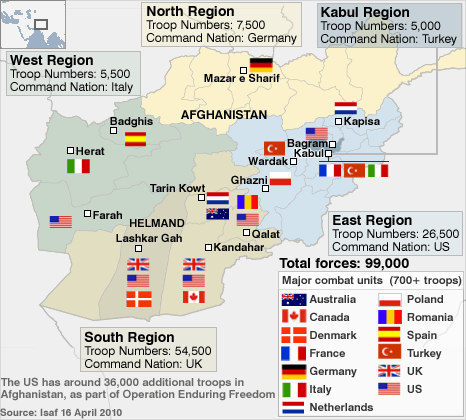
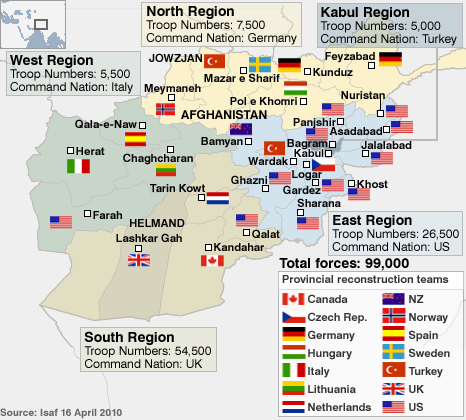
Numbers of troops
Albania
250
FYROM*
215
Norway
470
Australia
1,550
Georgia
175
Poland
2,515
Austria
3
Germany
4,365
Portugal
105
Azerbaijan
90
Greece
70
Romania
1010
Belgium
590
Hungary
360
Singapore
40
Bosnia and Herzegovina
10
Iceland
4
Slovakia
230
Bulgaria
525
Ireland
7
Slovenia
75
Canada
2,830
Italy
3,300
Spain
1,270
Croatia
290
Jordan
6
Sweden
485
Czech Rep
460
Latvia
115
Turkey
1,795
Denmark
750
Lithuania
145
Ukraine
10
Estonia
155
Luxembourg
8
UAE
10
Finland
100
Netherlands
1,885
UK
9,500
France
3,750
NZ
225
US+
32,415
Total (approx.): 73,554
* Former Yugoslav Republic of Macedonia
+ The US has around 36,000 additional troops in Afghanistan as part of Operation Enduring Freedom
 One-Minute World News
 E-mail this to a friend
  Printable version




 Albania
 FYROM*
 Norway
 Australia
 Georgia
 Poland
 Austria
 Germany
 Portugal
 Azerbaijan
 Greece
 Romania
 Belgium
 Hungary
 Singapore
 Bosnia and Herzegovina
 Iceland
 Slovakia
 Bulgaria
 Ireland
 Slovenia
 Canada
 Italy
Italy Spain
Spain Croatia
 Jordan
 Sweden
 Czech Rep
 Latvia
 Turkey
 Denmark
 Lithuania
 Ukraine
 Estonia
 Luxembourg
 UAE
UAE Finland
 Netherlands
 UK
UK France
 NZ
NZ US+
US+


 BBC News


Bookmark with:
What are these?