Five men have been jailed for a total of 56 years after being convicted of helping the bombers in the aftermath of the failed London attacks on 21 July 2005. But what exactly did they do? | THE CONVICTED MEN Muhedin Ali (pictured) Siraj Ali Abdul Sherif Wahbi Mohammed Ismail Abdurahman |
To many people helping a terrorist is helping a terrorist, but there is a subtle distinction between two of the convicted men and their three co-defendants.
The jury at Kingston Crown Court decided that Siraj Ali and Wahbi Mohammed had actually known about the plot beforehand and had failed to notify the authorities.
In contrast the other three - Abdul Sherif, Muhedin Ali and Ismail Abdurahman - were only convicted of helping them evade capture after the attacks.
So what were their roles?
ABDUL SHERIF
Sherif was the brother of bomber Hussain Osman and his role was mainly in assisting him to escape to Italy after the failed attacks of 21 July 2005.
Osman fled initially to Brighton but then headed back to London, equipped with his brother's passport.
Because of the close facial similarity between the brothers, Osman was able to board a Eurostar train to Paris and from there he travelled to Italy, where he was eventually captured and extradited back to Britain.
Sherif had also made numerous phone calls to Italy to arrange a safe house for his brother in Rome.
WAHBI MOHAMMED
Wahbi Mohammed's brother, Ramzi, was the bomber who tried to explode his device on a Tube train at the Oval.
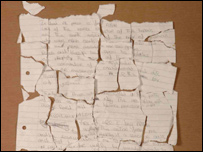
| Ramzi Mohammed's suicide note, reconstructed by police. 
|
Wahbi was present at his brother's home in Dalgarno Gardens in North Kensington on the morning of 21 July as the bombers set off on their murderous mission.
He took possession of a suicide note which Mohammed had written to his wife and children. He was also found in possession of a video camera on which his brother is believed to have made a final video which would probably have been broadcast after his death, as was the case with 7 July bomber Mohammed Sidique Khan.
 Abdul Sherif (right) lent his brother Hussain Osman his passport |
When his brother's bomb failed to go off and he was not killed - as planned - Wahbi disposed of the video tape and tore up the suicide note.
He also took food and other items to Ramzi and fellow bomber Muktar Ibrahim as they lay low in the Dalgarno Gardens flat in the week after the failed bombing.
SIRAJ ALI
Siraj Ali, who had been fostered by the same family as 21 July bomber Yassin Omar, lived in the same block of flats as him in Southgate, north London.
Omar's flat at Curtis House was used as a bomb factory by the gang and a considerable number of incriminating items were found in Ali's apartment.
 Incriminating items were found in Siraj Ali's flat |
Among them was a notepad bearing calculations for a detonator and main charge of an improved explosive device and notes describing the steps leading to "martyrdom".
Police also found a business card from a firm where the gang had bought large amounts of hydrogen peroxide, the main ingredient for the bombs.
ISMAIL ABDURAHMAN
Abdurahman provided Hussain Osman with a refuge in south London after the attacks.
Osman stayed at his home in Vauxhall until he was able to flee the country.
Abdurahman also retrieved a video camera, believed to have been used to record suicide videos, and fetched Osman's brother's passport for him and tried to buy a Eurostar ticket for him.
MUHEDIN ALI
Ali, who was from Ethiopia, was a close friend of Osman and the Mohammed brothers.
After his arrest in January 2006 police found Ramzi Mohammed's suicide note, which had been passed from Ramzi to Wahbi and had been handed over to Ali for delivery to Ramzi's family after the attacks.


 One-Minute World News
  News services
 E-mail this to a friend
  Printable version
 Enlarge Image


Bookmark with:
What are these?