The Scottish Parliament building has won this year's �20,000 Stirling Prize, awarded by the Royal Institute of British Architects for the building which has made the biggest contribution to British architecture in the past year. BBC News profiles the winning building, and the other five which were in the running for the prestigious annual prize.
THE SCOTTISH PARLIAMENT, EDINBURGH
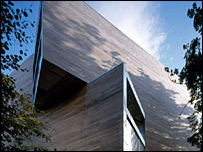
The Scottish Parliament, reviewed last August in this story by Jonathan Duffy, has been the source of great controversy, mainly because of its overrun budget.
But the judges were impressed with the quality of the building, whose architects were EMBT/RMJM Ltd, calling it "a remarkable architectural statement which has an enormous impact not only on the visitors to the building but also on the users who repeatedly move through a series of extraordinary spaces and their changing effects".
They added: "In its context the building manifests itself as an attempt at an organic transition between the city and the drama of the Scottish countryside surrounding it. An extremely successful landscaping makes this transition even more striking."
BMW CENTRAL BUILDING, LEIPZIG
This building, designed by Zaha Hadid Architects, lets you know immediately that car production is its central function thanks, the judges said, "to the nice conceit of half-finished Beamers gliding above your head on elevated conveyor tracks, making their silent stately way between the body shop and the paint shop, weaving above 500 office and production staff".
They added: "This building appears amongst the perfunctory BMW complex as powerful yet svelte - its form is a discrete sinew connecting to the blandness of the two sheds that make up the rest of an efficient looking car production plant which covers 400,000 square metres, the size of 50 football pitches."
LEWIS GLUCKSMAN GALLERY, UNIVERSITY COLLEGE, CORK
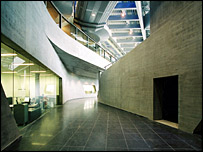
This gallery is in a key position at the entrance of the university. "On two sides it has a civic role in addressing the University and City beyond, on the other two a completely different, almost picturesque role, in settling into an important mature landscape," said the judges.
"That the building handles this difficult tension with apparent ease is the first mark of the incredible skill that the architects have brought to it."
They added that the building, whose architects were O'Donnell + Tuomey, "occupies the tight footprint of two previous tennis courts, but inside has a Tardis quality through the continuity of route and space."
MCLAREN TECHNOLOGY CENTRE, WOKING
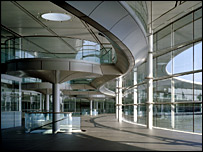
Foster and Partners' new headquarters for McLaren, built on a 50-hectare site, includes design studios, laboratories, testing facilities, electronics workshops, prototyping and production facilities for the company's Formula One cars and the Mercedes Benz SLR McLaren.
The judges said: "You arrive at the building having travelled around the lake, in Norman Foster's words, 'as if driving up to a country house'. The experience is perhaps more akin to Arthur C Clarke than Agatha Christie.
"The curved glazed facade suddenly appears in view, at first concealed by large undulating grass mounds. It stands alone except for its own reflection in the lake."
JUBILEE LIBRARY, BRIGHTON
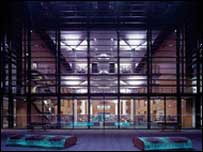
This library, from Bennetts Associates with Lomax Cassidy, is "clearly intended as a civic building of importance" said the judges.
"The blue-tiled, glass-fronted library faces the sea and is a simple, energy-efficient building with a good measure of style as befits this swaggering seaside city."
They added that the glass facade is "imposing, dissolving at night to expose the powerful library interior".
"The main library space is excellent with warm timber clad side walls, excellent concrete detailing and good natural lighting, the space is both monument and at the same time inviting. It is a joy to be in."
FAWOOD CHILDREN'S CENTRE, HARLESDEN
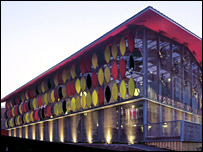
This children's centre is a three-storey building (architects Alsop Design Ltd) made from refurbished sea containers.
"Under a part-translucent, part-opaque pitched roof the enclosure is made from stainless steel mesh which incorporates coloured lozenges at the upper level where the mesh adopts a series of waved profiles," said the judges.
"The resultant spaces between the cage and the containers accommodate different play areas and a yurt."
The centre will include a small unit for children with special needs, mostly autism, alongside an existing nursery school for three- to five-year-olds. It will also provide space for adults' access to education.
The judges said: "The enthusiastic head reported that her charges seemed to be considerably healthier since the new building opened - a fine example of the beneficial effects of good architecture."


 One-Minute World News
  News services
 E-mail this to a friend
  Printable version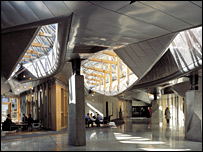

 Enlarge Image